
In 4009 BBY, the Massassi priest Zythmnr withdrew from his community on Yavin 4 and entered a twelve-year period of isolation. His tribe descended from the Massassi followers Naga Sadow had brought to the moon a thousand years earlier. Zythmnr remained apart until 3997 BBY, when the fallen Jedi Exar Kun arrived and was taken to the Temple of Fire.
A priest in a thousand-year-old exile community
Zythmnr belonged to a society separated from the old Sith Empire for roughly a millennium.
His tribe's identity centered on guarding temples and preserving ritual traditions after the political world that created them vanished.
Isolation ends with Exar Kun
Zythmnr emerged when Massassi captured Kun in 3997 BBY.
He interpreted the outsider through inherited religious expectations and eventually volunteered for Kun's alchemical transformation.
Anthropological assessment
Zythmnr shows how ritual communities can preserve institutional purpose long after the state that created that purpose disappears.
His later reaction to Exar Kun also demonstrates how prophecy and inherited expectation shape interpretations of unfamiliar outsiders.
c. 4009 BBY · Legends · evaluated historical source
Zythmnr's twelve-year withdrawal: a retrospective date
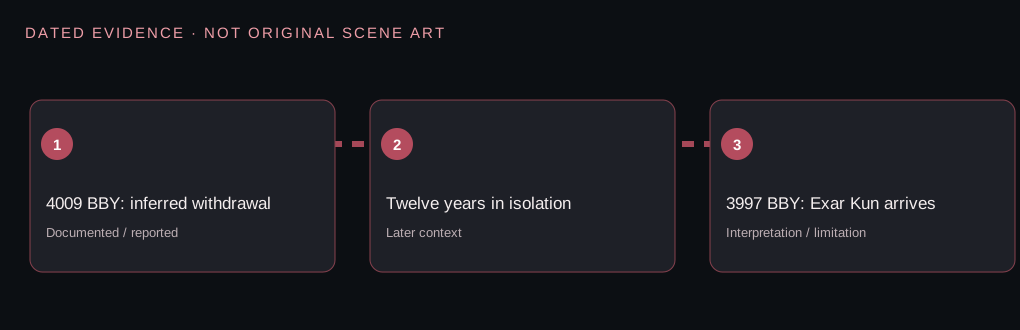
How the event is dated
Zythmnr's twelve-year isolation is dated by counting backward from his emergence during Exar Kun's arrival on Yavin 4 in 3997 BBY. The comic depicts the later encounter. A date around 4009 BBY for the beginning of isolation is an inference rather than a separately depicted scene.
What the source documents
Zythmnr was a Massassi priest associated with the guardianship of temples inherited from Naga Sadow's followers. When Kun arrived in 3997 BBY, Zythmnr interpreted him through the ritual expectations of that temple community. He later participated in Kun's experiments with Sith alchemy. These events are part of an ongoing Massassi society, not proof that all its people welcomed Kun or shared one attitude toward outside rulers.
Institutions and culture
Priestly seclusion can be analyzed as a distinctive form of ritual authority: limited public contact may strengthen the significance attributed to a person's later return. However, neither the origin of that practice nor its meaning for every Massassi inhabitant is described in the surviving narrative. The historical evidence supports a ritual role and a later reappearance, not a complete reconstruction of twelve years in isolation.
Limits of reconstruction
The comic's later scenes are a source for Zythmnr's actions when Kun arrives; they do not show daily life throughout the twelve-year period. The graphic therefore separates the inferred start date from the published scene in 3997 BBY.
Test your source judgment: Does Dark Lords of the Sith #4 illustrate twelve consecutive years of isolation?
Explanation: No. The withdrawal date is calculated retrospectively from the duration and the later event.
Source trail: Tales of the Jedi: Dark Lords of the Sith #4 (1995); The Dark Side Sourcebook. Read the reference record and bibliography →. The original publication may require page-level verification.
4009 BBY · Legends · Historical research
Zythmnr: twelve years of isolation inside a living temple tradition
Evidence and dating method
In the Legends chronology, Zythmnr entered twelve years of isolation on Yavin 4 around 4009 BBY, emerging in 3997 BBY when Exar Kun came to the Massassi temples. His people descended from the Massassi brought to the moon by Naga Sadow roughly a millennium earlier. Zythmnr held religious authority and possessed Sith amulets; that description belongs to a community that maintained buildings and ritual obligations after the collapse of Sadow's wider empire. The isolation date comes from counting backward from the later Exar Kun episode, not from an independent temple chronicle describing the first day of retreat.
Separate the birth or early event from later history
When Exar Kun reached Yavin 4, Massassi guards confronted him and brought him to the Temple of Fire. Zythmnr appeared after his long seclusion and interpreted the arrival through the community's inherited expectations and religious imagery. The episode involved an encounter with an ancient Sith wyrm and amulets connected to earlier Sith traditions. What happened in 3997 BBY should remain attached to that year. The 4009 BBY entry specifically identifies the beginning of Zythmnr's withdrawal, not Kun's arrival, the challenge in the temple, or later transformations of Massassi bodies.
Anthropological assessment
Temple guardianship creates continuity between architecture and a community's social identity. A site can retain cultural importance even after the political authority that originally built it has vanished. Isolation by a religious specialist may change the authority attributed to that person when they later return, but the original story does not detail all of Zythmnr's experiences during those twelve years. Reading the history through the maintenance of sacred places and the distribution of ritual authority is more reliable than inventing a daily ascetic routine. The story is also told through a later conflict, creating an imbalance in what is preserved about ordinary Massassi lives.
Limits of the surviving source
The source supplies the duration of isolation but not a complete set of teachings or location coordinates. The visitor who changes the community's trajectory arrives twelve years later. The exact circumstances of each year spent alone remain unavailable.
Historical reasoning: Did Zythmnr withdraw from the tribe because he had already met Exar Kun in 4009 BBY?
Correction and explanation: No. His seclusion preceded Kun's arrival around 3997 BBY by twelve years.
Source: Tales of the Jedi: Dark Lords of the Sith 4; Zythmnr Legends references. Reference and bibliography ↗. Published-edition pagination requires further collation.
Sources and further reading
- Tales of the Jedi – Dark Lords of the Sith.
- Zythmnr, Wookieepedia