
Around 4008 BBY, Jedi Master Jev Sunrider and three other Jedi traveled from Darada to Krayiss II after detecting a growing dark-side presence. None returned. The world contained an ancient Sith library-temple abandoned thousands of years earlier but still occupied by hostile spirits and dark-side influence.
A Watchman investigates a nearby threat
Jev served as Jedi Watchman of the Darada system.
The mission therefore fit the Watchman's responsibility to monitor threats affecting assigned territory.
An ancient site remains dangerous
The Krayiss II library-temple had been abandoned around 14,000 BBY.
Its political civilization was gone, but the site's dark-side inhabitants and ritual legacy remained lethal.
A disappearance becomes family history
Jev's grandson Andur was deeply affected by the loss.
The event helped shape Andur's later decision to pursue Jedi training.
Anthropological assessment
Jev's death shows how ruins continue to act in history long after the society that built them disappears.
For the Sunrider family, galactic archaeology became personal memory and eventually influenced another generation's institutional choices.
Early Republic / source-led investigation
A Jedi Watchman disappears into ancient Sith ruins
Jev Sunrider's journey to Krayiss II began as a Jedi response to a threat near the region where he served as Watchman. The world contained an ancient Sith library-temple whose political builders had long vanished. That disappearance did not make the site harmless. Jev and his companions investigated a surviving dark-side presence and failed to return. Later family memories and references assign the disappearance to approximately 4008 BBY, although the relative intervals in the Tales of the Jedi Companion leave a dating ambiguity.
The loss had personal consequences for Jev's grandson Andur. The younger Sunrider inherited stories of Jedi responsibility connected to the missing relative and eventually chose a path toward Jedi training himself. Jev's fate is also a warning about how archaeology, religion and security can intersect. An ancient temple can become dangerous to later visitors if it retains active supernatural influences, even when its society has disappeared. That premise belongs to Legends Force cosmology; the page should not invent named Sith spirits or a precise blow-by-blow battle in the absence of a source.
A ruin is not outside social history
The physical institution outlived its builders and remained meaningful to Jedi who were responsible for nearby communities. Its history acquired new importance when the danger it posed became immediate rather than purely scholarly.
Missing people create inherited obligations
Jev's disappearance affected a family long after the mission. The memory of an absent elder helped connect kinship, the Jedi vocation and feelings of duty, without proving any particular future action was inevitable.
Do the sources establish an exact day and a named killer for Jev?
No. The accepted approximate year and the lethal result are clearer than the complete details of the fatal encounter.
Source and continuity: Tales of the Jedi Companion; Jev Sunrider and Krayiss II Legends references. This page records Legends continuity; source limits are preserved rather than filled with undocumented events.
Legends · Research field note
Historical perspective: Jev Sunrider's death
A family death can become a turning point in later biographies without establishing every private response.
Reading the evidence: This interpretation draws out the social implications of the recorded event without supplying undocumented conversations, numbers or motivations.
Research question: what would stronger evidence require?
Compare the source cited below with nearby chronology entries. Distinguish what is explicitly recorded from broader conclusions about political institutions, lived experience and historical consequences.
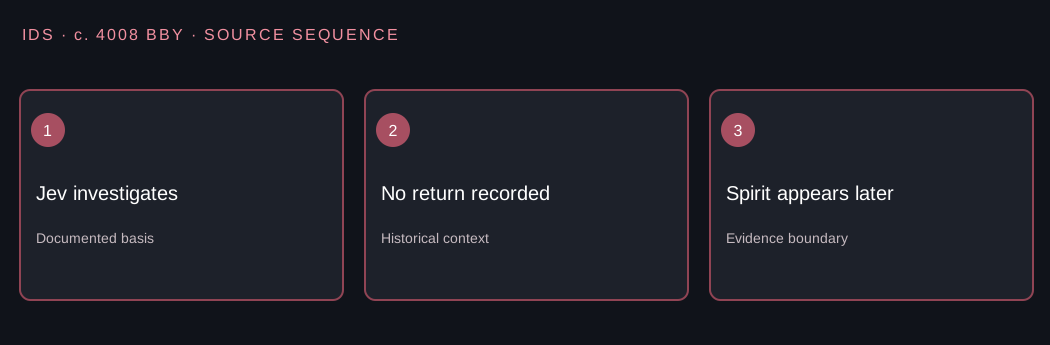
c. 4008 BBY · Legends · assessed sources
Jev Sunrider's disappearance and computed date
Evidence
The Tales of the Jedi Companion says Jev failed to return from a Jedi mission to Krayiss II. His spirit later appeared to Andur. The conventional c. 4008 BBY date is calculated backward from the family chronology.
Anthropological interpretation
Jev was part of an extended family whose Jedi identity continued after his absence. His disappearance and the later apparition are separate historical events with different witnesses.
What remains uncertain
The relative intervals can also suggest 4009 BBY. The exact death moment and full expedition record are not preserved.
Historical judgment: Is an exact moment of death supplied?
Explanation: No. The disappearance and inferred year are recorded retrospectively.
Source: Tales of the Jedi Companion; Jev Sunrider. Consult source record →.
c. 4008–4009 BBY · Legends · Source-critical investigation
Jev Sunrider: a historical date derived from family chronology
What the published record can establish
Jev served as the Jedi Watchman of the Darada system. With three fellow Jedi Masters, he went to Krayiss II in response to a dangerous dark-side presence associated with an ancient Sith library-temple. All four died. The existing site dossier correctly treats the mission as more certain than the exact day of death. The timing has been reconstructed by working backward through Andur Sunrider's childhood, rather than taken from a contemporaneous dispatch or incident report. This is particularly important because the various chronology references use slightly different anchors for Andur's later moves.
Historical sequence and causation
One reconstruction starts with Andur leaving H'ratth for Ambria around 3999 BBY, subtracts two years for his time on H'ratth, six years for the interval since Jev's ghost appeared, and another year to place Jev's mission. That produces approximately 4008 BBY. Another account places Andur's departure in 4000 BBY, which shifts the inferred mission into approximately 4009 BBY. This is a real discrepancy in the anchors, not proof that Jev undertook two fatal expeditions. Retaining the familiar approximate date while explicitly presenting the alternate chronology avoids artificial precision.
Anthropological interpretation
Jev's assignment connects the Jedi Watchman institution with active investigation of sites left by vanished political cultures. The Krayiss II library-temple was a material survival of an older Sith tradition; its continuing supernatural threat is part of the Legends narrative. Andur's later experience of his grandfather's apparition turned family loss into guidance for his own Jedi education. These are distinct forms of transmission: physical remains, institutional responsibility and the memory passed within a family. None requires inventing the killer's identity or a detailed battle in the temple.
Uncertainty and chronology safeguards
The Tales of the Jedi Companion does not provide the precise moment of Jev's death. The 4008 and 4009 estimates stem from relative dating. This article leaves the URL stable and describes both possibilities rather than silently changing the site-wide chronology.
Historical judgment: Does a difference of one year in a reconstructed timeline mean that there were two Jedi missions?
Correction and explanation: No. Both chronologies refer to one lost mission and use different assumptions about the dates of later events.
Source trail: Tales of the Jedi Companion; Star Wars Omnibus: Tales of the Jedi, Volume 1; Jev Sunrider notes. Reference notes and bibliography ↗. Original-publication pagination and visual-rights checks remain open.
Sources and further reading
- Tales of the Jedi Companion.
- Jev Sunrider, Wookieepedia