
In 4007 BBY, the Quesaya Border Conflict erupted near the Quesaya system at the edge of territory well explored by the Galactic Republic. The Republic's Rocket-Jumper Elite Advance Unit participated and later remembered the fighting as one of its legendary exploits.
Original IDS symbolic artwork; not a licensed or exact illustration of this historical event.
4007 BBY · Legends · Evidence map
What is actually known about the Quesaya fighting?
What the record establishes
The Quesaya Border Conflict took place in 4007 BBY near a system on the edge of space well explored by the Republic. Official historical commentary and a related roleplaying source confirm that the Republic's Rocket-Jumper Elite Advance Unit participated. These facts do not establish which planetary government, if any, initiated the conflict or provide a named commander on the opposing side.
The institutional and social consequences
The rocket-jumper corps had a long history of reconnaissance, difficult air insertion and raids, but describing the unit's general doctrine is not proof of a specific maneuver at Quesaya. The battle was later remembered as one of the force's notable exploits. Its incomplete record is a useful example of how institutions preserve honors even when the names and lived experiences of local populations are almost entirely absent.
Does the published source name the Quesaya enemy commander or an exact casualty count?
No. Do not invent either from the corps' broader military reputation.
Source basis: Galaxy at War (2009); official Warfare Author's Cut, Part 4. Reference and bibliography. The illustration is an original IDS interpretation, not a verified story frame. Where original text is sparse, missing dates and participants are not invented.
Conflict at the edge of mapped space
Quesaya lay near the practical boundary of well-explored Republic territory.
Such frontiers were zones where political authority and geographic knowledge both became less predictable.
A military reputation built across millennia
Rocket-jumpers had served in conflicts for thousands of years.
Quesaya became another episode through which the unit reproduced its own heroic institutional history.
Anthropological assessment
Quesaya shows how military traditions are built through remembered campaigns, even when broader political context is later lost.
The event also demonstrates that 'frontier' is partly a knowledge category: a region can be politically important because mapping and state reach become uncertain there.
4007 BBY · Legends · Source-critical investigation
Quesaya: what can a regimental remembrance prove?
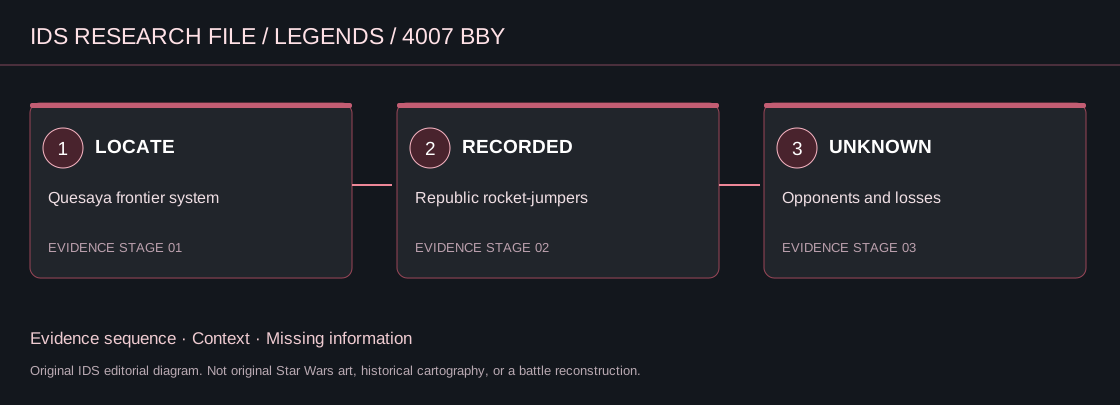
What the published record can establish
The military source does not narrate a complete battle. It identifies a border conflict around the Quesaya system in 4007 BBY and remembers the participation of the Republic's Rocket-Jumper Elite Advance Unit. That distinction is important: a unit's citation for valor can survive when its opponents, the civilian population, casualty lists and operational orders do not. The surviving detail supports a history of institutional memory, not a fictional campaign with invented enemy forces.
Historical sequence and causation
The system lay near the outer edge of space then well explored by the Republic. The phrase border does not necessarily refer to a straight territorial boundary between two named countries. Navigators, scouts and merchants may have known the surrounding area differently, and military patrols could encounter threats before an authority mapped or governed them consistently. The word frontier should therefore be explained as a relationship between state knowledge, travel routes and regional security, not as proof of a world being uninhabited or culturally empty.
Anthropological interpretation
The rocket-jumpers were a recognized specialist formation whose members appear in other episodes of Republic warfare. The Quesaya exploit added to the unit's inherited reputation. A military institution selects particular accomplishments for remembrance, but that choice is not a comprehensive record of an event. Readers should ask what kinds of evidence would be necessary to describe the people living near Quesaya, and why those people disappear from the recorded version of the conflict. An honors tradition can be historically meaningful while remaining incomplete as a history of a war.
Uncertainty and chronology safeguards
The published citation does not identify the opposing commander, the cause of hostilities, total casualties, or a precise campaign map. The diagram marks what can be verified and what remains unknown. The text does not assert that a specific rocket-assisted maneuver occurred on a named battlefield.
Historical judgment: Can a famous unit's involvement tell us which side started a war?
Correction and explanation: No. It tells us the unit participated. Attribution of cause and responsibility requires different evidence.
Source trail: Galaxy at War (2009); The Essential Guide to Warfare Author's Cut, Part 4. Reference notes and bibliography ↗. Original-publication pagination and visual-rights checks remain open.
Legends · Political and material consequences
The evidence limits of military commemorations
The Quesaya Border Conflict survives principally as a brief record of a Republic military unit's service. That is evidence for the Rocket-Jumper Elite Advance Unit participating in a named conflict, but not enough to reconstruct a detailed order of battle. A regimental memory tends to preserve achievements worth commemorating, while leaving the experiences of civilians or opponents largely inaccessible.
Researchers should distinguish a confirmed unit association from invented commanders, casualty totals and political causes. Neither the absence of those details nor the border location proves that the fighting was minor, justified, or universally supported. Compared with the fuller stories of the Mandalorian campaigns, Quesaya illustrates an important editorial principle: acknowledged gaps are more informative than a plausible-sounding account presented as a sourced fact.
Evaluate the evidence: Does a reference to a celebrated Republic unit identify the enemy's commander or establish casualty counts?
Correction: No. Those details need separate primary-source confirmation and must not be inferred from the unit's reputation.
Related event: battle of kuar → · Old Republic era overview →
Evidence limitation: interpretations here are separated from the page's named primary stories and reference histories. No invented eyewitness claims, precise casualty totals, or artwork attribution.
Sources and further reading
- Galaxy at War.
- Quesaya Border Conflict, Wookieepedia