
Hero image: original symbolic IDS illustration, not verified Star Wars source artwork. Review the story reference →
In 4606 BBY, Sith Lord Kel'eth Ur was executed by the Sith Emperor for teaching ideas considered heretical. Ur argued that fear and rage enslaved rather than empowered their users and increasingly moved toward light-side philosophy. The Emperor had him killed and his remains entombed in the Dark Temple on Dromund Kaas.
A Sith Lord rejects core Sith assumptions
Ur questioned the claim that passion and fear necessarily produced freedom.
His ideas challenged both religious doctrine and political ideology.
Doctrinal dissent becomes treason
Vitiate treated Ur's teachings as intolerable.
Execution transformed philosophical disagreement into an example of the limits of acceptable thought.
The heretic is buried inside an Imperial sacred site
Ur's body remained in the Dark Temple despite his condemnation.
His surviving teachings could still be rediscovered centuries later.
Anthropological assessment
Kel'eth Ur shows how authoritarian religious systems define doctrine through punishment as well as teaching.
Suppressing a dissenter can paradoxically preserve the dissenter's importance by making forbidden ideas objects of later curiosity.
Legends · Post-Manderon evidence file
A heresy condemned by the Sith Emperor survives its founder
Kel'eth Ur was a Sith Lord within the hidden state ruled by Vitiate, but he questioned central assumptions of Sith teaching. His argument that fear and rage could enslave rather than free those who embraced them challenged a doctrine that justified personal domination and political coercion. In 4606 BBY the Emperor ordered his execution, and his remains were entombed in the Dark Temple on Dromund Kaas. The details are established through later Star Wars: The Old Republic dialogue and associated records rather than a contemporary depiction of the execution itself.
The Emperor's response illustrates why ideas can threaten rulers even without an openly organized rebellion. Kel'eth Ur challenged the moral explanation through which Sith power was represented as liberation. Treating that critique as heresy drew a boundary around what members of the regime were permitted to believe and teach. Yet burial in a major Sith site did not ensure that the condemned perspective disappeared. Centuries later visitors could still learn about the dissenter and confront the claims for which he had been killed.
Doctrine is enforced through institutions
A ruler need not respond to a philosophical argument only with a counterargument. Execution and the classification of heresy can be used to make an intellectual dispute into a test of political loyalty. This illustrates coercive maintenance of religious authority.
Suppression can unintentionally preserve a history
A condemned person may remain important because later generations discover the records of their punishment or writings. Kel'eth Ur's posthumous visibility complicates the idea that state force can permanently erase a forbidden interpretation of a tradition.
Did Kel'eth Ur teach the Emperor's official Sith doctrine unchanged?
No. He rejected the belief that fear and rage bring genuine freedom and was condemned for views associated with the light side.
Source evidence: Star Wars: The Old Republic, Dromund Kaas Dark Temple narrative and Codex. Reference and bibliography →. This article distinguishes published events from IDS interpretations, with unavailable details acknowledged.
Legends · Research field note
Historical perspective: The execution of Kel'eth Ur
Punishing heresy illustrates how an authoritarian religious-political order polices acceptable belief.
Reading the evidence: This interpretation draws out the social implications of the recorded event without supplying undocumented conversations, numbers or motivations.
Research question: what would stronger evidence require?
Compare the source cited below with nearby chronology entries. Distinguish what is explicitly recorded from broader conclusions about political institutions, lived experience and historical consequences.
4606 BBY · Legends · Original sources & interpretation
Kel'eth Ur and the bounds of Sith belief
- A former Sith questions the language of freedom
Kel'eth Ur criticized the Sith claim that fear, rage and unrestrained passion create strength. He taught that peace and freedom from fear could offer a more durable source of power in the Force. These ideas resembled Jedi teachings, but he was acting from inside the Sith imperial community. He was not evidence that every Sith accepted one rigid interpretation.
- The Emperor marks dissent as heresy
According to the Dromund Kaas story told in SWTOR, the Emperor had Kel'eth Ur killed for his teaching around 4606 BBY. The death exemplifies how a ruler can use doctrinal boundaries to preserve political authority. The story does not provide a detailed transcript of the execution or the reactions of all those who heard the teachings.
- The Dark Temple fails to contain an idea
Kel'eth Ur's remains were placed in the Dark Temple, and his holocron could later be encountered in the game. The persistence of these teachings complicates the regime's ambition to suppress heterodoxy: a building intended to contain defeated opponents could become the place where later visitors found their arguments.
Was Kel'eth Ur a Jedi sent to infiltrate Dromund Kaas?
No. The available narrative presents a Sith whose philosophy moved toward ideals associated with the light side. That resemblance does not establish membership in the Jedi Order or a Republic espionage mission.
Source basis: Star Wars: The Old Republic, Dromund Kaas mission Buried Power; game dialogue and Kel'eth Ur holocron. Open the cited source or publication record →. The official SWTOR planetary overview establishes the setting. Specific statements about Kel'eth Ur are reported in the game's Buried Power mission and later compiled reference material; the publisher HoloNet overview alone does not directly document all dialogue or date details. This article does not supply undocumented dialogue, precise casualty counts or a falsely exact founding date.
4606 BBY · Legends · Evidence lab
Kel'eth Ur: a Sith dissenting from Sith orthodoxy
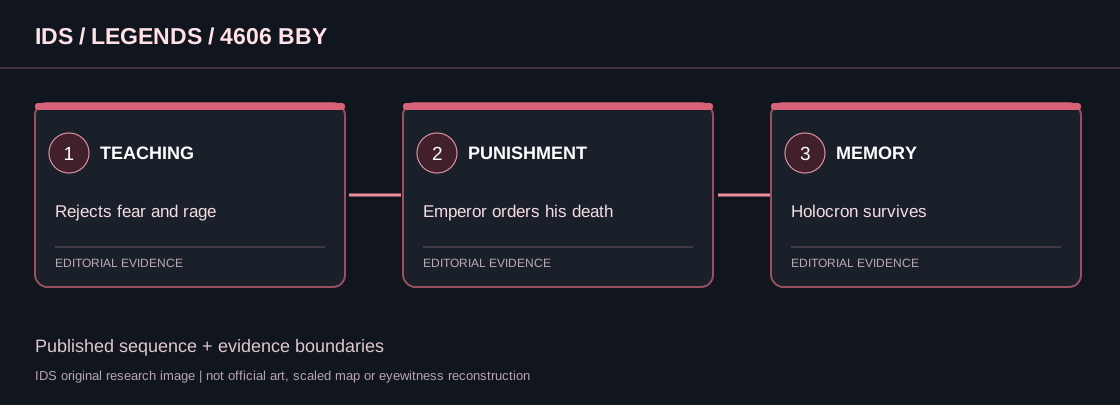
What the record establishes
In Star Wars: The Old Republic's Legends history, Kel'eth Ur argued against the use of fear and anger as sources of strength and gravitated toward teachings resembling the light side. The Sith Emperor treated the ideas as heretical and had him executed in 4606 BBY. Ur's remains were entombed within the Dark Temple on Dromund Kaas, where his holocron preserved teachings later encountered by others.
Anthropological assessment
Heresy is a boundary drawn by authorities claiming the right to decide which teachings count as legitimate. The execution shows the political enforcement of Sith doctrine, while the continued presence of his holocron shows that a persecuted idea can survive an individual teacher. The location of the record matters: a site intended to contain condemned enemies also allowed a later audience to discover dissent.
Evidence limits
Similarity between Ur's teachings and Jedi beliefs is not evidence that he formally joined the Jedi Order. The sources provide no complete execution transcript or proof of mass support for his ideas.
Check your historical judgment: Does his execution mean all Sith supported Vitiate's doctrine?
Correction: No. It demonstrates the regime's treatment of disagreement and the existence of at least one dissenting figure.
Source trail: Star Wars: The Old Republic, Buried Power; 4606 BBY chronology. Bibliography and reference history ↗. Printed page verification remains open.
Sources and further reading
- Star Wars: The Old Republic, Dromund Kaas mission “Buried Power,” in-game holocron and testimony. Official planetary reference →.
- Kel'eth Ur, Wookieepedia