
leader killed
regime continues
succession and opportunistic alliance
- Date
- 34 ABY
- Continuity
- Canon
- Setting
- Snoke's throne room, Supremacy
A prisoner hopes to redeem her enemy
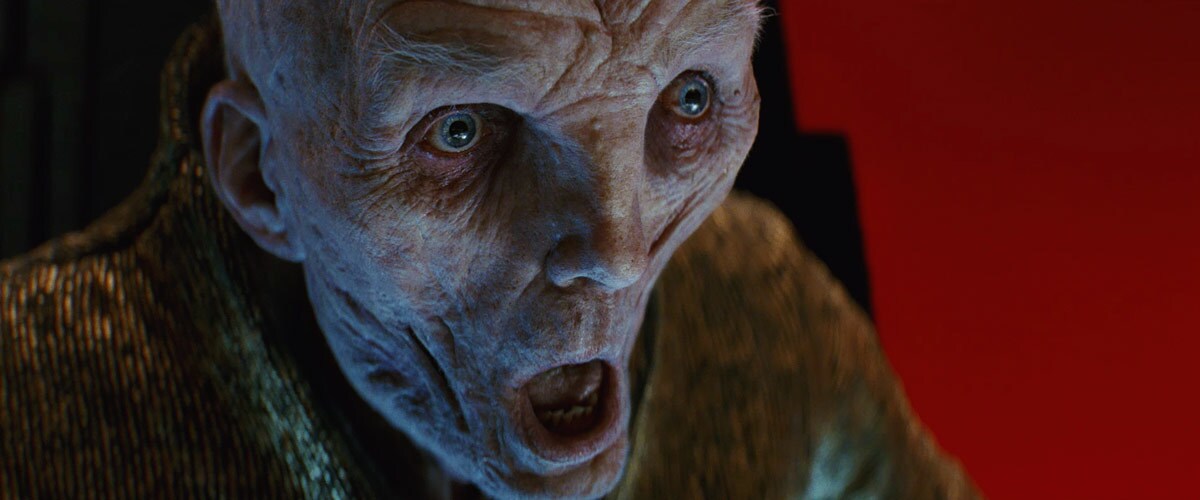
Rey voluntarily traveled to the First Order's colossal flagship, the Supremacy, because she believed Kylo Ren could turn against Snoke. Kylo led her into the throne room. Snoke revealed that he had encouraged their Force connection, intending to use Rey to find Luke Skywalker and extinguish the last Jedi. Rey's hope of cooperation had been deliberately exploited by a ruler who treated other people's emotional lives as instruments of control.
A sudden betrayal of the Supreme Leader
Ordered to kill Rey, Kylo instead used the Force to activate Luke Skywalker's lightsaber beside Snoke and cut his master in two. The red-armored Praetorian Guards attacked, and Rey and Kylo fought together to defeat them. Their temporary alliance was effective because both could confront a common immediate threat. It did not resolve what they believed a new government should become.
A new Supreme Leader emerges
Kylo offered Rey a partnership to rule the galaxy and leave older attachments behind. Rey refused, and the struggle for Luke's lightsaber broke the weapon. After Rey escaped, Kylo blamed her for Snoke's death and compelled General Hux to acknowledge him as the First Order's new Supreme Leader. The regime changed leaders without ending its policies of conquest and coercion.
Anthropological assessment
The throne-room crisis distinguishes regime succession from political liberation. Removing an abusive ruler can reproduce the same authoritarian institutions when a successor seeks only to occupy the vacant position. Rey's refusal asserts that personal attachment does not require consent to domination.
Interactive archive lab
Did Kylo Ren defeat Snoke to dismantle the First Order?
No. He killed Snoke, tried to recruit Rey, and became Supreme Leader himself.
Explore how the historical evidence reads from different perspectives.
Regime succession through a violent coup
Supreme Leader Snoke holds Rey captive and orders Kylo Ren to kill her. Instead, Kylo uses the nearby lightsaber to kill Snoke, then fights alongside Rey against the guards. He does not join the Resistance: he proposes a different political future and soon assumes control of First Order leadership.
The episode distinguishes a tactical alliance from agreement about political goals. Two opponents can cooperate briefly against an immediate threat while retaining incompatible plans. Snoke's death is a succession crisis inside a militarized organization, not the end of that organization; Kylo's new office preserves much of its coercive structure.
Source boundary: Official Lucasfilm story reference. The precise day within 34 ABY is not inferred from release dates. Interpretations about political institutions and culture are IDS analysis.
Test your historical judgment
Two questions with a score, corrections and a research insight.
Canon · 28–34 ABY · Evidence and institutions
Killing a master did not restore Ben Solo to the light
Rey allows herself to be taken to Snoke's throne room aboard the Supremacy because she hopes Kylo Ren can abandon the dark side. Snoke orders Kylo to kill her, but Kylo turns Luke Skywalker's lightsaber against Snoke instead. Rey and Kylo then fight the Praetorian guards together. These observable acts are distinct from the political conclusion Rey had hoped for: Kylo does not return with her to the Resistance. He asks her to rule with him, and after she refuses he becomes the First Order's new Supreme Leader.
Lucasfilm's Snoke Databank confirms both his position as the First Order's ruler and Kylo's murder of him. It also identifies the later revelation of Snoke's creation and manipulation by a more powerful Sith figure. That later information must not be presented as something Rey or Kylo fully knew during the throne room fight. Nor should the clash be described as an alliance between the Resistance and all of Kylo's troops; the cooperation between two people lasts only through their immediate danger.
IDS's interpretation centers on how political succession can follow an individual's change of allegiance without any broader institutional reform. Replacing the ruler did not end the authoritarian organization or its campaign. The chaos aboard the Supremacy and the later Crait attack show how quickly Kylo's new authority becomes relevant to other people.
Official reference: Lucasfilm Databank: Supreme Leader Snoke. Narrative events come from the named film, novel or comic. Databank and editorial summaries are supporting sources, not complete scene transcripts. Interpretations of institutions, authority and culture are original IDS analysis. Year labels indicate the archive chronology, not an exact day.
Sources and verification
This article uses official film continuity. Analysis of political institutions and cultural practices is original commentary rather than additional story dialogue.