
- Brianna
- Echani-Human heritage
- Mical
- Human, future Jedi historian
- Visas Marr
- Miraluka of Katarr
- Later era
- Dark Wars
The same year the Mandalorian Wars began, later Legends chronology places the births of Brianna, Mical, and Visas Marr. They would grow into radically different social worlds: Brianna inside Echani and Jedi-linked family conflict, Mical through Republic and Jedi education, and Visas Marr among the Miraluka of Katarr. All three would eventually intersect with Meetra Surik after the Jedi Civil War.
3976 BBY · Legends · Source analysis
Lives before the Exile
What the historical record establishes
Legends chronology places the births of Brianna, Mical and Visas Marr around the beginning of the Mandalorian Wars. These biographical placements do not mean the three met or shared institutions during childhood. Brianna's family came from the Echani tradition, Mical would be educated in Republic and Jedi institutions, and Visas grew up among the Miraluka on Katarr. Their adult meeting with Meetra Surik belongs to Knights of the Old Republic II, not the initial year.
People, institutions and consequences
The same approximate birth year connects three divergent social settings without turning them into a single cohort in direct contact. Later Jedi and Sith conflict disrupted the institutions and communities that shaped them. Biography is not destiny: the three should be interpreted through the choices and losses represented in the 2004 game, not as future roles already fixed at birth.
Source trail: Star Wars: Knights of the Old Republic II – The Sith Lords (2004); Legends chronological/character reference entries. Original publication or game reference → Supplementary chronology →. IDS interpretations are marked as analysis; illustrated hero is original symbolic artwork, not an official scene.
Brianna: family secrecy and institutional rules
Brianna was born from the relationship between Jedi Arren Kae and Echani General Yusanis. Her existence later contributed to Kae's exile from the Jedi Order once the relationship and child became known.
Her biography makes the abstract Jedi rule against attachment a family event with consequences for a child who had no role in creating the violation.
Mical: a future historian of a damaged Order
Mical would enter Jedi training young and later become one of the Republic's most historically minded survivors. In the aftermath of the Jedi Civil War he served as a diplomat and investigator trying to locate surviving Jedi.
His later importance lies partly in preserving institutional knowledge when the Order itself was near collapse.
Visas Marr: a child of Katarr
Visas was born among the Miraluka on Katarr. Her later life would be transformed by Darth Nihilus's destruction of the planet and its Force-sensitive population.
Placing her birth here reminds the timeline that entire communities existed before they became famous primarily as victims of later catastrophe.
Explore this entry
Why combine three births into one entry?
Because the year is secure enough to mark a generational cluster, but there is little event-level material about the births themselves. Combining them avoids pretending that we know exact intra-year order while still giving each life meaningful context.
What unites the three biographies?
Each later becomes connected to the problem of rebuilding or redefining Jedi identity after institutional collapse. Their childhoods begin during one war, while their adult importance emerges from the consequences of later wars.
Anthropological assessment
Birth entries matter because they re-center history on generations rather than only institutions. Wars create cohorts whose lives are shaped by conditions they did not choose.
Brianna, Mical, and Visas also show how one chronology can contain very different childhood worlds at once. A single date does not imply a single shared social experience.
Historical judgment · 3976 BBY
Test your historical interpretation
Choose two answers. Your assessment includes an explanation and a correction for each question, not just a score.
One birth year, three distinct histories
Later Legends chronologies · 3976 BBY. Original published story records, later chronology and anthropological interpretation are distinct evidence types.
A retrospective group, not a shared childhood
Brianna, Mical and Visas Marr are grouped in a later Legends chronology under 3976 BBY. That does not mean they knew one another as children or belonged to a common educational institution. Brianna’s history is bound to the Echani tradition and her complicated relationship to Atris’s handmaidens. Mical’s later life is tied to Jedi scholarship and the Republic’s institutional survival. Visas Marr grew up among the Miraluka of Katarr before Darth Nihilus destroyed much of her society.
Separate species, separate social identities
Echani cultural practices cannot be deduced simply from a person's ancestry, and a Miraluka character cannot stand in for every Miraluka community. An anthropological treatment should identify concrete family rules, educational settings and forms of authority rather than explaining future choices through species categories. The three characters’ later association with Meetra Surik marks a convergence of histories. It does not turn the earlier years into a single biographical event involving the trio.
The limits of an exact birthday
Knights of the Old Republic II supplies much of the characters' later biography and the consequences of the Jedi Purge. Lucasfilm’s game materials document that story’s setting, but they do not provide a common on-screen birth certificate for all three. The 3976 BBY placement must therefore remain attributed to subsequent Legends character chronologies. Where sources differ on age or personal timeline, an estimated birth year should not be converted into an exact birth date.
Research judgment: Does sharing a later chronology year establish that these three characters grew up together?
Explanation: No. A retrospective birth-year grouping is not a shared childhood or common social identity.
Follow the evidence: Lucasfilm: KOTOR II story and publication → · Lucasfilm: preceding RPG →. The linked source descriptions and commentaries are publication evidence; detailed scene claims require the original game or comic.
c. 3976 BBY · Legends · evidence file
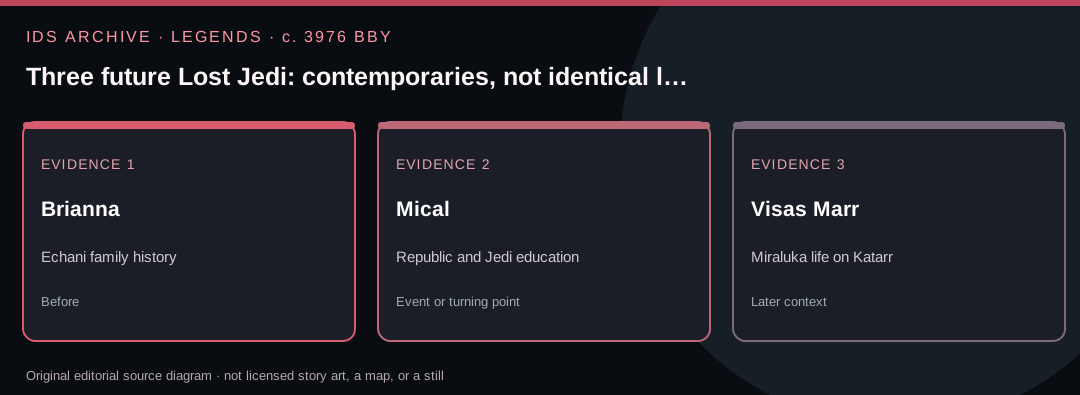
Three future Lost Jedi: contemporaries, not identical lives
Published evidence
Later Legends chronologies associate the births of Brianna, Mical and Visas Marr with the era when the Mandalorian Wars began. The game establishes each person's later identity and experiences under very different institutions.
Institutions and culture
Grouping character births by year is a navigational convenience, not evidence that the three shared a common household or childhood. Their eventual connection through Meetra Surik illustrates how political catastrophe can draw people from disparate cultural backgrounds together.
What remains unverified
The births are retrospective estimates, not three simultaneous birth scenes depicted in the original game. Visas's later trauma on Katarr and Mical's later political choices must not be attributed to events at birth.
Check the historical record: Does a shared approximate year prove the three characters met as children?
Explanation: No. They lived in different societies and only become connected much later.
Sources and further reading
- Star Wars: Knights of the Old Republic II: The Sith Lords.
- The Complete Star Wars Encyclopedia.
- Later Legends character chronologies.