
- World
- Kashyyyk
- People
- Wookiees
- Status imposed
- Madclaw
- Later consequence
- Capture by slavers
Later Legends chronology places the confrontation around 3976 BBY, when Zaalbar discovered that his brother Chuundar was cooperating with offworld slavers and profiting from Czerka's exploitation of Kashyyyk. During the resulting confrontation, Zaalbar attacked Chuundar with his claws. Wookiee culture strongly prohibited using natural climbing claws as weapons against another Wookiee, and Zaalbar was branded a madclaw and banished.
3976 BBY · Legends · Source and culture
ZAALBAR’S EXILE
What the published record supports
Zaalbar challenged his brother Chuundar over collaboration with outsiders who were enslaving Wookiees. In the dispute he used his claws against another Wookiee and received the stigmatizing designation madclaw. The taboo had force because it expressed a shared rule about violence within Wookiee society, even as political rivals could exploit that rule.
Power, society and interpretation
The episode involves two forms of power at once: a community’s sanction against intragroup violence and a colonial trading corporation benefiting from local leadership divisions. Calling Zaalbar merely a criminal without describing the slaving dispute removes the moral context. Equally, his opposition to Chuundar does not erase the taboo violation or the consequences of banishment and capture.
Did Zaalbar attack Chuundar without a political context?
No. Their dispute concerned Chuundar’s cooperation with slavers exploiting Kashyyyk.
Is madclaw a universal legal verdict about Zaalbar’s morality?
No. It is a consequential Wookiee social designation tied to the taboo against using claws in intra-Wookiee conflict.
Evidence trail: Star Wars: Knights of the Old Republic (2003), Kashyyyk family quest and dialogue; Knights of the Old Republic Campaign Guide. Compiled source bibliography →. The image above is original IDS symbolic art, not a source panel.
Why the claws mattered
The madclaw label was not simply a description of violence. It marked a violation of a specifically Wookiee moral boundary concerning how the body should and should not be used against kin.
The same physical act could therefore carry a cultural meaning far beyond ordinary assault.
Chuundar controls the story
Zaalbar's punishment cannot be separated from the politics of evidence. Chuundar's collaboration with slavers was not accepted by their father at the time, while the visible claw attack was undeniable.
The person who controlled the more believable public story gained the immediate advantage.
Exile increases vulnerability
Banishment removed Zaalbar from kin protection at a moment when Czerka and slaving networks were active around Kashyyyk.
He was later captured by slavers, showing how a local moral sanction could push someone directly into an external system of coercion.
Explore this entry
Was Zaalbar actually 'mad'?
No. Madclaw was a cultural and legal label tied to the taboo against using claws as weapons. His attack happened during a political and family crisis over Chuundar's cooperation with slavers.
Why is this more than a character backstory?
It links Wookiee law, kinship, corporate colonialism, and slavery. One family dispute becomes a window into how offworld exploitation destabilized local political authority.
Anthropological assessment
Zaalbar's exile shows how taboo categories can become durable legal identities. A single prohibited act can outweigh a more complicated political context when institutions rely on visible rules rather than hidden motives.
It also shows the danger of exile in a colonial setting. Removing a person from local protection can expose them to outside markets in bodies, labor, and coercion.
c. 3976 BBY · conventional chronology · Legends · original-source analysis
Kashyyyk · taboo, testimony and kinship politics
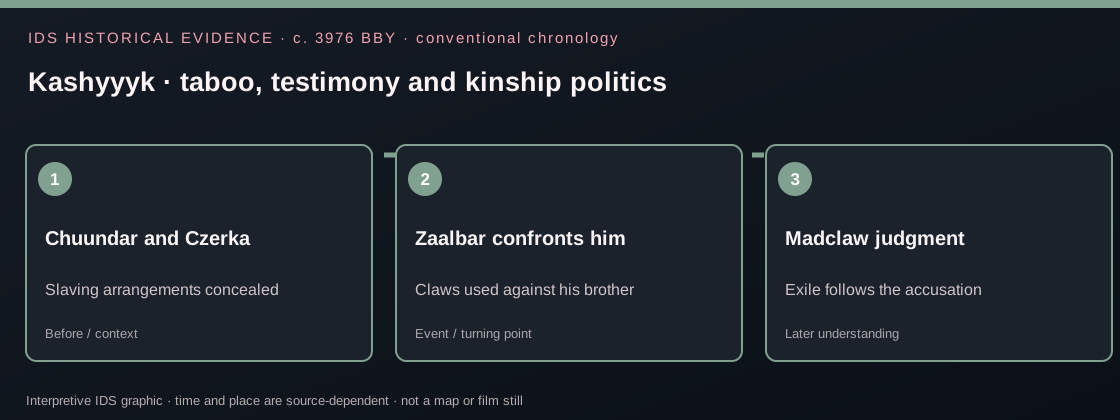
What the source establishes
Zaalbar was banished after striking his brother Chuundar with the climbing claws that Wookiees regarded as forbidden weapons against their own people. Chuundar had been working with Czerka slavers, a fact that was not publicly understood when Zaalbar was judged a madclaw. His father Freyyr initially accepted the accusation.
Material culture and authority
The charge illustrates how a culturally significant rule can be enforced without full public knowledge of the surrounding conflict. Chuundar's ability to control the narrative benefited from his political position and access to Czerka's resources. The meaning of exile thus includes both a violation of taboo and manipulation of evidence.
What the evidence does not resolve
The 3976 BBY year is supplied by later biographical chronology, not an exact timestamp for the confrontation in the original 3956 BBY game. The taboo is specific to Wookiee culture in the Legends story and should not be generalized to all species.
Test your historical reading: Does being called a madclaw prove Zaalbar supported Czerka's slave trade?
Explanation: No. The charge concerned his use of claws, while the dispute arose because he opposed Chuundar's collaboration with slavers.
Evidence trail: Knights of the Old Republic (2003), Zaalbar and Freyyr dialogue; KOTOR Campaign Guide. Reference, notes and further bibliography →.
Sources and further reading
- Star Wars: Knights of the Old Republic.
- Knights of the Old Republic Campaign Guide.