
- World
- Malachor
- Builder
- Darth Tanis
- Power source
- Giant kyber crystal
- Continuity
- Canon
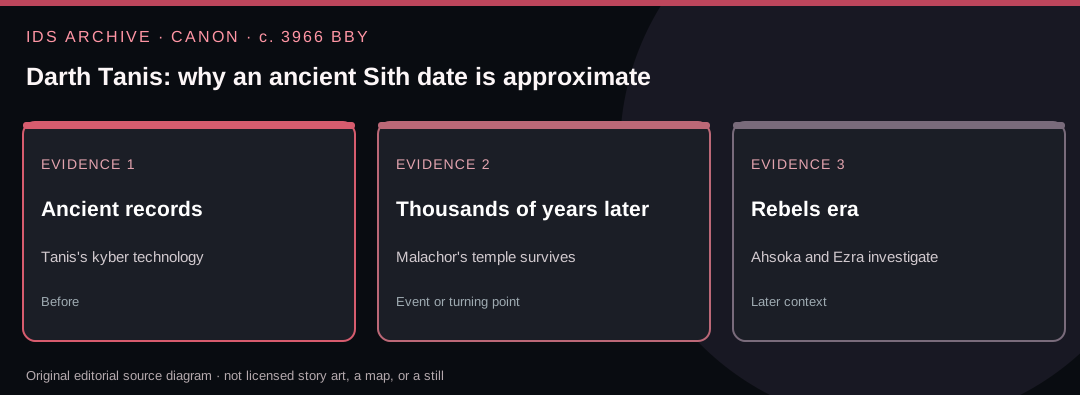
Current canon preserves an approximate ancient date, commonly converted to c. 3966 BBY, from records described as four thousand years before the 34 ABY Starkiller incident. Sith accounts from that year describe kyber weaponry developed by Darth Tanis on Malachor. The technology was housed within the Sith temple later explored by Ahsoka Tano, Kanan Jarrus, Ezra Bridger, and Maul in Star Wars Rebels.
A temple built around a weapon
The Malachor temple contained machinery powered by a giant kyber crystal. When activated, the weapon could petrify living beings, and ancient Jedi and Sith bodies remained frozen across the battlefield.
The architecture therefore combined sacred space, military technology, and mass death in one site.
Darth Tanis survives through records and naming
Very little of Tanis's life is known, but the superweapon was remembered strongly enough that the Sith Eternal later named its 17th Legion after the ancient Lord.
The contrast is striking: the person is obscure, while the artifact and political memory remain powerful.
Canon Malachor is not Legends Malachor V
In Legends, Malachor V becomes central at the end of the Mandalorian Wars, where Meetra Surik activates the Mass Shadow Generator. In canon, Malachor is associated with a Sith temple, Darth Tanis, and an ancient Jedi-Sith catastrophe.
IDS keeps both histories because continuity labels are evidence, not cosmetic tags.
Explore this entry
Did the Great Scourge happen in 3966 BBY?
Canon establishes that Sith records from 3966 BBY described Tanis's kyber weaponry and that the weapon existed by then. The exact date of the later battle and catastrophic activation is not fixed as securely.
Is Darth Tanis the same kind of ancient Sith as Revan or Exar Kun?
No direct continuity link should be assumed. Tanis belongs to current canon, while the familiar KOTOR-era Sith chronology is Legends unless separately reintroduced.
Anthropological assessment
Malachor is an archive problem as much as a battlefield. Later societies know an ancient conflict through ruins, records, taboo, and petrified bodies rather than through a complete narrative.
The page also shows why continuity discipline matters. Reusing a place-name does not make two different fictional histories one event.
c. 3966 BBY · Canon · evidence file
Darth Tanis: why an ancient Sith date is approximate
Published evidence
The Visual Dictionary states that Sith accounts describing the Malachor weapon were made four thousand years before the Starkiller incident. With the latter dated to 34 ABY, that rounded interval yields about 3966 BBY. Darth Tanis is named as the weapon's builder, and Rebels shows the temple machinery in a much later period.
Institutions and culture
A dated account is not identical to a dated construction event. Temple technology, written records and later archaeological encounters represent separate layers of evidence. This is Canon Malachor, not the Legends planet Malachor V or the Mandalorian Wars' Mass Shadow Generator.
What remains unverified
The expression four thousand years before a later event is an approximate historical interval. It does not establish the exact day Tanis built the weapon or the date of the Great Scourge of Malachor.
Check the historical record: Does circa 3966 BBY directly date the Great Scourge battle?
Explanation: No. It estimates the age of Sith accounts. The battle and construction require their own source evidence.
Sources and further reading
- The Rise of Skywalker: The Visual Dictionary (2019), date expressed as four thousand years before the Starkiller incident; conversion to c. 3966 BBY is editorial.
- Star Wars: The Rise of Skywalker: The Visual Dictionary.
- Star Wars: Timelines.
- Star Wars Rebels, “Twilight of the Apprentice.”