
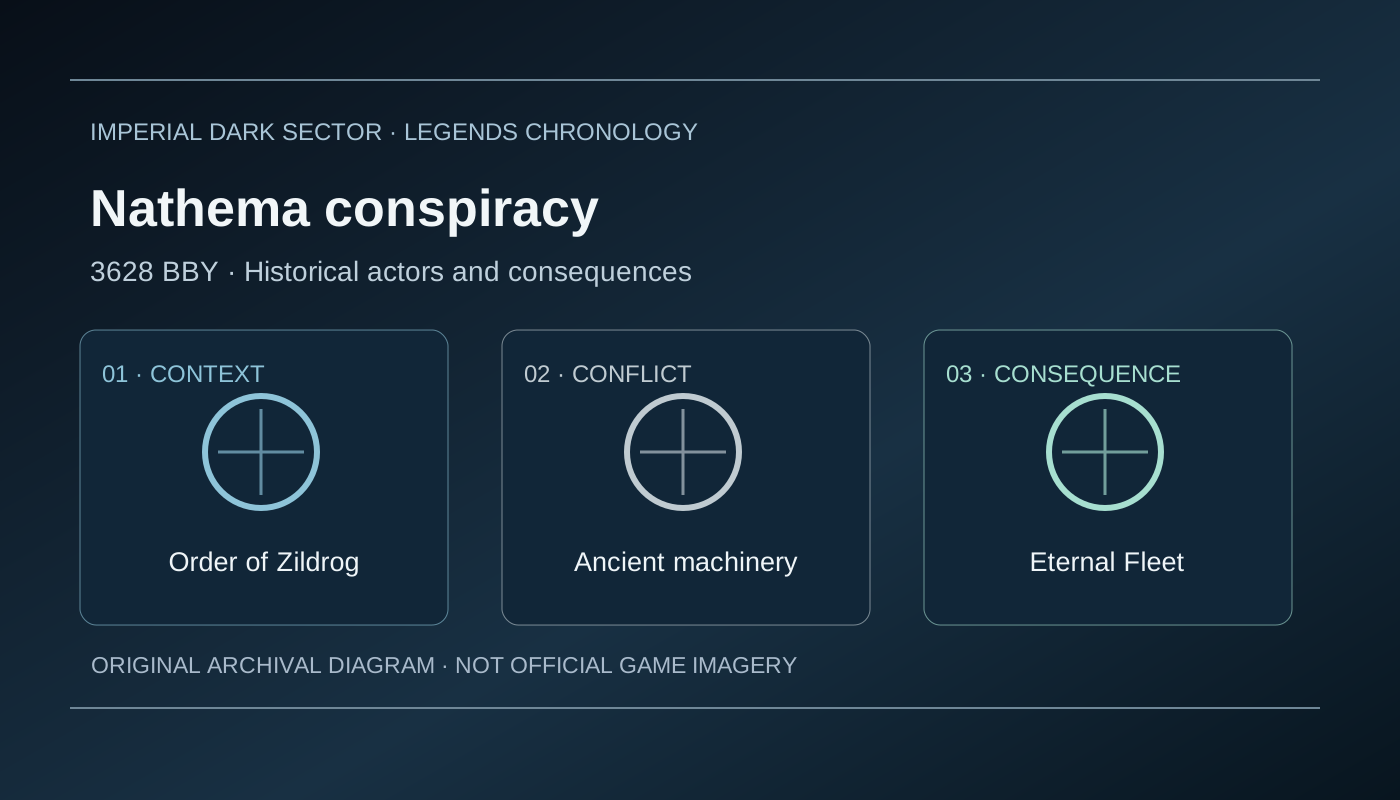
- World
- Nathema
- Enemy
- Order of Zildrog
- Weapon
- Zildrog
- Strategic result
- Eternal Fleet destroyed
In 3628 BBY, the pursuit of Theron Shan reached Nathema, the dead world created by Vitiate's ancient ritual. There the Alliance finally learned the truth: Theron's apparent defection had been an infiltration of the Order of Zildrog, a coalition of enemies who wanted to destroy the Commander's new galactic order. The revelation came too late to prevent the conspiracy from activating Zildrog.
Theron's 'betrayal' is reclassified
At Nathema, the Alliance discovers that Theron had entered the Order to identify its members, locate its weapon, and prevent a larger attack. Actions that had looked like treason on Umbara and Copero become evidence of an extreme covert strategy.
The reinterpretation does not erase the damage done to trust. Allies had acted for months on the reasonable assumption that Theron was hostile.
The Order of Zildrog unites people with different grievances
The conspiracy drew strength from figures alienated by the Commander's previous decisions and from people who viewed the Eternal Alliance as an illegitimate new empire. Their unity came less from one ideology than from shared opposition.
This resembles the earlier Uprisings but at a higher level of organization: diverse enemies coordinated around a weapon capable of breaking Alliance power permanently.
Zildrog attacks the source of Alliance supremacy
The Order did not need to conquer Odessen or defeat every Alliance soldier. Destroying the Eternal Fleet was enough to change the galactic balance.
When Zildrog activated, the automated armada that had made the Alliance untouchable was wiped out. The Gravestone, another Iokath-derived strategic asset, was also lost.
Victory leaves the Alliance weaker
The Commander defeated the Order, but the strategic objective had already been achieved. Republic and Sith leaders no longer faced a third power with an overwhelmingly superior automated navy.
That loss created the conditions for the old Republic-Sith war to return in full. The Alliance survived institutionally, but it could no longer impose a postwar order through fleet supremacy.
3628 BBY · Legends · Evidence reviewed
Nathema conspiracy: history and interpretation
Historical evidence
The Nathema Conspiracy attacks the Eternal Alliance through ancient systems linked to the technological order on which its supremacy depended. The loss of the Eternal Fleet reveals a critical weakness in a political system whose extraordinary military advantage was concentrated in one exceptional asset.
Anthropological assessment
The final revelations also change the interpretation of Theron Shan's earlier conduct. His personal fate depends on choices, but the collapse of the Alliance's fleet supremacy is a shared historical consequence. A chronology should not select one possible companion resolution as if all players witnessed it.
Dating and source limits
The BBY year is a Legends chronology placement. A real-world update release date is not independent proof of an exact in-universe year. Playable branching results are not one fixed history.
Publisher evidence: Official SWTOR update and source trail →. The diagram is original analytical art rather than a game screenshot.
Event sequence
The hunt for Theron reaches the dead world.
His apparent defection is explained.
The conspiracy attacks Alliance strategic infrastructure.
Alliance supremacy collapses.
The conspiracy ends, but its strategic effect remains.
Explore this entry
Did the Alliance win or lose?
Tactically, the Order of Zildrog was defeated. Strategically, the Order succeeded in destroying the Eternal Fleet, removing the Alliance's strongest source of power.
Why use Nathema?
Nathema carried deep connections to Vitiate and Sith history, and its isolation made it suitable for a clandestine project. The choice also gave the conspiracy symbolic power by returning the struggle to one of the Emperor's foundational atrocity sites.
What changes next?
Without the Eternal Fleet, the Republic and Sith Empire can again compete directly for territory. Within the same year, the Sith attack the hidden Jedi colony on Ossus and the Third Galactic War begins.
Anthropological assessment
Nathema demonstrates that power can rest on infrastructure more than territory. The Alliance's military rank depended disproportionately on one technological system.
It also shows how sabotage can produce regime-level change without conquering the regime. Destroying the institution or technology that makes authority possible may matter more than defeating its personnel.
3628 BBY · Old Republic · Legends
Why this event matters: The loss of the Eternal Fleet
Dependence on concentrated military technology can become a strategic weakness when that system is destroyed.
Anthropological interpretation: The event can be examined through institutions, social loyalties and the control of resources or information. That analytical perspective should not be confused with additional source-documented scenes.
Evidence check: documented event or interpretation?
The event and its broad place in the chronology are source-based. The social implications above are interpretation; exact private motives, undocumented dialogue and unreported casualties are not asserted.
Sources and further reading
- Star Wars: The Old Republic, Flashpoint: “The Nathema Conspiracy.”
- 3628 BBY chronology
Test your historical judgment
Check both answers to receive corrections and an explanation of the evidence.