
- World
- Ossus
- Conflict
- Third Galactic War
- Jedi leader
- Gnost-Dural
- Returning Sith
- Darth Malgus
Later in 3628 BBY, the Sith Empire struck a hidden Jedi colony on Ossus. The Jedi had returned to the ancient world while recovering from the First Jedi Purge and wars against Zakuul. The attack revealed that Darth Malgus—presumed dead after his failed New Empire decades earlier—had survived and had been forced back into Imperial service.
Ossus had become a hidden reconstruction site
The Jedi's return to Ossus carried enormous historical meaning. The world had been devastated during the Great Sith War but remained one of the Order's foundational landscapes.
A hidden colony allowed Jedi scholars, farmers, students, and survivors to rebuild away from the major fronts. Discovery turned sanctuary into a strategic liability.
Malgus returns as both weapon and prisoner
The Empire deployed Malgus because his battlefield reputation and power remained useful. Yet his obedience was not freely given; Imperial authorities had imposed controls after his earlier rebellion.
This created an unusual form of military authority: a famous Sith commander whose state wanted his violence but feared his independence.
The Third Galactic War begins
The Ossus campaign signaled that the post-Zakuul pause had ended. With the Eternal Fleet gone, Republic and Sith forces again possessed enough relative parity to fight a conventional interstellar war.
The conflict did not simply resume the previous war exactly where it had stopped. Both states had changed through Zakuulan occupation, Alliance cooperation, demographic loss, and new leaders.
Ancient knowledge becomes a wartime target again
Ossus had already demonstrated the vulnerability of archives during Exar Kun's era. The renewed attack repeated that pattern thousands of years later.
Malgus's interest in material connected to hidden Sith history also foreshadowed the Darth Nul storyline that would emerge after the Meridian campaign.
3628 BBY · Legends · Evidence reviewed
Ossus under siege: history and interpretation
Historical evidence
An Imperial attack on the hidden Jedi settlement on Ossus brings an educational and religious refuge into an expanding interstate conflict. The targets include more than fighters: the colony's archives, instructors, apprentices and relationships form institutions that can be harmed even when buildings survive.
Anthropological assessment
The publisher's Jedi Under Siege update offers Republic and Imperial perspectives, and players can make different decisions within them. The assault and the colony's exposure belong in the shared chronology; details specific to one faction's mission should be labelled, not silently treated as universal.
Dating and source limits
The BBY year is a Legends chronology placement. A real-world update release date is not independent proof of an exact in-universe year. Playable branching results are not one fixed history.
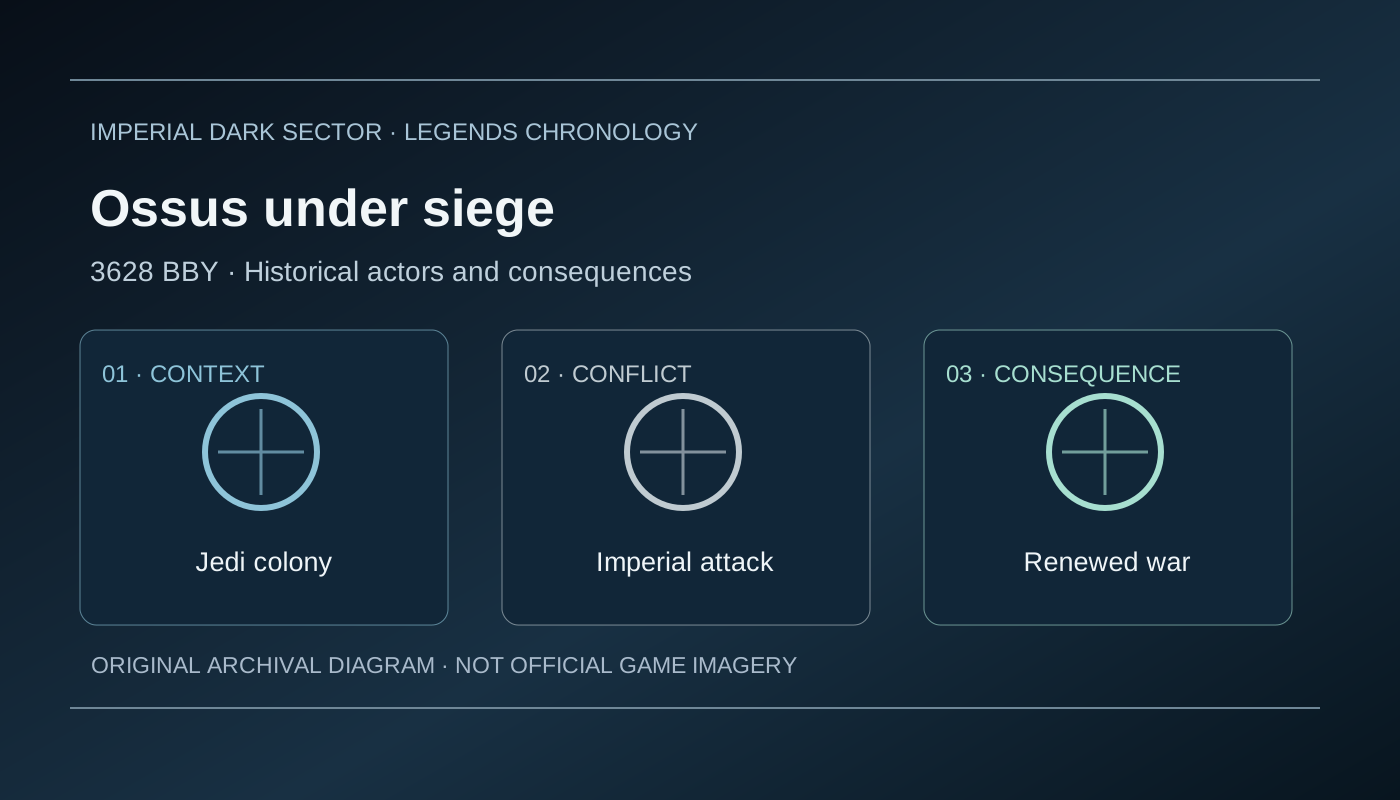
Publisher evidence: Official SWTOR update and source trail →. The diagram is original analytical art rather than a game screenshot.
Event sequence
A hidden colony grows on the ancient Jedi world.
Ossus becomes an invasion target.
The old Sith warlord appears alive in Imperial service.
Player allegiance shapes local outcomes.
The Third Galactic War begins.
Explore this entry
Why was Ossus such a powerful target?
It combined practical value—a concentration of Jedi—with symbolic value as one of the Order's oldest sacred and archival worlds.
Why did the Empire trust Malgus after his earlier rebellion?
It did not fully trust him. His combat value was useful enough that Imperial leaders attempted to control him through technological and political restraints.
Is the Third Galactic War just a continuation of the Great Galactic War?
It inherits the same Republic-Sith rivalry, but the intervening decades radically changed both societies. It is better treated as a new phase with old institutional enemies.
Anthropological assessment
Ossus is a landscape of recurring institutional memory. Returning to an ancestral site can strengthen identity, but it also concentrates symbolic and human value in a place enemies know matters.
Malgus's return demonstrates another institutional pattern: states often reuse dangerous specialists they do not trust when strategic need outweighs political comfort.
3628 BBY · Old Republic · Legends
Why this event matters: The hidden Jedi settlement
Attacking a concealed community makes secrecy, refuge and cultural survival central to the conflict.
Anthropological interpretation: The event can be examined through institutions, social loyalties and the control of resources or information. That analytical perspective should not be confused with additional source-documented scenes.
Evidence check: documented event or interpretation?
The event and its broad place in the chronology are source-based. The social implications above are interpretation; exact private motives, undocumented dialogue and unreported casualties are not asserted.
Sources and further reading
- Star Wars: The Old Republic, Game Update 5.10: “Jedi Under Siege.”
- 3628 BBY chronology
Test your historical judgment
Check both answers to receive corrections and an explanation of the evidence.