
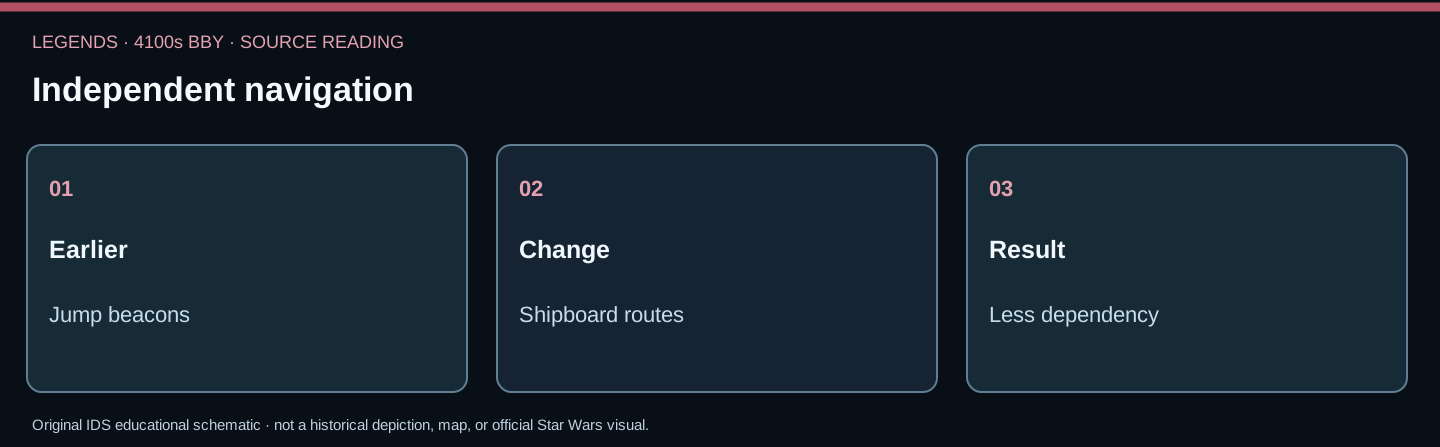
During the 4100s BBY, new navicomputer technology increasingly allowed starships to calculate hyperspace routes without depending on fixed jump-beacons. Beacon networks had been essential to early long-distance travel because they stored or transmitted safe route data. More capable onboard computation shifted navigational authority from infrastructure in space to equipment carried inside each ship.
The old beacon system
Early hyperdrive travel depended heavily on fixed reference points and stored route data.
Beacons made travel safer but also concentrated movement through specific infrastructure.
Navigation moves onboard
Better computers gave crews more autonomy in choosing and calculating routes.
Ships became less dependent on governments or operators controlling beacon networks.
Technology changes political geography
Independent navigation made new routes and detours more practical.
It could reduce the strategic importance of some old chokepoints while opening more decentralized travel.
Anthropological assessment
Navicomputers show how infrastructure changes power relationships.
When navigational knowledge moves from public fixed systems into privately controlled ships, travelers gain autonomy while older institutions lose some ability to channel movement.
Legends · 4100s BBY · Historical source comparison
Navigation moves knowledge from fixed networks into ships
The transition away from reliance on fixed jump-beacons changed who controlled the knowledge necessary for long-distance travel. A beacon network made routes legible through external infrastructure. More capable navicomputers allowed ships to calculate certain hyperspace trajectories without constantly depending on a line of fixed navigational markers.
This was an extended technical transition rather than an overnight disappearance of every beacon in the galaxy. Routes remained subject to risks and constraints, and advanced computation did not make every possible path safe. Governments, merchants and private navigators encountered this change differently depending on access to equipment, data and established trade corridors.
The shift is relevant to the earlier histories of colonial contact and to much later military sabotage involving navicomputer systems. Those parallels are interpretations, not evidence that one technology was unchanged for thousands of years. The IDS visual is a comparison of navigation systems rather than a fabricated engineering schematic.
Check the evidence: Did independent route computation immediately eliminate all hyperspace navigational hazards?
Explanation: No. Improved navicomputers reduced dependence on external beacons, but not the inherent need for safe route information.
Related timeline event → · Pius Dea research guide →
Primary reference tradition: The Essential Guide to Warfare; Legends history of hyperspace navigation. The current research has not verified every original printed page; no source-thin numerical detail is invented.
Sources and further reading
- The Essential Atlas.
- Post-Manderon period, Wookieepedia