
In 4024 BBY, Mandalorian Crusaders attacked the Nevoota, a sentient insectoid people living in the Colonies. The campaign became known as the Nevoota Extinction. The Nevoota resisted under leaders including Ithcharaka, while Republic involvement failed to prevent the Mandalorians from gradually destroying the population.
Original IDS symbolic artwork; not a licensed or exact illustration of this historical event.
4024 BBY · Legends · Evidence map
An invasion directed against a sentient society
What the record establishes
Mandalorian Crusaders attacked the Nevoota homeworld in 4024 BBY, targeting a sentient insectoid population in a campaign remembered for exterminatory violence. Historical accounts present the invaders as seeking formidable opponents with whom to prove their fighting reputation. The Nevoota, led in part by Ithcharaka, were not willing participants in a test of martial prestige. They resisted the invasion over several years.
The institutional and social consequences
The campaign later helped shape the ideological significance that Mandalorian groups attached to warfare. That is a claim about how the attackers understood their conduct, not an ethical judgment by the people being attacked. The earlier years should not be collapsed into the endpoint of 4021 BBY, when the Nevoota were described as exterminated. The record preserves relatively few Nevoota voices.
Did the Nevoota cease to exist as soon as the 4024 BBY invasion started?
No. The war continued for about three years before the reported extinction in 4021 BBY.
Source basis: The Essential Guide to Warfare, Mandalorian Crusades. Reference and bibliography. The illustration is an original IDS interpretation, not a verified story frame. Where original text is sparse, missing dates and participants are not invented.
A crusade against a people
The objective went beyond capturing territory or forcing a treaty.
The campaign ultimately destroyed the native population.
Nevoota resistance
The Nevoota fought rather than disappearing without opposition.
Later Mandalorian memory interpreted their resistance through a warrior ideology that increasingly deified war itself.
Anthropological assessment
The Nevoota Extinction shows how martial ideology can redefine genocide as proof of strength.
Remembering victims only through the conquerors' admiration risks reproducing the worldview that justified their destruction.
Early Republic / evidence and interpretation
The invasion begins a three-year campaign of extermination
The Mandalorian Crusaders began attacking the Nevoota in 4024 BBY. The species inhabited a world in the Colonies region and had a reputation for dangerous resistance. Its communities did not disappear as soon as the invasion began. Legends accounts describe a struggle extending for several years, with the Nevoota fighting under leadership that included Ithcharaka. The distinction between the date of first attack and the eventual end is important because an act of extermination can unfold through multiple campaigns rather than a single battle.
Later Mandalorian accounts interpreted the conflict as part of a tradition that made the pursuit of war sacred. The Nevoota, however, were sentient people with a society of their own, not simply opponents in a warrior test. An archive must be careful when its surviving sources repeat the conqueror's description of an enemy as worthy prey. Such language can commemorate military strength while erasing the lives and institutions destroyed. The source record preserves the outcome more clearly than ordinary Nevoota perspectives.
The war is not one instantaneous massacre
Starting an extermination campaign and completing it are different events. The three-year span gives importance to organized resistance and to changes in Mandalorian priorities. A timeline that lists both dates must explain why they belong to one sustained war rather than invent separate unrelated conflicts.
The limits of perpetrator-centered sources
The surviving material gives stronger detail about Mandalorian belief and the campaign's reported outcome than about Nevoota government, ritual or everyday life. Those absences should remain part of the discussion. Unsupported invented Nevoota biographies would repeat a different kind of erasure by replacing missing evidence with fiction.
Does 4024 BBY mark the extinction of every Nevoota?
No. It is the opening year of the campaign; Legends places the destruction of the remaining population around 4021 BBY.
Published evidence: Star Wars: The Old Republic, Codex: The Nevoota Extinction; The Essential Guide to Warfare; Star Wars Insider 80. This entry belongs to Legends; historical details not established by the cited sources are not invented for narrative effect.
Legends · Historical source review
A campaign against a species begins in 4024 BBY
The Mandalorian Crusaders began attacking the Nevoota, a sentient people, around 4024 BBY. The surviving records give a campaign against a population, not an ordinary single-day battle for territory. Nevoota resistance is part of the historical record, though the sources preserve the invaders' actions more fully than the daily lives of those attacked. The first phase must be distinguished from the catastrophic end around 4021 BBY. The lack of a complete Nevoota archive is a reason for caution, not permission to invent their domestic practices or to treat their communities as faceless obstacles. The later Neo-Crusader war against the Republic belongs to another Mandalorian generation and political context.
Evidence boundary and primary-source trail
The Essential Guide to Warfare, early Mandalorian Crusades. View source or reference information →. Source-supported fiction history is distinguished from IDS interpretation of political institutions and material culture. No undocumented eyewitness testimony, precise casualty figures or invented rituals are claimed.
History quiz · Legends
Test your historical judgment
Get a score and a correction explaining the source for each question.
4024 BBY · Legends · Primary source context
Nevoota: invasion and the beginning of extermination
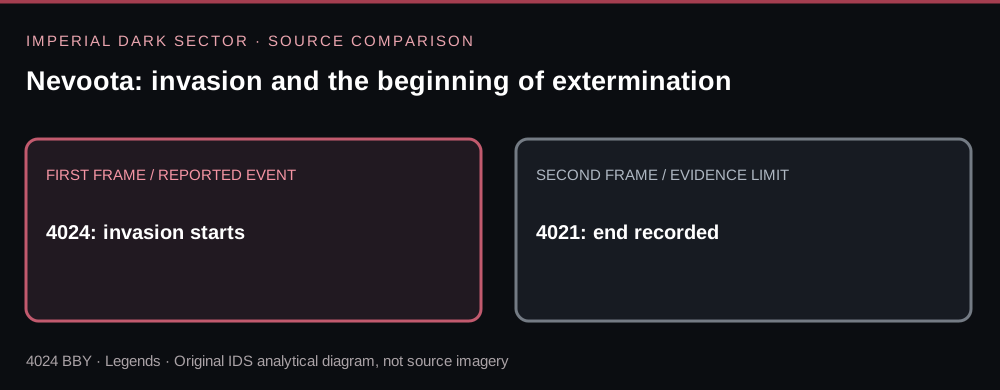
Documented sequence
The Nevoota Extinction is placed between 4024 and 4021 BBY in Legends chronology. Mandalorian Crusaders attacked the Nevoota, a sentient insectoid society. The campaign was a prolonged process of extermination, not a single encounter in which every Nevoota died at once.
Political and cultural implications
The Nevoota were a society with a history and leadership of their own. An account centered exclusively on the Mandalorian victors risks reproducing the aggressors' priorities. Identifying the invasion as the beginning of a campaign allows the Nevoota's resistance, political life and eventual destruction to remain visible.
What the evidence cannot show
The available historical summary does not establish a reliable number of Nevoota survivors in each year, precise killing methods at every battle or geographic coordinates of each settlement. The motives ascribed to Crusaders should be grounded in identifiable sources rather than generalized to everyone who identified as Mandalorian.
Source judgment: Does the start date alone establish the extinction occurred in 4024 BBY?
Explanation: No. The campaign begins in 4024 BBY and its ending is separately dated around 4021 BBY.
Legends · Political and material consequences
An invasion against a sentient people
The 4024 BBY attack on the Nevoota must not be described as a consensual trial of military excellence. The people being invaded had their own communities and leaders, including Ithcharaka. Their defense was resistance to external violence, while the attackers framed difficult opponents through Mandalorian martial ideals. The same episode can therefore be remembered very differently by an aggressor's military culture and by its intended victims.
The word extinction describes the campaign's later outcome, not a complete event accomplished at the opening attack. The surviving chronology places years between the beginning and the destruction of the Nevoota. That duration implies continued survival and resistance, but does not support invented battle-by-battle troop numbers or a precise catalog of settlements destroyed. Link the beginning and ending as related but distinct historical events.
Evaluate the evidence: Did the 4024 BBY invasion immediately end the Nevoota species?
Correction: No. The campaign continued for several years before the extinction event recorded around 4021 BBY.
Related event: nevoota extinction ends → · Old Republic era overview →
Evidence limitation: interpretations here are separated from the page's named primary stories and reference histories. No invented eyewitness claims, precise casualty totals, or artwork attribution.
Sources and further reading
- The Essential Guide to Warfare.
- Nevoota Extinction, Wookieepedia