
- Location
- Unmasked research station
- Enemy
- The Unmasked
- Leaders
- Lord Kanoth / Lady Dominique
- Objective
- Ancient weapon technology
In 3625 BBY, a small Sith cult called the Unmasked attempted to turn the wreckage and technology surrounding the R-4 anomaly into a new source of power. Their leaders did not command an empire or major fleet. Their danger came from access to technology associated with an ancient weapon whose effects were far beyond the scale of the cult itself.
Small organizations can inherit enormous destructive capacity
The Unmasked lacked the industrial base of the Republic or Sith Empire. That did not make them harmless. Advanced artifacts let a small group bypass the normal relationship between organizational size and military power.
This is one of the recurring dangers of archaeological technology in Star Wars: the people who discover a weapon do not need to understand or reproduce the civilization that built it.
The cult is organized around a remembered Sith catastrophe
The Unmasked studied legacies associated with Darth Nihilus and other extreme transformations of the dark side. They treated destructive anomalies not only as hazards but as models to investigate.
Historical memory here becomes aspirational. Rather than studying a catastrophe to prevent repetition, the cult studies it in hope of reproducing exceptional power.
A research station becomes a ritual and scientific site
The Unmasked blur categories often separated by modern institutions. Their work combines technical experimentation, Sith alchemy, cult hierarchy, and ideological devotion.
Calling the site a laboratory alone misses its religious function; calling it a temple alone misses the practical experimentation underway there.
Destroying the cult does not erase the knowledge problem
Alliance forces can defeat Kanoth, Dominique, and station defenses, but the R-4 incident proves that dangerous fragments of ancient technology continue circulating across the galaxy.
The strategic problem is therefore archival and material: who knows where relics are, who can access them, and which institutions are capable of monitoring discoveries.
3625 BBY · Legends · Research context
People, political institutions and historical evidence
R-4 anomaly and the Unmasked: what the story records
The R-4 Anomaly Operation involves an obscure Sith cult that seeks technology associated with an ancient weapon. The story presents an organization whose relationship with the Sith past is based on recovering and using hazardous machinery, not merely preserving knowledge. The Operation is distinct from the main story campaign about Malgus, although both appear in the Digging Deeper update.
Anthropological analysis and limits
The cult's activity permits an analysis of institutional memory and the militarization of archaeology. The source does not establish that every cult follower shares identical beliefs or that the recovered technology is understood completely. Details of Operation bosses should not be mistaken for the separate storyline about Darth Nul.
Verify the historical claim
The named SWTOR story or mission supports the event; the precise BBY placement can be an editorial Legends reconstruction rather than a date quoted by the publisher. In-game faction choices and unspecified casualties must not be converted into a single invented account.
Primary publisher source: SWTOR story and release record →
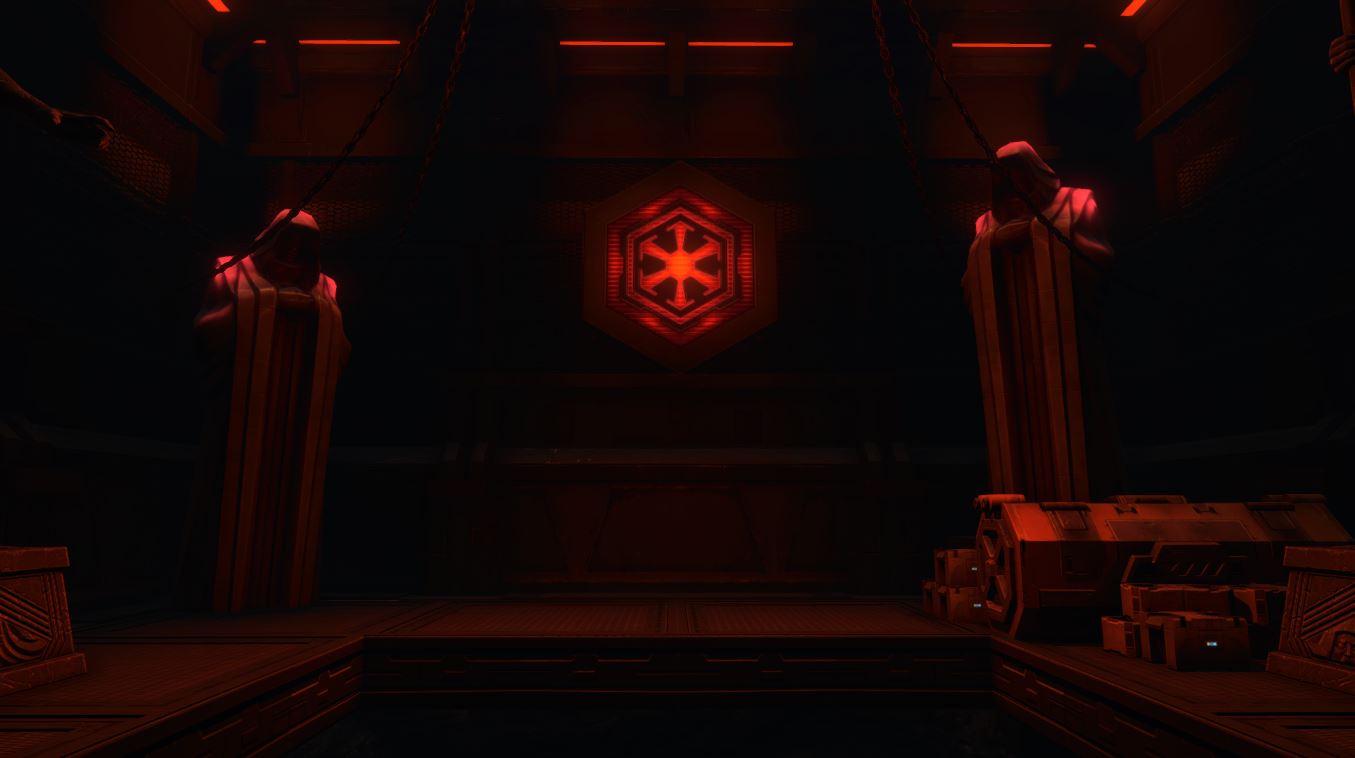
Event sequence
The cult studies the R-4 anomaly and ancient weapon remnants.
Kanoth and Dominique organize experimentation.
Alliance personnel mount an eight-person strike.
The Unmasked operation is broken.
The galaxy still contains recoverable technologies beyond modern understanding.
Explore this entry
Why is an 'obscure cult' a galactic threat?
Because destructive capability can be concentrated in artifacts. A small group that gains a civilization-scale weapon no longer behaves like a small group strategically.
Is the R-4 story science or religion?
Both. Sith traditions routinely combine experimentation, metaphysics, ritual, biology, and engineering without drawing the institutional boundaries modern audiences may expect.
Why separate R-4 from the Malgus story?
It occurs in the same expansion era but represents a distinct threat: independent Sith actors exploiting ancient technology rather than Malgus reconstructing Darth Nul's suppressed history.
Anthropological assessment
R-4 demonstrates how cults can be innovation networks. Strong shared belief, secrecy, and charismatic hierarchy can organize technical experimentation just as effectively as formal laboratories.
It also raises a heritage-security dilemma: preserving ancient technology makes research possible, while destroying it prevents study but may reduce the risk that small groups weaponize it.
3625 BBY · Old Republic · Legends
Why this event matters: The R-4 anomaly
A mysterious site attracts groups seeking power through knowledge that other institutions cannot readily verify.
Anthropological interpretation: The event can be examined through institutions, social loyalties and the control of resources or information. That analytical perspective should not be confused with additional source-documented scenes.
Evidence check: documented event or interpretation?
The event and its broad place in the chronology are source-based. The social implications above are interpretation; exact private motives, undocumented dialogue and unreported casualties are not asserted.
Sources and further reading
Test your historical judgment
Choose your answers to receive a score, individual corrections and historical explanations.