
In 6899 BBY, the second year of the Exiles' arrival under the chronology of The Essential Atlas, Sorzus Syn penetrated the Sanctum of Sakkra-Kla on Korriban and recovered the Holocron of King Nakgru. The device had remained sealed for more than ten thousand years. Syn used it to study the history, social structure, religious traditions, and war practices of the Sith people she and the other Exiles had recently conquered.
An archive from a much older Sith past
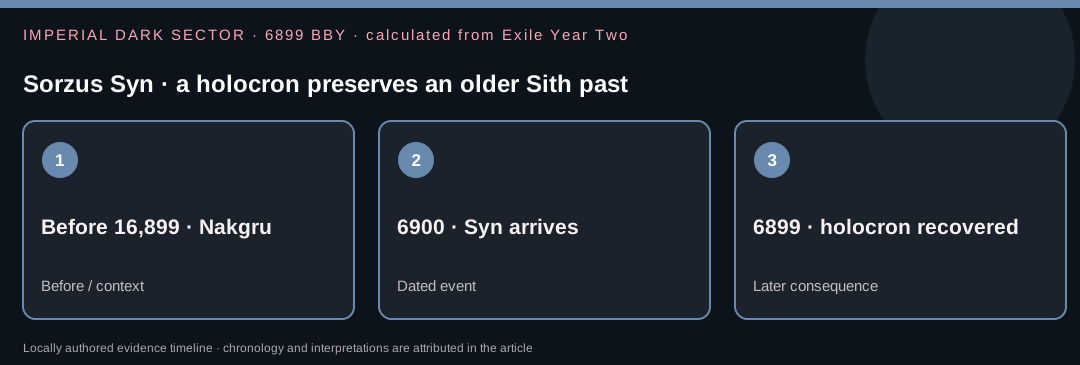
Nakgru had ruled before 16,899 BBY, making the holocron vastly older than the new Exile-led Sith Order.
Its survival gave the conquerors access to knowledge unavailable through ordinary political records.
Sorzus Syn as conqueror and ethnographer
Syn studied Sith history, priestly traditions, alchemy, warbeasts, and prophecy.
Her writings became a major later source for understanding early Sith culture.
Knowledge as a tool of rule
The Exiles did not merely destroy indigenous institutions; they studied and incorporated them.
Learning local traditions made it easier to build legitimacy and expand dark-side practices.
Anthropological assessment
Syn's use of the Nakgru Holocron resembles knowledge gathering by a conquering elite. Studying local history can serve curiosity, but it can also help rulers reinterpret and control the society they have conquered.
The holocron also demonstrates how archives allow a political culture to speak across enormous spans of time, even after dynasties and institutions disappear.
6899 BBY · calculated from Exile Year Two · Legends · Source and continuity dossier
Sorzus Syn · a holocron preserves an older Sith past
Documented account
Sorzus Syn's chronicle reports that she entered the Sanctum of Sakkra-Kla and recovered the Holocron of King Nakgru during the second year after the Exiles arrived. With their arrival placed in 6900 BBY, the event belongs in 6899 BBY. The sanctum had been sealed for more than ten thousand years. This establishes a pre-Exile Sith record far older than the newcomers' conquest.
Anthropological interpretation
Syn's search resembles an imperial attempt to collect another society's sacred and political knowledge. The holocron contained historical material not found in oral tradition or fragile texts, but the person interpreting it was also a conqueror interested in new dark-side techniques. Access to data should therefore not be mistaken for a neutral or complete ethnography of the indigenous Sith.
Dates, continuity and historical caution
Nakgru did not become king in 6899 BBY; only the recovery of his holocron occurred then. The inferred date of his reign predates 16,899 BBY because the sacred storehouse had already been sealed for ten millennia. The exact day of discovery within Exile Year Two is not stated.
Test the evidence: Does 6899 BBY mark the date King Nakgru first ruled the Sith?
Correction and insight: No. It dates Syn's recovery of a much older holocron, not Nakgru's reign.
Publication trail: Book of Sith: Secrets from the Dark Side (2012), Chronicle of Sorzus Syn, Exile Year Two, months 7–9; The Essential Atlas. Public reference: Check this Legends source history →. Original publications may require independent print issue or page verification.
Sources and further reading
- Book of Sith: Secrets from the Dark Side.
- Holocron of King Nakgru, Wookieepedia