
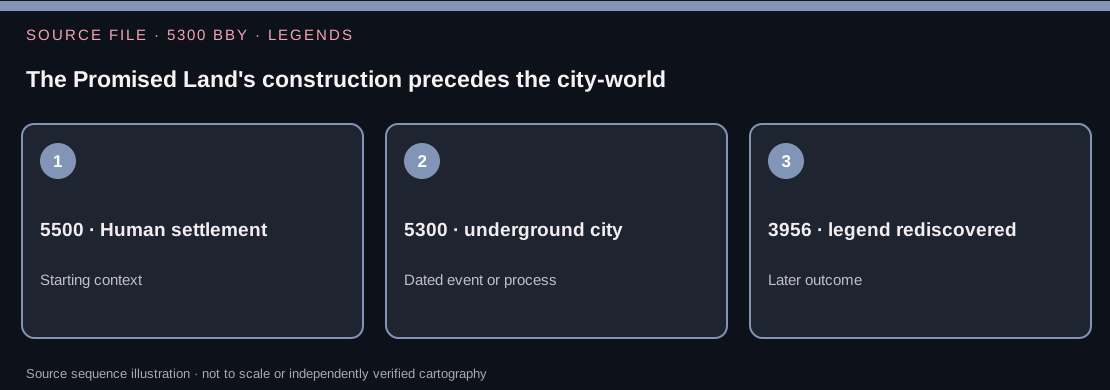
By 5300 BBY, the first Tarisian settlers had completed the underground city later remembered as the Promised Land. Governed by the Taris Civil Authority, the settlement was designed to be self-sufficient. As Taris urbanized above it, the original city was eventually buried beneath new layers and disappeared from public knowledge.
A self-contained founding settlement
The underground city was built to sustain its population independently.
Droid labor and infrastructure became central to later stories about the site.
A city buried by later cities
Later development created the Undercity and then higher urban layers.
The original settlement became physically and socially separated from later Taris.
History becomes myth
By the Jedi Civil War, Undercity residents searched for the Promised Land as a legendary refuge.
The transformation from known city to religious hope shows how urban memory can mutate when records are lost.
Anthropological assessment
The Promised Land is a case of archaeology becoming mythology within one city.
Later marginalized residents interpreted traces of an earlier settlement through their own needs for escape and social renewal.
5300 BBY · Architecture and remembered origins · Legends
The Promised Land's construction precedes the city-world
Published evidence
Legends chronology describes the first Tarisian settlers completing an underground settlement by 5300 BBY, about two centuries after the earliest Human colonists arrived. The self-sufficient city later became remembered as the Promised Land. Rukil and the outcasts in Knights of the Old Republic treat its existence as an alternative to the inequalities and danger of later Taris.
Culture and power
The physical settlement and its social memory are different kinds of evidence. Buried infrastructure can be a literal former home, while the idea of a promised refuge provides collective hope for a politically marginalized population. This helps explain why early city records, droid systems and oral traditions acquire meaning centuries later.
Dating and continuity limits
The video game's later inhabitants did not witness construction in 5300 BBY. The year appears in retrospective Legends chronology rather than in an ancient building inscription reproduced on screen. The Promised Land should not be described as the entire surface-level ecumenopolis.
Historical judgment: Was the Promised Land originally constructed for the Undercity outcasts of 3956 BBY?
Correction and explanation: No. It was the earlier settlers' city; the later outcasts inherited stories about it.
Reference: Knights of the Old Republic (2003), Rukil and Undercity quests; Promised Land Legends timeline. Review reference history →. Specific printed page numbers and historical claims need independent source verification.
Sources and further reading
- Star Wars: Knights of the Old Republic.
- Promised Land, Wookieepedia