
By Imperial Dark Sector
CHARACTER DOSSIER / FULL STORY
Friend, father, infiltrator
Bode arrives as an ordinary mercenary, becomes Cal Kestis’s most trusted battlefield partner, and ends the story as one of his most personal enemies. The 2023 game Star Wars Jedi: Survivor gives the same person three seemingly incompatible roles: devoted father, former Jedi Knight, and Imperial informant. The important question is not whether his love was genuine. It is what he was willing to do with that love.
All major story outcomes are explained below. Source-established events are separated from IDS’s anthropological interpretation. The two interactive sections explore the chronology and the choices without pretending to create alternate Canon endings.
01 / BEFORE THE EMPIRE
A Jedi trained to live behind a cover story
Long before anyone on the Stinger Mantis knew the name Bode Akuna, he was a Jedi Knight working with Republic Intelligence during the Clone Wars. That assignment makes his story different from the many survivors who were discovered by accident or kept alive by isolation. Bode’s official work required him to conceal affiliations, read people carefully, and move between identities without revealing why he had entered their lives.
He worked under Lank Denvik, an intelligence officer who later held authority inside the Imperial Security Bureau. The relationship matters because it connects both halves of Bode’s biography. Denvik knew his abilities before the collapse of the Republic and understood why those same abilities would remain useful to a successor regime. When the Jedi were declared enemies of the new Empire, Bode already possessed unusually effective skills for disappearing.
The Jedi ideal of public service and the methods of clandestine intelligence were not identical. An undercover agent often gains access by withholding information from the people who offer trust. In the Republic, Bode could frame that secrecy as an official wartime assignment. In the Imperial period, the techniques remained while the political authority claiming his work changed completely.
02 / SURVIVING ORDER 66
Disappearing was a skill, not a cure
Order 66 and the Jedi Purge forced Bode into hiding. Unlike a survivor who continued to display a lightsaber or publicly defend the Order, he could pass as a professional gunman. His blasters, jetpack, and mercenary habits later helped convince Cal that Bode was simply a capable non-Jedi ally. Yet the hidden identity did not mean he had ceased to be Force-sensitive or forgotten his earlier commitments.
Bode’s story connects the purge to the social costs of secrecy. To survive, he had to restrict who knew his past and make ordinary relationships into potential security risks. Other Jedi such as Cal Kestis survived through concealment too, but Cal eventually found companions who shared the danger. Bode increasingly treated information itself as something he must control alone. That difference becomes decisive once he has a daughter to protect.
The game's late disclosures reframe the early missions. His excellent timing, ability to anticipate a team's needs, and access to undisclosed contacts can be read as evidence of training. They are not independent proof that every friendly gesture was false. The final story makes a sharper point: competence in concealment can protect a threatened person, and it can enable that same person to harm others.
03 / FAMILY AND LOSS
Tayala and Kata change the meaning of survival
After disappearing, Bode built a family with Tayala and became the father of Kata Akuna. Their domestic life offered an identity beyond the Jedi Order and the clandestine missions of the Republic. It also gave him an obligation he understood as more important than any political cause. The Empire later brought that private life into the conflict when the Inquisitorius located his family.
Tayala warned Bode to stay away, allowing him and Kata to escape. She was killed. Her death matters as more than a motive in an action plot: it changed the available choices for a parent living under a state that punished association with the Jedi. Bode could no longer imagine safety as something secured by retreating once. In his view, any known refuge would eventually be discovered.
Kata is not merely a symbol used to explain her father’s anger. She loses her mother, moves under conditions shaped by her father's secrecy, and expresses judgments of her own. As Bode becomes more coercive, his claim to protect her diverges from the safety and companionship she actually needs. Her perspective is essential to judging the story rather than treating parental intent as the only evidence.
04 / THE IMPERIAL BARGAIN
Protection in exchange for betrayal
With the Inquisitors hunting him and Kata, Bode reached out to Lank Denvik, now attached to Imperial intelligence. Denvik offered concealment in return for covert service. That deal did not make Bode a typical believer in the Empire’s ideology. He was a useful operative who feared what the Empire could do to his family. The agreement still meant that his work actively served a violent institution.
The arrangement gave Denvik information and deniability. An infiltrator whose true Jedi identity was not broadly known could move where uniformed Imperials could not. For Bode, the apparent reward was a protected location for Kata, but the price was continued dependence on an officer whose power rested on the very government he feared.
Those conditions should not be confused with a harmless transaction among equals. Denvik held state resources, the threat of exposure, and the ability to withdraw shelter. Bode nevertheless remained responsible for the particular choices he made once embedded with Cal and the Hidden Path. Institutional pressure explains why the bargain looked attractive; it does not erase the deaths that followed it.
05 / CORUSCANT MISSION
A newcomer who survives when the team does not
In 9 BBY, Bode entered Cal’s anti-Imperial operation as a mercenary. Their raid on Coruscant targeted intelligence held by Senator Daho Sejan. The mission ended with heavy losses. Bode helped Cal escape, and the two became the survivors of an operation in which other team members died. That shared experience gave their relationship an immediate basis in grief and practical reliance.
For a player meeting him for the first time, Bode seems to fill several useful roles. He is mobile, equipped for ranged combat, and willing to help an injured companion get away. Later cooperative encounters reinforce that impression: Cal can rely on his skills during action scenes and travel with him without apparent hostility. Respawn presented these partner mechanics as a deliberate part of the game’s design, not only as a narrative cutscene.
The infiltration is particularly effective because Bode does not arrive announcing political ambitions. He shares ordinary details, including his daughter’s existence. These disclosures establish intimacy while withholding what would permit Cal to make an informed judgment about his loyalties. The discrepancy between shared personal truths and hidden institutional commitments is central to how the deception works.
06 / RELATIONSHIPS
The friendship was real
Across Koboh, Jedha, and the effort to find the lost world of Tanalorr, Bode becomes a companion whose presence Cal welcomes. They fight common enemies, speak as people exhausted by the Empire, and share a concern for how to protect the vulnerable. Bode’s attachment to Kata also invites Cal to see him as someone acting from familiar obligations rather than as a career Imperial officer.
The game's developers explicitly characterized Bode as someone who genuinely cared about Cal. That statement makes the betrayal less straightforward than a theatrical unveiling of a completely invented personality. Bode’s affection and his secret mission existed at the same time. His feelings did not require him to become honest, and Cal’s trust did not give Cal access to the facts needed to protect his friends.
For a social reading, trust is not simply an emotion. It gives someone access to people, places, plans, and material resources. Cal’s openness allowed Bode to learn about the Hidden Path and its vulnerable network. That knowledge increased the cost of betrayal because the people exposed were not just combatants who agreed to take part in a mission.
07 / A WORLD AS A REFUGE
One planet, two ideas of safety
The discovery of Tanalorr brought Cal and Bode into a conflict that a normal tactical victory could not settle. The planet lies beyond the dangerous Koboh Abyss, and reaching it requires specialized knowledge and equipment. After learning of the High Republic Jedi’s abandoned project, Cal imagines its concealment as a way to shelter the Hidden Path’s refugees from Imperial pursuit.
Bode initially appears to share that hope. For someone whose family had been located once before, a planet difficult to reach could plausibly provide protection. But the difference between them concerns who should be admitted. Cal wants a refuge for many people. Bode fears that allowing people he does not personally trust to settle there would eventually reveal the route and threaten Kata.
The argument is not that one character values family and the other does not. Cal also values his found family and the protection of people at risk. Instead, Bode concludes that the safest refuge must be exclusive. The territory becomes a proposed private sanctuary rather than a shared shelter. See also the Dagan Gera dossier for a different possessive claim over the same world.
More people gain protection, but every additional relationship and arrival creates a responsibility to guard the route.
Keeping the destination for Kata appears to reduce disclosure, but it also strips her of support and assigns her father unilateral control.
08 / THE BETRAYAL
The killing of Eno Cordova
After Eno Cordova succeeds in repairing a compass capable of guiding travelers toward Tanalorr, Bode reveals the lethal reach of his divided loyalty. He shoots Cordova and takes the compass. The theft deprives Cal’s group of its most direct route to the hidden planet and gives Bode the means to claim that destination for himself and Kata.
His betrayal also brings the Empire down upon the refuge network on Jedha. During the assault, Cere Junda attempts to defend the archive and is killed by Darth Vader. It is important to distinguish the different parts of that catastrophe: Bode kills Cordova directly; the Imperial assault creates the circumstances in which Cere confronts Vader and dies. Both consequences form part of Cal’s reckoning with the loss.
When Cal pursues Bode, the mercenary’s concealed Force powers finally become visible. The revelation changes how the earlier friendship is understood: Bode had hidden not only his employer but his identity as a Jedi survivor. Cal must suddenly confront someone with training similar to his own who has chosen a profoundly different response to fear.
09 / NOVA GARON
The sanctuary was an Imperial facility
Following evidence of the betrayal leads Cal to the Imperial base on Nova Garon. There he uncovers Bode’s connection to Denvik and meets Kata. Their quarters are especially significant because they reveal the limits of Bode’s bargain. His daughter has not been living beyond Imperial influence; she has been sheltered inside a system of control sustained by Denvik’s continuing cooperation.
Bode explains his past as a Jedi, his service in intelligence, the loss of Tayala, and the terms under which he works. The disclosures answer questions the player has carried since Coruscant without making the earlier deception harmless. He and Kata still flee with the compass. Cal, enraged, comes dangerously close to killing Denvik while drawing on the dark side, and Merrin helps interrupt that escalation.
This sequence exposes a parallel danger. Cal's anger may be understandable after the death of his friends, but anger does not reliably determine just treatment. The confrontation is not simply an investigation into Bode; it also tests whether Cal will respond to a loved one’s betrayal by abandoning restraint himself.
10 / FINAL BOSS CONFRONTATION
On Tanalorr, protection becomes possession
Cal and Merrin follow Bode to Tanalorr for the final confrontation. Cal attempts to reach him, but Bode will not abandon his demand for exclusive control. His refusal brings the personal and political questions of the story together. He wants to keep Kata away from danger, yet his conduct now creates immediate danger for the people around her, including Kata herself.
During the battle, Bode fights as a Force-sensitive former Jedi rather than only as the ranged-support mercenary the player first met. His movement, blasters, and lightsaber expose the combination of his public identity and concealed training. The game's last encounter is therefore a confrontation with both the friend Cal knew and the covert operative he did not.
Cal fatally shoots Bode after attempts to end the confrontation fail. The surviving group later mourns him along with the other people they lost. Kata lives and remains with Cal’s companions. The narrative does not ask the player to deny Bode’s affection for his daughter; it asks whether that affection can coexist with accountability for harm done to others and to the child in whose name he acted.
11 / MATERIAL CULTURE AND DESIGN
A mercenary equipped to conceal a Jedi
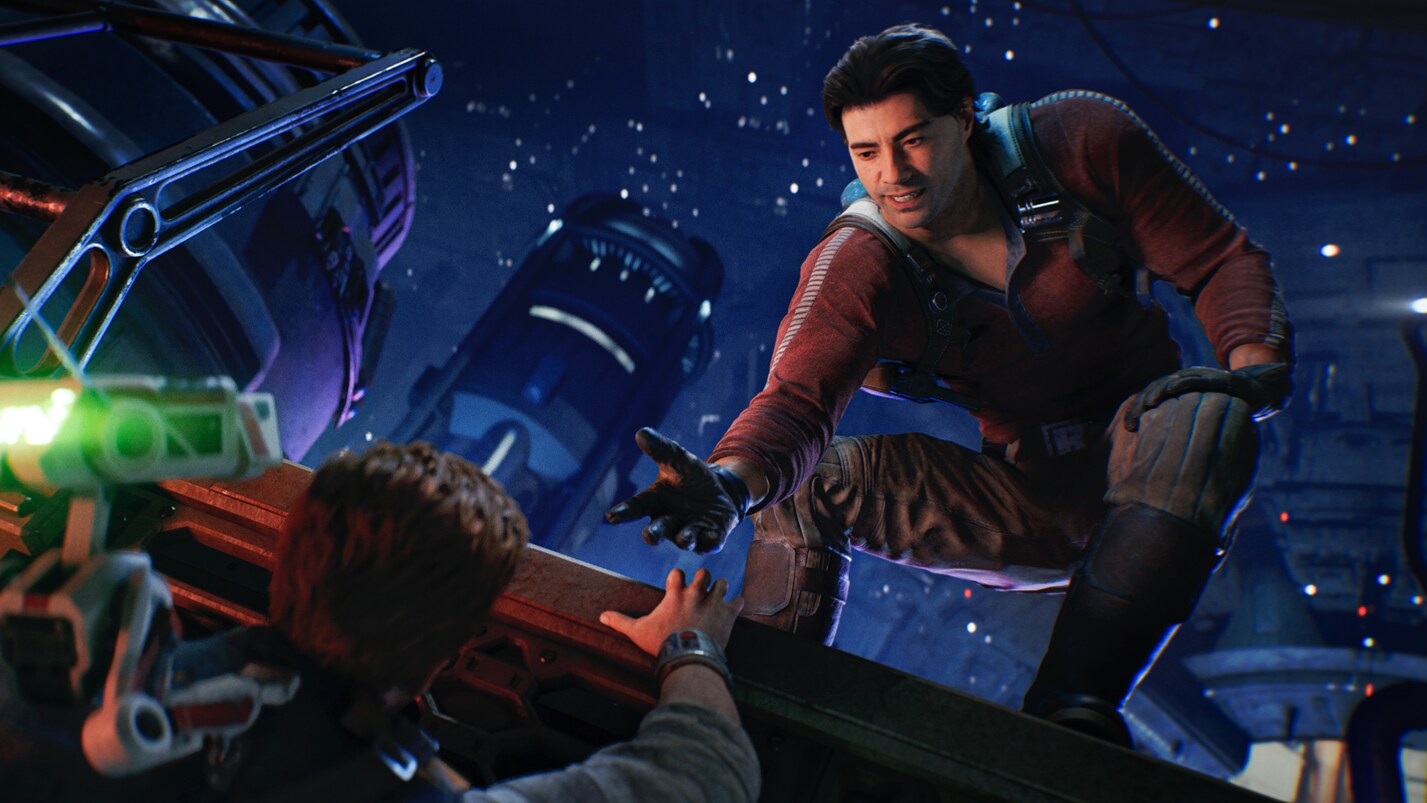
Official character imagery shows Bode as a dark-haired human man wearing a red shirt or jacket, practical utility straps, and field gear. His twin blaster pistols and jetpack make him credible as a freelance gunslinger. Those objects matter as narrative evidence because they provide a complete occupational identity that does not require a lightsaber or visible religious affiliation.
His equipment also places him within the working world of the campaign. He can travel, fight at range, and assist Cal in environments where another lightsaber wielder would attract attention. The original presentation establishes trust through useful labor rather than through a claim to inherited status. His later use of Force abilities and a lightsaber reveals that the mercenary costume concealed a second layer of expertise.
His material life has another side: the secured domestic space furnished under Denvik’s protection. That housing appears to meet basic needs but also makes the family dependent on Imperial surveillance and access. The contrast between mobile professional gear and stationary protected quarters captures the contradiction in Bode’s strategy. He can move covertly through the galaxy while leaving his daughter’s security tied to an institutional sponsor.
12 / IDS RESEARCH ASSESSMENT
Kinship, secrecy, and institutional dependence
Bode’s main relationships show how kinship obligations can conflict with wider political responsibilities. Fatherhood is neither a false excuse nor an automatic defense. His determination to protect Kata is grounded in the loss of Tayala and the Empire’s persecution of Jedi families. But the same determination leads him to exclude other endangered people, violate Cal’s trust, and use force against people his daughter has no reason to treat as enemies.
His agreement with Denvik provides a useful example of dependency under coercive authority. An operative needs shelter for a family member; the state officer controls access to that shelter; the operative pays through secrecy and harmful acts. The exchange can continue precisely because the officer retains the power to make the original danger return. Bode seeks independence from the Empire by accepting protection furnished by an Imperial institution.
The Tanalorr dispute is also a question about territorial governance. A remote refuge does not have a moral purpose of its own. The purpose emerges from rules governing entry, secrecy, resource sharing, and accountability. Cal’s proposal includes new risks from a larger community. Bode’s proposal removes other refugees from consideration and leaves Kata subject to his private decisions. Neither idea can be understood by describing the planet as simply hidden.
Finally, the game distinguishes affection from trustworthy conduct. Someone can love a friend while concealing information that puts that friend at risk. Bode can grieve Tayala and still be answerable for killing Cordova. An anthropological account must hold those facts together rather than assigning the character one unchanging label. These are IDS interpretations of documented events, not additional scenes or statements of Canon doctrine.
13 / INTERACTIVE EVIDENCE FILE
Follow the double agent's mission
Choose a phase to see the disclosed facts in story order. This is a narrative reference, not a branching game with invented outcomes.
Republic Intelligence and Jedi training
A Jedi Knight learns covert work under Lank Denvik. Those skills later help Bode hide his Force-sensitive identity after Order 66.
14 / INTERACTIVE ANTHROPOLOGY
Whose safety counts?
Select a claim used to justify action. The findings explain the different people affected. None of these buttons changes what actually happened in the game.
Protection is not the same as control
Kata needs safety, but her own wishes matter. A parent can act out of love and still make decisions that restrict the child’s freedom and support.
What is the evidence standard for this interactive study?
The button panels summarize established events from Jedi: Survivor and present IDS interpretation of those events. They do not represent alternate dialogue, game choices, or additional Canon lore.
15 / COLLECTOR REFERENCE
Collecting this Character
Bode’s confirmed appearance in the 2023 game is the primary material reference. Star Wars Jedi: Survivor offers the most direct way to study his design, dialogue, team interactions, and final confrontation. The official Lucasfilm Databank image can serve as a visual identification reference for listings.
Before purchasing cards, figures, prints, or other purported Bode Akuna collectibles, verify the manufacturer, set, character identification, and licensing information. This dossier does not claim that a specific Topps card, LEGO minifigure, or action figure exists without a verified product record. For related Star Wars material, browse the IDS card archive or the Star Wars Games hub.
16 / CONTINUITY AND RESEARCH
Sources and evidence boundaries
Lucasfilm: Bode Akuna Databank verifies his public identity, weapons, locations, and connection to Cal and Kata. Lucasfilm: Cal Kestis Databank provides the wider campaign context. Lucasfilm: Jedi: Survivor retrospective with Respawn developers confirms that Cal and Bode’s friendship was meant to be genuine and that the betrayal was a central story event.
Lucasfilm: Stig Asmussen on companion gameplay establishes the design of Bode’s cooperative gameplay role. Electronic Arts: official 2023 release identifies Bode as played by Noshir Dalal and places him among Cal’s allies. Lucasfilm: Jedi: Survivor game page links to official screenshots and the game’s presentation.
The playable main story of Star Wars Jedi: Survivor is the primary source for the concealed Jedi identity, work for Denvik, the family revelations, Jedha betrayal, and Tanalorr ending. The character and source index is useful for locating related game dialogue but is secondary to the game. Bode does not appear as a participant in Fallen Order; that earlier game supplies Cal’s context. The social and ethical analyses above are original IDS interpretations, not statements attributed to Lucasfilm.