
By Imperial Dark Sector
IDS CHARACTER DOSSIER · CANON
A Jedi who called a planet his own
Dagan Gera is a High Republic Jedi Knight whose ambition, technical partnership with Santari Khri, and discovery of Tanalorr should have secured a place in the history of exploration. Instead, he becomes an antagonist in Star Wars Jedi: Survivor after the Jedi Order abandons the planet and his attempts to reverse that decision turn violent.
His life links a century-spanning political conflict to the question faced by Cal Kestis: who is entitled to turn a hidden planet into a sanctuary, and who must accept the consequences when a shared institution withdraws its support?
01 / HIGH REPUBLIC
The Jedi who explored beyond established routes
Dagan Gera was a Jedi Knight during the High Republic, a period in which the Republic and the Jedi Order pursued wide-reaching exploration, public service, and a larger presence in the Outer Rim. The game introduces him through the remnants of a much older Jedi project rather than through a continuous account of his youth. His birthplace, childhood, and full apprenticeship are not established by the story. What matters for his surviving record is the reputation he developed as an explorer and as a pilot willing to attempt a route others considered too dangerous.
He pursued Tanalorr, a world hidden inside the Koboh Abyss. The hazardous region interfered with ordinary navigation and communications, making the planet both difficult to find and difficult to govern. Dagan saw opportunity in that isolation. For him, reaching a place beyond normal travel lanes was a demonstration of courage, technical skill, and a willingness to take risks on the frontier. It was not a simple solo achievement: machinery, research, and a community of Jedi made the discovery usable.
The game’s surviving recordings make a distinction between Dagan's early optimism and his later possessiveness. Before the tragedy, he spoke of Tanalorr as a hopeful place for the Order. Cal’s encounters reconstruct how that aspiration changed. Read with the Cal Kestis dossier to compare two Jedi survivors who encounter a collapsed institution and attempt to give its ideals a future.
02 / RELATIONSHIP AND LABOR
Santari Khri helped make the discovery possible
Santari Khri, a Jedi Master and researcher, worked closely with Dagan on the Tanalorr project. Her engineering and scientific work was necessary to turn an extraordinary flight through the Abyss into a route that could be followed by others. The partnership is visible through the game’s recordings and the old infrastructure spread across Koboh and the Shattered Moon. Dagan’s ability to pilot a route and Santari’s ability to reproduce its navigation conditions were complementary forms of expertise.
Their differing dispositions also shaped the project. Dagan was impatient with caution and delay; Santari took technical constraints and institutional approval seriously. Those differences became more serious when a Council decision threatened the future they had invested in. Dagan interpreted resistance to the project as a lack of loyalty, while Santari continued to distinguish her concern for him from agreement with his actions.
The source material supports an intimate bond of trust and an unusually important working partnership. It does not require the archive to invent a romance, a private marriage, or later reconciliation. By the time Cal uncovers the story, the people who knew them are gone and the surviving evidence consists largely of recordings, physical ruins, and Force impressions. That incomplete record matters: a close relationship can be central to a historical event even when important details of it remain unknown.
03 / EXPLORATION
Crossing the Koboh Abyss
The Koboh Abyss surrounds Tanalorr with hazards that made the normal travel routes unreliable. The difficulty was not only a challenge to a pilot. If a settlement could not maintain transport or exchange information with the wider Republic, it would depend on specialized systems and those who knew how to maintain them. That dependence made the discovery politically significant from the beginning.
On Koboh and the Shattered Moon, High Republic-era research installations supported attempts to reach the planet. Santari’s navigation technology included Abyss compasses capable of helping travelers make the dangerous passage. The construction of the route also involved the arrays and other systems Cal later investigates when trying to reach Tanalorr himself. These remains show a technical landscape developed by multiple contributors, not a personal claim established by a single explorer.
The moment Dagan reached Tanalorr was important because it demonstrated that the impossible route could be crossed. The subsequent challenge was reproducibility. A pilot’s experience may get one expedition through; a protected community requires repeatable movement and shared maintenance of equipment. That difference becomes crucial after the Nihil attack and, much later, when both Cal and Bode Akuna look toward the planet as a potential refuge.
04 / REPUBLIC GOVERNANCE
The plan for a Jedi community on Tanalorr
Dagan and Santari proposed making Tanalorr more than a remote waypoint. The High Republic project included a Jedi presence and the possibility of using the planet to train initiates. The work required facilities, navigation equipment, and the approval of authorities with responsibility for the safety of students and other personnel. Evidence of the settlement and temple appears in recordings and ruins uncovered during Jedi: Survivor.
For Dagan, the opportunity was deeply personal. He believed the hidden world could represent the best of the Jedi’s future. For the Council, the situation involved several competing obligations: exploration, security, communication with the Republic, defense, and the welfare of those who would live in a place reached only through a hazardous corridor. The Council could not judge the project solely on the enthusiasm of the person who first found it.
This explains why the later withdrawal was experienced in two contradictory ways. An institutional decision can be both a strategic attempt to protect people and a devastating disappointment to those who gave years of work to a project. Neither position proves that Dagan acquired private ownership of the planet. The settlement was a public program involving an organization, its members, and its resources.
05 / CRISIS
The Nihil assault and the evacuation
The Nihil attacked Tanalorr during the High Republic period. The assault interrupted plans to establish a lasting Jedi presence and demonstrated that the planet’s isolation did not guarantee safety. Dagan helped defend the site, but the forces gathered against the defenders and the difficulty of reinforcement made the operation untenable. The Jedi Council ordered abandonment instead of a campaign to hold or retake the world.
The Council also ordered the destruction of the Abyss compasses. By removing the means to navigate the route, the Order sought to deny access that hostile forces might exploit. That decision destroyed more than devices: it threatened the entire body of work that had transformed Tanalorr from a discovery into a possible home. Dagan saw this as a rejection of his achievement and of the people who had served there.
Within the story, Dagan’s anger is understandable as grief for a shared project and resentment toward distant decision makers. But his conclusion is not a necessary response. The fact that a defensive strategy is disputed does not make lethal retaliation against fellow Jedi legitimate. The conflict moves from policy disagreement to personal violence when Dagan refuses to recognize any authority to end the undertaking.
06 / FALL
Rejecting the Council and attacking the Jedi
Dagan increasingly treated the Jedi Order as the betrayer and himself as the rightful claimant to Tanalorr. Rather than accepting the evacuation or continuing to argue for its reversal, he attacked members of the Order as compasses were being destroyed. The original Jedi who had served beside him became obstacles to be overcome in the name of reaching the planet again.
His campaign reveals a shift in the meaning of loyalty. Earlier, the project had depended on the collective labor of Santari and other Jedi. Later, Dagan claimed that commitment to Tanalorr required opposition to the same institution that made the project possible. A shared hope became a test of whether other people would submit to his preferred outcome.
The Jedi are not portrayed as universally faultless. The game permits audiences to understand why a controversial withdrawal could alienate those who risked their lives on a frontier. Nevertheless, recognizing the costs of institutional retreat is different from endorsing Dagan's killings. His turn to the dark side is shown through the violence of his decisions and, in the Imperial era, through the deliberate transformation of his kyber crystal.
07 / INTERRUPTION
Santari's intervention and the bacta tank
Santari tried to stop Dagan’s pursuit of a surviving compass. Her warnings did not persuade him to abandon the attempt. When he forced his way toward the device, she severed his right arm and incapacitated him. The confrontation brought their partnership to a violent end, though it did not erase the importance they had once held for one another.
Dagan was placed in a bacta tank inside the Rehabilitation Wing of Koboh’s Forest Array. The chamber preserved him while events outside the facility continued across generations. Santari’s decision left open the possibility of recovery instead of ending his life, but the record does not document a successful restoration of their earlier relationship. The stasis tank later became a rare material bridge between the High Republic and the Imperial era.
Centuries passed while the High Republic facilities deteriorated and the Jedi Order itself fell. By the time Cal arrived on Koboh, Dagan was not merely a wounded Jedi. He was a person whose last conscious political conflict concerned a decision made by an institution that no longer existed. His isolation created a dangerous mismatch between remembered grievance and the conditions of the changed galaxy.
08 / FIRST BOSS
Cal frees a survivor at the Forest Array
Cal Kestis discovers the one-armed Jedi suspended in bacta during his search through the Forest Array. The encounter initially appears to offer an extraordinary possibility: another Jedi has survived the centuries, and that person may have knowledge of a protected world. Dagan reaches toward Cal through the Force and persuades him to open the tank.
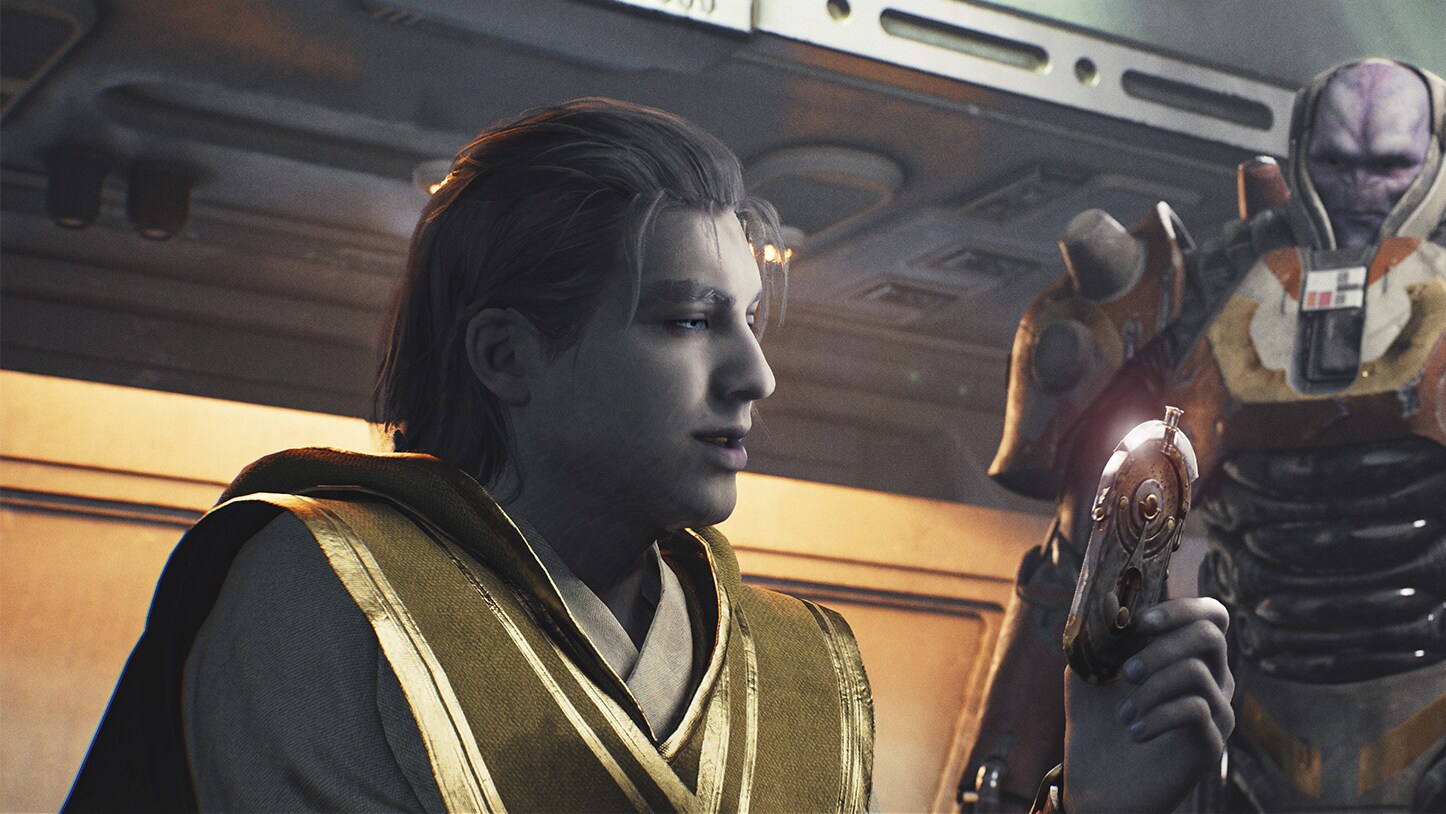
Dagan’s awakening overturns Cal's expectations. He remains consumed by anger over Tanalorr and the Council’s decision. While explaining his grievance, he takes apart his lightsaber and bleeds its kyber crystal, changing the weapon’s blade from yellow to red. Lucasfilm’s Databank profile specifically identifies this act and the attack that follows.
Cal's first duel against him is a major playable boss encounter. Rayvis then helps Dagan escape. Cal is left with evidence that a surviving Jedi does not automatically offer a trustworthy ally, and that the old Order's unresolved conflicts can survive in physical form. The early alliance Cal hoped for is replaced by a search for the same hidden world now desired by an enemy.
09 / POWER AND LOYALTY
Rayvis and the Bedlam Raiders
Rayvis is a Gen’Dai warrior who owes Dagan loyalty following a defeat in combat long before Cal’s journey. Their relationship differs from the formal hierarchy of the Jedi. Rayvis respects the outcome of a contest, understands obligation through combat and honor, and continues to regard Dagan as a leader worthy of service even when his methods violate Jedi principles.
In the Imperial era, Rayvis commands the Bedlam Raiders, an armed organization with droids, captured equipment, and a growing presence on Koboh. The Raiders' reach gives Dagan the people and weapons to pursue the lost route to Tanalorr. This force can seize sites and intimidate local populations, but it cannot reconstruct Santari’s specialized navigational knowledge through violence alone.
Dagan’s collaboration with Rayvis is therefore both a personal alliance and a strategic dependence. His former allegiance to the Jedi provides the history and aim of the campaign. Rayvis and his raiders provide coercive force. The arrangement does not turn the Bedlam Raiders into the original High Republic settlement, nor does it make the surrounding population part of Dagan's claimed community.
10 / SEARCH FOR ACCESS
Zee, lost compasses, and hidden knowledge
Dagan's renewed campaign focuses on recovering enough information to cross the Koboh Abyss. That search brings Cal into conflict with the Bedlam Raiders at the ruins of High Republic facilities. The droid ZN-A4, commonly called Zee, preserves knowledge connected to Santari. Rayvis's forces seek that information because the old research systems remain valuable long after their creators have disappeared.
On a crashed Lucrehulk and at other abandoned installations, Cal discovers records showing how the compasses were developed and how Santari tried to protect the last route. Knowledge survives unevenly: some components are damaged, some droids remain operational, and some memories are available only through the Force. The player is repeatedly asked to reconstruct events from fragments.
Dagan's strategy increasingly depends on controlling this material record. He wants the final compass and the knowledge associated with it, but he treats obstacles as enemies rather than as reasons to question the justice of his claim. The distinction between finding the route and deciding who may use it is the same distinction the future inhabitants of Tanalorr will need to confront.
11 / GAMEPLAY AND NARRATIVE
Three encounters with Dagan Gera
The fights are not interchangeable boss arenas. They organize the story's revelations about his physical injury, Force abilities, anger, and cooperation with Rayvis. Select a confrontation in the interactive encounter guide below to identify the setting and narrative turning point.
Forest Array / Rehabilitation Wing
Cal releases Dagan. The kyber crystal turns red, and Cal learns that the surviving Jedi has become hostile. Rayvis intervenes after the duel.
Lucrehulk / Forward Control Tower
Dagan pursues Santari’s technology while Cal tries to rescue Zee. Bode’s arrival helps Cal escape a dangerous second confrontation.
Koboh Observatory
The final fight combines lightsaber combat, illusions, and the failure of Dagan’s confidence that Tanalorr must belong to him.
These encounters support the IDS Games hub and its walkthroughs. This dossier interprets character development; it does not claim that players can permanently alter Dagan’s canonical fate through dialogue or a branching decision.
12 / FINAL SHOWDOWN
The Observatory ends his claim to Tanalorr
The final confrontation takes place at the observatory on Koboh, where Santari’s surviving compass can be obtained. Bode Akuna accompanies Cal. Dagan’s powerful Force techniques and illusions give the fight its distinctive character. He summons a phantom arm that allows him to fight with a visual approximation of the limb Santari removed centuries earlier.
Cal ultimately turns Dagan’s own fear and memory against him through an illusion involving Santari. The sight of the person most associated with his loss disrupts Dagan’s control. Cal wounds him, and Bode also intervenes with his blasters as the struggle reaches its end. Dagan dies at the observatory rather than reaching Tanalorr again.
The death resolves the pursuit of the compass by this particular claimant, but not the debate about the planet. Cal and Bode Akuna later disagree about whether a refuge should protect a whole network or only an individual family. Dagan's account therefore matters after his last boss battle. It establishes the first fully dramatized example of a person confusing discovery and devotion with an entitlement to dictate the planet's future.
13 / VISUAL AND MATERIAL CULTURE
Gold robes, a changed blade, and a phantom limb
Dagan's character design marks the separation between eras. His High Republic-style robes use gold accents and structured forms associated with the Order during a period of expansion. When Cal meets him, this clothing already belongs to the visual past. The setting emphasizes that the wearer has outlived the institutions that once gave his uniform a clear place in the galaxy.
His double-bladed lightsaber begins with a yellow blade and can be separated into two components. In the Rehabilitation Wing, he bleeds the kyber crystal red. That action is an observable turning point, not a decorative change of color: it brings the story's account of resentment into the language of a Force-sensitive object. The weapon becomes evidence that Dagan has chosen to express his conflict through domination and violence.
His missing right arm and later Force-generated phantom limb deserve careful treatment. The injury is a specific result of Santari’s intervention, not a generic sign that physical disability causes corruption. The later phantom limb appears as a combat technique and a visible expression of Dagan’s attempt to overcome and conceal that loss. His downfall arises from choices, grievances, and violence, not from the fact of having an altered body.
14 / IDS ASSESSMENT
Discovery does not create private ownership
Dagan’s story is useful for studying the difference between exploration, institutional authorization, and claims of property. His passage to Tanalorr proves skill and determination. Santari’s compasses and the Republic’s investment turned that discovery into a practical route and planned community. None of those facts automatically gives the original discoverer a permanent right to exclude everyone else.
The Jedi Council's retreat illustrates the limits of institutions. A public decision can preserve resources and protect people while also making the people who worked on the abandoned project feel disposable. Dagan describes the decision through betrayal. The account becomes destructive when he treats disagreement with institutional authority as evidence that violence against former colleagues is justified.
Santari represents a different relationship to responsibility. Her laboratory expertise does not prevent her from defending the Council's broader obligation to consider risks to inhabitants. She also faces a personal conflict because she knows the person who rejects that decision. Their last encounter shows how an interpersonal bond can become entangled with duties that cannot be satisfied at once.
Rayvis adds another dimension. His combat-derived oath explains why he follows Dagan without sharing the social ideals of the Jedi. The Raiders illustrate how a personal obligation can scale into organized coercion when a leader commands weapons and people. Meanwhile, Cal’s later proposal for Tanalorr recasts the same location as shelter for displaced people rather than as payment for an explorer’s suffering.
A careful reading does not need to flatten Dagan into a figure who was always selfish. The game establishes his earlier investment in a potential Jedi community, his loss when it was abandoned, and his eventual responsibility for violent acts. IDS treats his claim of betrayal as testimony about his experience, not as a neutral account that settles whether the Order's evacuation was wrong.
15 / INTERACTIVE CHRONOLOGY
Reconstruct a two-century conflict
Select a phase to trace what the source material establishes. These stages are ordered by the story rather than by date precision: the game does not provide a complete day-by-day biography of Dagan's High Republic life.
A navigable path to Tanalorr
Dagan pilots a route through the Koboh Abyss. Santari and the Jedi research the means to reproduce access and develop a presence on the planet.
16 / INTERACTIVE RESEARCH
Who has the authority to decide?
Select one claim about Tanalorr to test what it assumes about labor, danger, and rights. This is an anthropology exercise based on the story, not a new Canon outcome.
A successful voyage is not exclusive title
Dagan’s accomplishment matters. It does not by itself grant authority to exclude every other member of the project from governing the place discovered.
How should the interactive results be interpreted?
Each response separates a source-established role from an IDS analytical question. The controls compare competing claims about authority. They do not state what an imagined Jedi court would rule or create undisclosed dialogue.
17 / VERIFIED COLLECTIBLES
Collecting this Character
Unlike many minor game characters, Dagan has licensed physical collectibles with independently verifiable manufacturer records. The products below are distinct releases. Pricing and stock can change; this dossier records release identification, not live availability.
The Black Series Dagan Gera
A six-inch Dagan Gera action figure issued by Hasbro. The manufacturer’s listing identifies SKU G15505X00 and confirms the Jedi: Survivor character design.
See verified Hasbro product →Dagan Gera and BX Droid (Hybrid)
A separate Gaming Greats Black Series two-pack with Dagan and the droid, 6-inch-scale figures, and three accessories. Compare the packaging and included pieces with Hasbro's published details.
See verified Hasbro two-pack →The game itself remains the primary reference for his robes, kyber crystal, and phantom arm. Check the IDS cards archive for separately documented card appearances; this page does not invent a Topps or LEGO release. These manufacturer links are references, not claims about current availability or an affiliate purchase.
18 / CANON AND EVIDENCE
Primary sources and reading notes
The playable main story of Star Wars Jedi: Survivor (Respawn Entertainment, Electronic Arts, and Lucasfilm Games, 2023) is the primary narrative source for Dagan’s dialogue, the Nihil attack, Santari’s intervention, the compasses, his three encounters with Cal, and his death.
Lucasfilm: Dagan Gera Databank confirms the preserved Jedi, Cal’s intervention, the Tanalorr grievance, and the bleeding of his kyber crystal. Lucasfilm: Cal Kestis Databank identifies the Forest Array encounter and Cal’s interest in Tanalorr. Lucasfilm: What Is the High Republic? locates the character in the publishing era. Lucasfilm: Jedi: Survivor provides official game description, images, and trailers.
For authorized product identification, see Hasbro: individual Dagan figure and Hasbro: Dagan/BX Droid two-pack. For a secondary index to scenes and terminology, see Wookieepedia: Dagan Gera, which is not used to override the game or Lucasfilm.
Continuity: Canon, High Republic and Imperial eras. First named narrative appearance: Star Wars Jedi: Survivor (2023). His precise childhood and an exhaustive pre-Tanalorr biography are not supplied by this game. The anthropological questions and evaluative language on this page are IDS interpretation, not new events or officially attributed character motives.