

CANON · GAME CHARACTER FILE
Inside the Jedi: Survivor story
Story, identity and institutions
A High Republic-era droid preserved beneath Koboh connects Cal Kestis to Santari Khri, the lost route to Tanalorr, and a century-spanning question of memory and duty.
The droid buried below an ordinary outpost
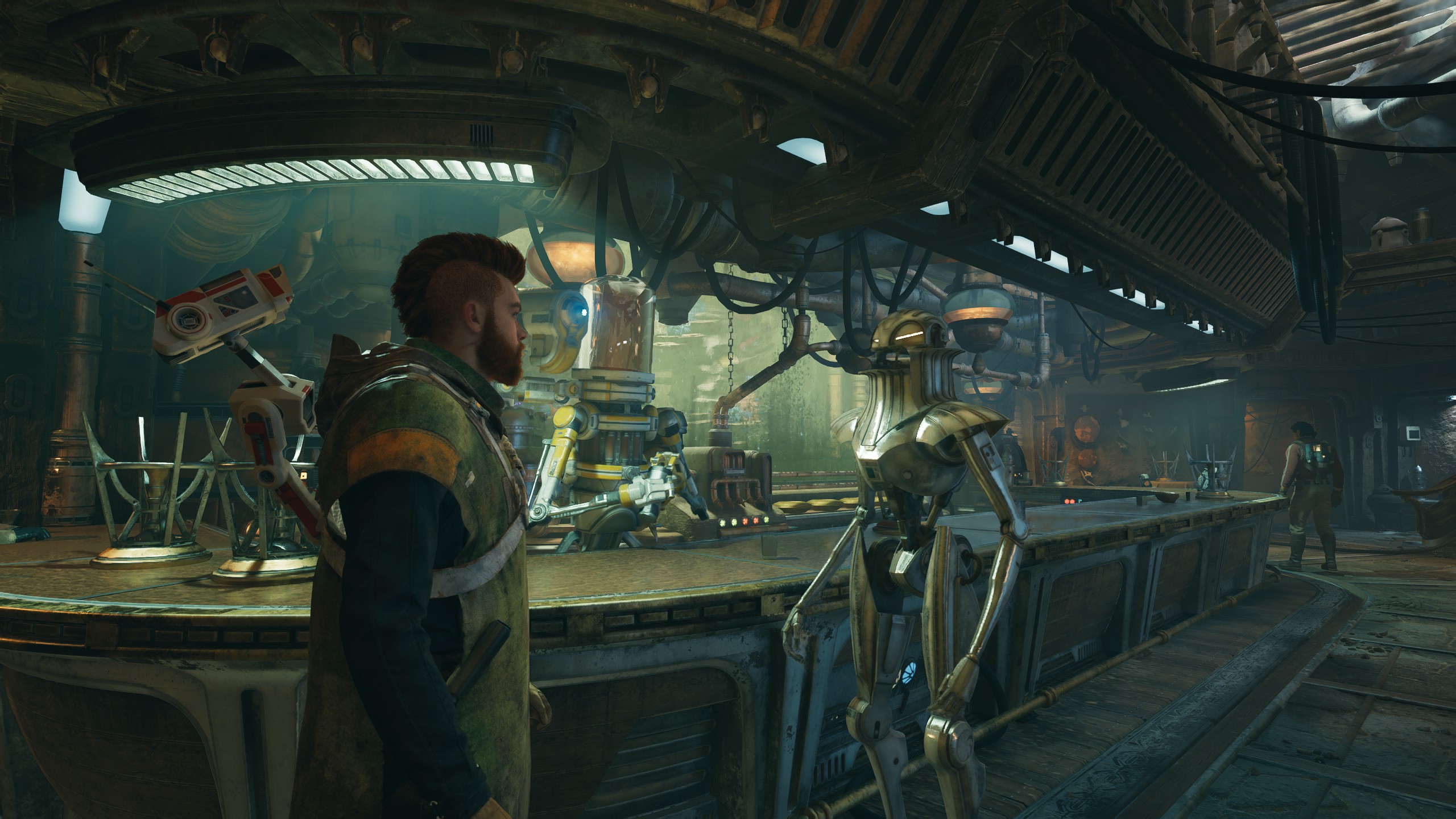
Zee is encountered beneath Pyloon's Saloon in the Chamber of Duality, a High Republic structure hidden under the ground where the people of Rambler's Reach conduct ordinary business. The discovery is striking because it brings two eras into direct contact. Cal Kestis is trying to repair the Stinger Mantis in an Empire-dominated galaxy. Zee remembers an older Republic in which Jedi explored the galaxy with a degree of institutional support that Cal has never experienced as an adult. Their meeting is therefore more than a device activating a mission objective.
The droid's full designation is ZN-A4. Her familiar name, Zee, quickly makes her a person-like participant in the party's discussions, but the archive should also recognize the limits of its language. The game presents a speaking, remembering machine built for tasks within the old Republic. Describing that portrayal does not resolve the real philosophical question of artificial consciousness. In the story, what matters is how other characters treat her memories, commitments and choices.
Her appearance also reflects a different age of industrial design. Her long articulated limbs, narrow body and elaborate head distinguish her from BD-1's compact exploratory machinery. These visual differences tell the audience that the galaxy's technologies have histories. The model image in this article is a developer sculpt and should never be mistaken for a gameplay still or proof that her surfaces are monochrome during the finished game.
Santari Khri and the interrupted assignment
During the High Republic era, Zee worked with Jedi Master Santari Khri. A crisis interrupted an assignment connected to Koboh's Forest Array and a Republic tuner. The device was essential to navigating the extraordinary technologies connected to Tanalorr, the elusive world whose concealment lies near the center of the game's larger mystery. The surviving task gave Zee a clear operational obligation, but she could not simply complete it by determination alone.
As disaster struck Koboh, Zee became trapped within the chamber. She remained dormant beneath the outpost for centuries, while the Republic whose projects she served disappeared and the Empire took its place. This is an unusually literal example of an institution outliving its people through archives and machines. Zee's continued existence did not preserve the High Republic's laws, personnel or political authority. It preserved one partial perspective on them.
Cal's rescue allows the interrupted task to enter a radically different political setting. The old assignment was conceived within a flourishing Jedi institution. Cal acts as a fugitive Jedi survivor, suspicious of Imperial power and hopeful that Tanalorr might shelter people fleeing persecution. The same equipment may have different moral and political meanings when the society around it has changed.
The Forest Array and the problem of inherited instructions
Zee's information helps Cal locate and understand the Forest Array. The relevant sequence grows out of the Chamber of Duality puzzle, where Force-manipulated orbs and bridges restore access to the trapped droid. The interactive mechanics are part of the player's experience, while the story explanation concerns a damaged research network and a surviving witness. Confusing puzzle controls with historical evidence would turn a useful character study into a disguised walkthrough.
Zee regards Santari Khri with devotion and understands the old Republic through the relationships that shaped her mission. Yet obedience to an instruction created generations earlier cannot be taken as proof that the instruction remains fully appropriate. The danger of interpreting the past through only one recovered device is visible in the mystery surrounding Dagan Gera and the Jedi's attempts to control access to Tanalorr. A witness may remember an event accurately and still lack all the surrounding context.
A responsible archive records what Zee saw, what she was told, and what Cal later discovers independently. Her value as evidence does not come from claiming that she is infallible. It comes from the combination of memory, technical knowledge, and direct association with a lost historical project.
The Empire's present and the Republic's past
Zee's continued loyalty to Santari is emotionally meaningful because the world in which that loyalty formed has vanished. Cal has the opposite problem: he knows the Republic through fragments and memories while actively resisting the regime that replaced it. Their conversations can therefore expose a difference between nostalgia for an admired institution and the practical needs of people living under current oppression.
The game does not prove that every action taken by the High Republic Jedi was correct. The project surrounding Tanalorr involved unusual technology, dangerous secrecy and disagreements among powerful people. Cal's decision to pursue its route takes place amid his own losses and urgent obligations. Zee gives him access to knowledge; she cannot make the question of what to do with it morally simple.
Material objects are central to this connection. A tuner, an array and a chamber remain when the people who built them are gone. They can still function, but their continued function should not be equated with continued legitimate ownership. The identity of the people most affected by a recovered machine matters as much as the name of its original operator.
Anthropological assessment: living archives and their limits
Zee is an unusually effective figure for the anthropology of archives. A traditional archive often appears as documents, artifacts or preserved recordings. She can answer questions, respond to changing circumstances and connect an old instruction to new events. But her ability to speak does not make her an objective narrator. Her experiences were limited by where she served, whose orders she followed and what she could observe.
The archaeology of the Chamber of Duality offers a second perspective. Cal does not merely acquire a useful tool. He changes the state of a site, activates mechanisms and extracts knowledge from a material setting. A researcher would want to record that context before relocating artifacts or treating the old chamber as simply an obstacle on the way to a reward. The recovered droid's words are evidence, yet so are the technologies and physical arrangements around her.
Zee's story ultimately asks how an institution's legacy should be handled when its historical authority has ended. An old command can be honored as a clue to the past without becoming an unquestionable obligation in the present. Her survival is evidence of long-lasting technology and personal continuity, not a legal claim that the High Republic should simply be restored as it was.
Story chronology
Events are ordered by the game narrative and associated canon sources. No unverified birth year or original mission date is invented.
High Republic
Serves alongside Jedi Master Santari Khri during the research and exploration of Tanalorr.
Emergency assignment
Carries the tuner mission toward the Forest Array while crisis threatens Koboh.
Chamber of Duality
Becomes trapped and remains dormant beneath Koboh for centuries.
Cal's discovery
Cal finds and frees Zee after navigating ancient Jedi chamber machinery.
Forest Array
Her surviving instructions guide investigation of the Array and the lost route.
Later exploration
Remains a witness to historical events that Cal must compare with new evidence.
Relationships and rivalries
Santari Khri ↗
Jedi Master and former colleague whose commission shapes Zee's mission.
STORYCal Kestis ↗
The Jedi who rescues and questions her in the Imperial era.
POWERDagan Gera ↗
A High Republic Jedi whose choices complicate how the old project is remembered.
CREWBD-1 ↗
A very different research-support droid traveling with Cal.
STORYToa ↗
Twi'lek researcher who seeks testimony about High Republic Koboh.
Anthropological analysis
Choose a frame of analysis. These perspectives are editorial interpretation, not statements about biological differences or actual game mechanics.
Witness
Identify what Zee experienced directly, and distinguish observation from received instruction.
Where the evidence ends
A scene, collectible entry, gameplay system, and editorial interpretation are different kinds of evidence. Treating any one of them as all four produces an unreliable Star Wars archive.
Interactive evidence lab
Zee remembers a High Republic order to activate a device. What should Cal do before treating that order as binding today? Select a response to see the consequences for interpretation; this is not a dialogue tree in the game.
Choose an assessment
Compare competing explanations with the documented source record.
Check the story record
Which material supports this biography?
The cited EA, StarWars.com and character-specific game records. Every social-science claim is IDS interpretation.
Are interactive choices the same as gameplay outcomes?
No. The controls compare interpretations. They do not replace a walkthrough or guarantee any in-game result.
Why label story spoilers?
The dossier explains late-game revelations needed to understand the character's loyalties and historical role.
Collecting this character
Game appearance, concept development, books and licensed collectibles should be distinguished. This page does not claim a numbered physical card, minifigure or action figure unless its release can be verified. Trading-card images are displayed only when supplied by the collection owner.
Research sources
- EA, Jedi: Survivor official game ↗
- Chamber of Duality gameplay guide ↗
- Chamber of Duality historical record ↗
- StarWars.com game overview ↗
- Source of character-specific image ↗
Development sculpt of ZN-A4 by character artist Tim Wallace, mirrored on Pinterest from an ArtStation presentation; grayscale sculpt, not an in-game screenshot. Source-check the linked image rather than interpreting it as independent biographical evidence.
Star Wars narrative and game materials establish story details; IDS anthropology provides interpretation. Publisher commentary and fan-compiled reference pages are identified by their links. No invented outcome, quote or universal game strategy is presented as canonical.