
By Imperial Dark Sector
HIGH REPUBLIC SCIENTIFIC ARCHIVE / CANON
The researcher who mapped an impossible passage
Santari Khri is a High Republic Jedi Master who led scientific work around Koboh's dangerous Abyss. Her navigation systems, mentorship, and final confrontation with Dagan Gera shape the story of Star Wars Jedi: Survivor centuries after she is gone.
Her principal achievement was not discovering Tanalorr alone. Dagan undertook the extraordinary first flight, while Santari and a research team transformed the resulting information into machinery, compasses, and repeatable travel. Her most difficult decision came when the same person she had helped could no longer accept the Jedi Council's withdrawal.
01 / HIGH REPUBLIC
A Jedi Master who worked as a scientist
Santari Khri served the Jedi Order as a Master during the High Republic, an era associated with an expanding Republic and a substantial Jedi presence beyond the Core Worlds. Within that institution, Santari was a researcher and engineer, not merely a combatant who happened to use technical equipment. The surviving game records situate her at the center of a collaborative scientific project on Koboh, involving Jedi and Republic researchers who sought to understand the nearby stellar anomaly.
The researcher’s occupation is central to her biography because the project demanded patient investigation of an environment that ordinary hyperspace navigation could not safely cross. Physical infrastructure, controlled tests, recorded observations, and technical tools were part of her work. She also remained a teacher committed to the Order’s broader principles. That combination challenges a simplified picture of Jedi life as only diplomatic negotiation or lightsaber conflict.
The original game does not establish her childhood, homeworld, family group, or early apprenticeship in a way that permits a detailed personal chronology. Those gaps should remain explicit. Her enduring importance is documented by the laboratories, compasses, arrays, recordings, and droid instructions that Cal Kestis encounters two centuries after her active research period.
02 / KOBOH RESEARCH
Koboh matter as a scientific problem
Santari became head scientist of a project devoted in part to Koboh matter, a hazardous and unusual substance encountered near the Koboh Abyss. Cal later uses a specialized device to direct beams capable of burning away deposits of that matter. The game turns knowledge produced through the research program into practical interaction: previously blocked passages can be opened once the necessary technology is available.
The distinctive material also made the local environment a research landscape rather than just a location for ruins. Its origin, behavior, and possible relationship to the Abyss raised problems that no single Jedi could solve by intuition. Santari's team combined experimentation and engineering to understand what could be controlled and what remained dangerous. The installations on Koboh preserve a record of that work even when the scientists themselves are absent.
For an anthropological study of labor, these facilities matter because scientific discoveries are not isolated mental achievements. They depend on instruments, maintenance, repeated trials, technical assistants, and organizations willing to support the work. Santari's reputation therefore reflects individual expertise within a collective research program.
03 / TRUST AND COLLABORATION
Dagan Gera's closest collaborator
Dagan Gera's partnership with Santari connected exploration to engineering. He was prepared to attempt the dangerous route into the Abyss when other travelers could not reach its interior. She understood the mission's technical risks and initially resisted his proposal to make the flight alone. Dagan persuaded her to help, and their confidence in one another became essential to the work that followed.
Sources describe the relationship as a close friendship and shared intellectual commitment. Dagan imagined Tanalorr as a future home for the Jedi, while Santari sought to ensure that the route and its equipment could function safely for more than one explorer. Their partnership is a documented social relationship. It does not need an invented romance or private family history to explain why the breakdown was devastating.
Both researchers contributed materially, but their responsibilities differed. Dagan supplied a dangerous first passage and practical flight observations. Santari translated that information into navigation technology and systems capable of sustaining further journeys. The story's later conflict becomes clearer when the initial discovery is recognized as collective labor rather than the achievement of one rightful owner.
04 / FIRST VOYAGE
A risky flight becomes evidence
The Koboh Abyss created a problem that conventional hyperspace charts could not solve. Dagan undertook a dangerous exploratory flight and located Tanalorr within the region. His return provided the project with a crucial body of observations, showing that travel was possible even if the environment remained hazardous. Santari's work then converted that exceptional journey into procedures and devices usable by other pilots.
The distinction between a successful expedition and repeatable access is important. A single courageous traveler may survive by instinct and experience, but a colony, training facility, or refuge needs predictable logistics. Supplies must arrive, damaged equipment must be replaced, and people must be able to leave if conditions turn unsafe. Reproducibility made Tanalorr a political and institutional question as well as an exploratory discovery.
Her role in this transition is why the original game keeps returning to recordings of Santari and Dagan. The research could not be separated from the growing personal attachment to the planet. While technical success gave the Jedi a route, disagreement about the colony's security eventually placed that shared accomplishment under threat.
05 / INSTRUMENTS
The compasses and linked arrays
Santari and her team developed Abyss compasses using information from Dagan's flight. These devices provided a means to guide starships through the dangerous region, making movement toward Tanalorr less dependent on a single explorer's knowledge. The original project also left installations such as the Forest Array on Koboh, a lunar research facility, and the observatory whose instruments retained significance much later.
Cal's story reveals the dangers of concentrating vital knowledge in vulnerable objects. Once the Nihil reached Tanalorr, the Jedi Council feared that the compasses might let hostile forces find the route again. The order to destroy them attempted to block another incursion, but it also threatened to erase the practical work that had made the settlement possible.
Santari ultimately kept one compass, making a decision that complicated her relationship with both the Jedi Council and Dagan. Its continued existence allowed an old conflict to survive in physical form. As an artifact, the compass was simultaneously a navigational tool, a possible security breach, and evidence of Santari's refusal to relinquish every possibility of reaching the planet.
06 / TANALORR SETTLEMENT
A proposed sanctuary for Jedi training
Once travel became possible, the Jedi established a presence on Tanalorr, including a temple associated with training future members of the Order. The location promised seclusion and a place in which the Order's ideals might be practiced far from ordinary political routes. Santari's work had helped make such a proposal technically feasible, but technical feasibility did not settle whether the settlement was prudent.
Communications through the Abyss were unreliable. If residents needed rescue or assistance, the difficult route could make aid slow or impossible. Santari recognized the importance of institutional approval and safety review. The Jedi Council's concerns were thus not only abstract opposition to Dagan's vision. They concerned the people who would depend on the infrastructure and the authority responsible for them.
The difference between the collaborators gradually sharpened. Dagan experienced Tanalorr as an extraordinary achievement that should be defended. Santari valued the world too, but remained willing to assess it as a complex undertaking whose survival depended on other people and institutions. Neither the beauty of the destination nor its isolation guaranteed the community's safety.
07 / INSTITUTIONAL AUTHORITY
Why the Jedi Council was divided
The Jedi Council had to decide whether the difficult and weakly connected world could safely support a continuing settlement. Santari's position joined support for the project with respect for the Council's responsibility to consider broader risks. Oppo Rancisis appears in the historical record as a Jedi Master who visited the site, giving the undertaking direct attention from the Order's leadership.
For Dagan, delayed or disputed approval felt increasingly like rejection. Santari did not interpret every concern in the same way. She recognized the distinction between an institution assessing hazards and an institution condemning the people who had devoted themselves to the project. Her approach was neither blind obedience nor a simple willingness to abandon her friend.
The dispute demonstrates how institutions distribute decision-making authority. The people performing research have firsthand expertise, but the organization authorizing settlement also bears responsibility for its consequences. When the two positions clash, the problem cannot be resolved by declaring that the first person to arrive owns the world.
08 / THE CRISIS
Nihil attack, withdrawal, and destroyed routes
During the High Republic, Nihil raiders reached Tanalorr and attacked the Jedi presence there. The assault forced a retreat and confirmed the risk that enemies could overcome the protective isolation of the Abyss. The Jedi Council chose to abandon the project and destroy the means of navigation to prevent additional incursions. Santari and other personnel had to leave the place to which they had dedicated so much work.
The loss was not merely of property. Equipment, a school, travel infrastructure, and plans for a future community became difficult or impossible to maintain. Dagan saw the evacuation as a profound betrayal of Tanalorr and of his personal contribution. Santari had reason to grieve the same loss without agreeing that the institution's strategic decision licensed violence.
Because the Nihil threat, the decision to withdraw, and the destruction of compasses are distinct events, the page keeps them separate. The initial attack did not itself turn Dagan into a dark-side antagonist. His response to the retreat, his coercive search for a compass, and his treatment of fellow Jedi complete that transformation.
09 / FRIENDSHIP UNDER PRESSURE
The argument turns into a threat
After the evacuation, Dagan continued to pursue a return to Tanalorr. His anger intensified as the Jedi Order moved away from the abandoned settlement. He treated the planet not simply as a shared aspiration but as something that had been taken from him and to which he was entitled. This shift brought him into direct conflict with Santari, whose understanding of their project remained tied to responsibility for others.
Santari urged him to reject the violent path and attempted to reach the friend she believed still existed beneath his anger. Those efforts did not reverse his commitment. When he tried to take the remaining compass against her wishes, the dispute ceased to be a negotiation over scientific objectives. He attempted to force a former colleague to surrender a tool that might enable another dangerous expedition.
The story does not require the conclusion that Santari ceased to care for Dagan as soon as he became dangerous. Her concern and the need to prevent harm existed together. That tension is a defining element of her character and one of the reasons her eventual choice is more complex than either obedience to the Council or simple loyalty to her collaborator.
10 / THE REHABILITATION WING
Santari stops Dagan without executing him
Santari confronted Dagan as he moved to take the compass. During their clash, she severed his right arm and rendered him unable to continue. The injury was an outcome of a violent confrontation, not the cause of his fall. His earlier choices and growing obsession had already placed him on a destructive course. This distinction matters when discussing both disability and fictional moral characterization.
Rather than kill Dagan, Santari placed him in a bacta tank within the Rehabilitation Wing of the Forest Array. The chamber preserved him in suspended treatment, leaving open the possibility that he might one day return to the Jedi path. She did not fully disclose the decision to the Council. That concealment shows how her trust in his capacity for change conflicted with institutional accountability.
The preservation had unintended consequences. Dagan remained alive while the Order's world changed and eventually collapsed. When Cal freed him centuries later, the conflict over Tanalorr had not been resolved. Santari's compassion spared a life, but it could not guarantee the choices that a future Dagan would make.
11 / A MESSAGE ACROSS CENTURIES
An invitation rather than an assurance
Santari left a holorecording for Dagan, meant to be encountered when he awoke. Its message offered him an alternative to continuing his possessive pursuit of Tanalorr. He could seek her out, confront his actions, and attempt to recover something of their previous relationship. The invitation reflected a belief that change remained possible, even after the violence that forced her to stop him.
By the events of Jedi: Survivor, Santari is no longer present to speak to him directly. The message survives as an artifact, but the personal relationship that once gave it force has been interrupted by centuries. When Dagan reaches the observatory, Cal discovers that the recording is connected not only to the past but also to a route to Tanalorr.
This makes the recording more than background exposition. A preserved account of intention may guide a later person, but it cannot compel a listener to accept its meaning. Dagan watches evidence of Santari's continued hope and still pursues control. Cal later uses the complete preserved information for a different purpose.
12 / DROID KNOWLEDGE
ZN-A4 carries a mission she cannot finish
Santari entrusted duties to the droid ZN-A4, known as Zee, whose loyalty and memory survived the research community's disappearance. Santari also restricted part of the droid's navigational knowledge, protecting information that could expose Tanalorr. The security measure helped keep the route from hostile users but meant that any later attempt to reconstruct it would require more than simply asking Zee for directions.
Zee was assigned a task involving the Forest Array and the remaining means of access. Environmental catastrophe intervened, and the droid was trapped before completing the work. Centuries later, Cal freed her. Their partnership allowed an old instruction to take on a new meaning in an Empire-dominated galaxy.
The droid's situation illustrates the difference between information storage and organizational continuity. A machine can preserve instructions, technical memories, and personal loyalty. It cannot reproduce the entire institution that created the instructions or settle how a new community should apply them. Zee is therefore more than a convenient guide: she is an active bearer of the consequences of decisions made long before Cal was born.
13 / KOBOH'S CHANGED LANDSCAPE
The Great Hyperspace Disaster reaches the research colony
The Great Hyperspace Disaster, a major High Republic-era event, brought destruction into the Koboh system when debris emerged near the moon and struck the area. Santari's research installations were damaged, while the conditions of evacuation and destruction helped scatter people and knowledge that the project had accumulated. The droid Zee remained trapped for generations in the aftermath.
The disaster should not be confused with the Nihil attack on Tanalorr. The two are connected to the larger High Republic crisis but occurred as different threats, with different immediate consequences. The attack undermined the security of the Tanalorr settlement. The later catastrophe helped sever the remaining practical links to Santari's research network.
By the time Cal explores Koboh, ruins give the player access to the past through broken machines, damaged architecture, and Force echoes. Santari is absent, yet her work shapes where the player can travel and which questions become solvable. Those remains are important historical evidence precisely because they are incomplete.
14 / IMPERIAL ERA
The work that Cal Kestis eventually recovers
Cal's efforts to locate Tanalorr depend repeatedly on Santari's preserved research. Zee guides him toward the Forest Array; damaged historical facilities provide clues; compasses become contested objects; and the observatory yields another recording with information Dagan had not used to reach a reconciliation. The objects are not interchangeable. Each preserves a different part of the project.
After Dagan's death, Cal and the Stinger Mantis crew uncover the fuller message. It contains the coordinates and instructions needed to align the array network and open a passage toward Tanalorr. Zee assists from the Alignment Control Center while the crew attempts the dangerous journey. The ultimate crossing remains risky, but it becomes possible because Santari designed a system that could outlive her.
The contrast with Dagan is important. He treated Tanalorr as recognition owed to him for discovery and loss. Cal approaches the same site as a refuge for people pursued by the Empire. Whether the future settlement succeeds is not guaranteed. Santari's engineering provides access, not a moral instruction about who deserves to enter or rule.
15 / DESIGN AND OBJECTS
A Jedi whose legacy is built into machines
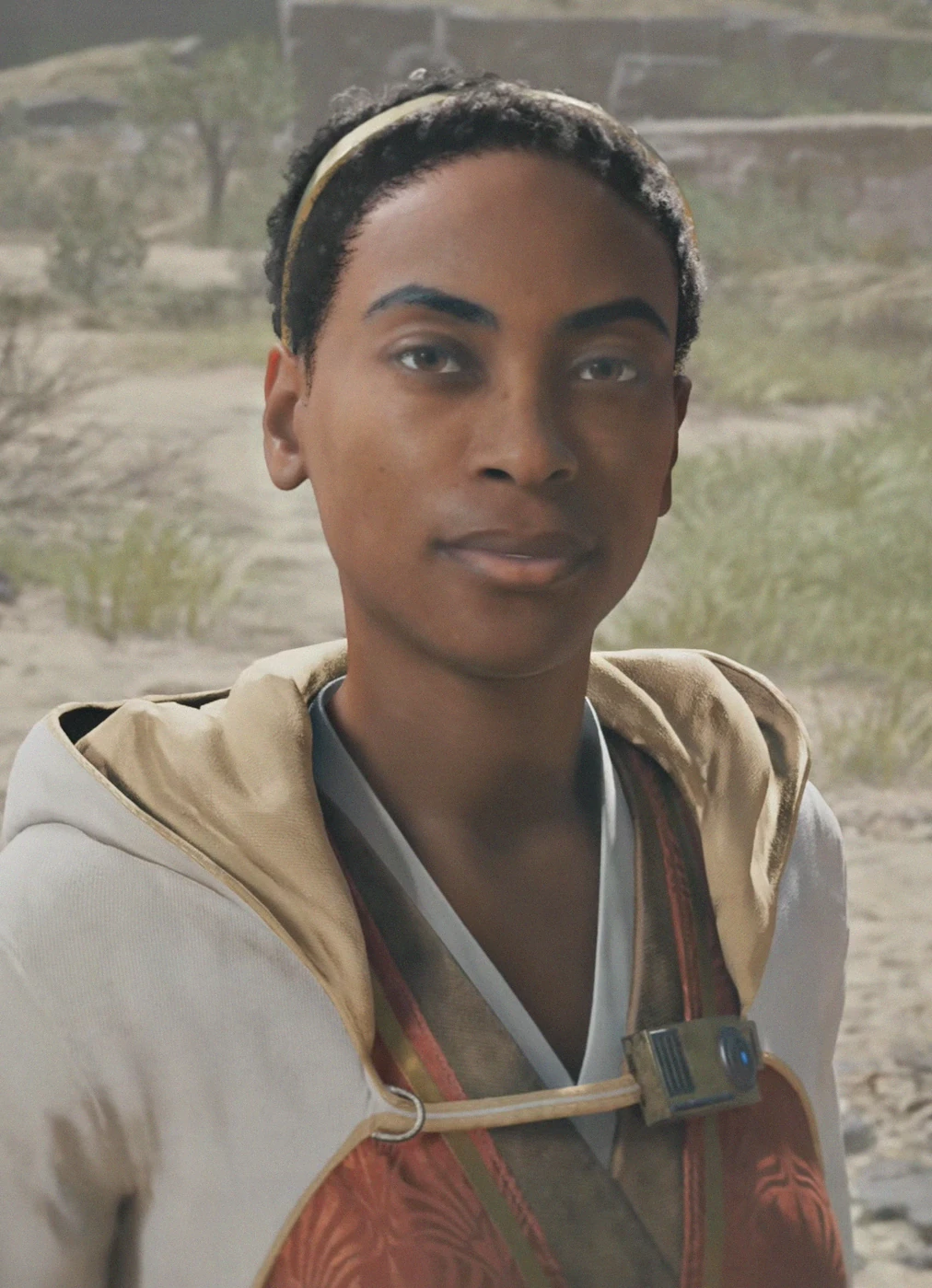
Surviving art and in-game echoes depict Santari as a human Jedi woman in High Republic-era clothing. Her visual design places her in the Order's established traditions without reducing her work to a generic military role. Her own tools were not limited to a lightsaber. She supervised navigation instruments, experimental arrays, meditation chambers, and specialized devices that turned hazardous natural conditions into research questions.
The Abyss compass is her clearest material signature. It enables navigation through a region that might otherwise isolate a planet completely. The arrays constitute a larger infrastructure, requiring distributed equipment and coordination across multiple installations. The objects reveal the interdependence of individual invention and long-term maintenance.
Her depiction is best examined through licensed original artwork, including Jordan Lamarre-Wan's published Santari Khri concept art, which quotes the official artbook and identifies the research work as central to her life. The portrait above is a character-specific local archive image. No generic Jedi image is used as an uncredited substitute.
16 / IDS ANTHROPOLOGY
Scientific authority, belonging, and the ethics of care
Santari illustrates how a religious and diplomatic institution can also organize technical knowledge. The Jedi Order supported scientific stations, shared equipment, and education. Its members could pursue spiritual commitments and empirical inquiry without treating them as mutually exclusive. Her laboratory was not outside Jedi culture: it was one way that culture produced and transmitted expertise.
The Tanalorr project also shows that discovery is a collective achievement. Dagan's flight was essential, but the route became socially useful through Santari's experimentation, navigation systems, and institutional support. Credit and ownership are different categories. An explorer may deserve recognition while lacking sole authority to decide who lives in a place that an organization helped develop.
Her decision to spare Dagan shows a conflict between interpersonal care and wider responsibility. She believed in the possibility of rehabilitation, and this belief shaped her refusal to kill him. At the same time, withholding information from the Council limited the institution's ability to assess the risk she was preserving. A morally important motive does not determine the consequences of every decision made from it.
Research archives can also be instruments of power. Erasing or restricting navigational information helped protect the route from hostile use, but it transferred decision-making authority to those who controlled the remaining artifacts. Cal's later work depended on reconstructing access through objects and records distributed among ruins. The result highlights that control of technical knowledge affects movement, protection, and political membership.
These observations are interpretations of a fictional story, not statements attributed to historical anthropologists or official Lucasfilm commentary. They help explain why Santari's influence persists even when she is never physically present in Cal's era: institutions disappear, but selected objects, instructions, and unresolved obligations can remain consequential.
17 / INTERACTIVE CHRONOLOGY
Follow the High Republic research record
Use the controls to trace the research project in order. The stages reflect documented events, but the story does not provide exact calendar dates for every discovery and meeting.
The Koboh research program
Santari directs Jedi-Republic study of Koboh matter and the nearby Abyss. Laboratories and experimental facilities establish a technical foundation.
18 / ENGINEERING FILE
Understand the route Santari helped build
A schematic of the High Republic research network
This interactive representation explains the roles of the installations. It is an editorial diagram, not a screenshot or an exact navigational map of Koboh.
Understand the hazard first
Santari's Koboh matter experiments make the dangerous local environment more tractable. The materials and devices are not the same as a reliable route through the Abyss.
19 / INTERACTIVE ETHICS
Examine Santari's hardest decisions
Different choices affected Dagan, the Council, Zee, and later travelers. Select a case for a research question grounded in the game. These panels do not create alternative Canon endings.
A test that cannot be completely safe
Dagan chose a hazardous experimental voyage. Santari could assess the technical risk and support planning, but a successful flight did not guarantee a secure settlement.
What is Canon and what is analysis?
The game establishes Santari's work, the evacuation, the confrontation with Dagan and her instructions to Zee. Questions of institutional ethics, stewardship and research practice are interpretive exercises authored by IDS.
20 / COLLECTOR FILE
Collecting this Character
Santari Khri's confirmed appearance is in Star Wars Jedi: Survivor (2023). Collectors can examine her design through the game itself and Jordan Lamarre-Wan's published production artwork. The Art of Star Wars Jedi: Survivor, published by Dark Horse Books, documents the game's visual development and is a more reliable reference than uncredited images.
No licensed, character-specific Topps trading card, LEGO minifigure or mass-market action figure was verified for this dossier. This page does not display an invented figure or imply that an unverified custom product was officially released. When researching collectible listings, confirm the product's creator, rights holder, edition and actual Santari identification.
The Star Wars Games hub and IDS cards archive contain related playable and collectible material. Commerce links should be labeled sponsored only when they are commercial affiliate links.
21 / RESEARCH AND SOURCE BOUNDARIES
Source notes and continuity
StarWars.com: Star Wars Jedi: Survivor supplies the official context for the game. The playable game and its High Republic recordings, Force echoes, and character records are the primary sources for Santari's actions, the compasses, Zee, the two crises and the route through the Abyss.
Jordan Lamarre-Wan: Santari Khri concept-art portfolio quotes The Art of Star Wars Jedi: Survivor and describes her work on the frontier, relationship with Dagan and scientific legacy. The same artist's Dagan Gera portfolio explains Santari's decision to spare him and the judgment Dagan feared. These are production-artist sources, stronger for approved character design than fan art or invented portraits.
Wookieepedia's Santari Khri bibliography is a secondary index for in-game dialogue, Koboh matter, the compass and Great Hyperspace Disaster. It helps locate facts but does not override the original game. GamesRadar: Alignment Control Center walkthrough documents how the final array route is used during gameplay. Lucasfilm's High Republic reading guide provides era context.
Continuity: Canon. First appearance: Star Wars Jedi: Survivor (2023). Known facts: Jedi Master, scientist, Dagan's close collaborator, designer of Abyss navigation technology, and creator of crucial surviving records. Unconfirmed: precise birth and death dates, homeworld, family, personal life after evacuation and a full account of all research collaborators. IDS's discussion of scientific authority and institutional ethics is interpretation, not additional Canon.