

By Imperial Dark Sector
COMPLETE CHARACTER FILE · CANON
A warrior who outlived the Jedi Order
Rayvis is a Gen'Dai warrior whose relationship with the fallen Jedi Dagan Gera begins in defeat and lasts across centuries of captivity. By the events of Star Wars Jedi: Survivor, he commands the Bedlam Raiders and pursues the same hidden world that once consumed his former opponent.
Read his documented history first, then examine his conception of honor, the political organization he built on Koboh, and the final two-phase boss fight on the Shattered Moon. Interactive sections present evidence and gameplay guidance without adding fictional events to Canon.
01 / THE GEN'DAI
A life lived on a different timescale
Rayvis belongs to the Gen'Dai, a long-lived species whose distinctive anatomy makes them unusually resilient to injury. Respawn's cinematic director Dori Arazi and lead writer Danny Homan discussed the character's biology and cultural outlook before the game's 2023 release. Their published explanation describes Gen'Dai bodies as masses of regenerative, tendril-like tissue supported by armor that helps maintain a humanoid shape. Rayvis therefore cannot be understood as an ordinary armored mercenary who happens to be physically strong.
Gen'Dai longevity also affects how Rayvis views institutions. He remembers a Jedi Order that Cal Kestis only knows through its collapse, and he has watched political structures change while his personal obligations endure. To a human, a promise maintained over centuries might be inherited history; to Rayvis, it can remain a direct relationship with the person to whom the promise was made.
His lifespan should not be mistaken for omniscience. He knows many eras and combatants but still misunderstands people and makes destructive decisions. The game's writers use him as a contrast to Cal, another survivor associated with a nearly destroyed community. The differences lie in the responses they choose: Cal seeks new loyalties, while Rayvis locates much of his identity in an older martial code and the debt it created.
02 / A LONG HISTORY
Survival, displacement, and violence
The Gen'Dai are described in Respawn's developer interview as intergalactic nomads whose ancestral homeworld was destroyed. The precise personal experiences Rayvis had during that catastrophe are not documented. His history belongs to a species marked by dispersal, but it would be inaccurate to turn an account of species-wide displacement into invented details about his parents or childhood.
Over his long life, Rayvis became a formidable combatant who challenged Jedi and collected lightsabers from defeated opponents. The game's Bedlam Raider tactical records connect his collection with weapons later given to trusted Raider lieutenants. A lightsaber appears within his organization not as proof that the wearer was trained by the Order but as a trophy and a symbol of status granted by the commander.
This is a central part of his characterization. He has encountered Jedi as dangerous rivals and objects of personal respect, not only as the public servants represented in Republic institutions. Later, his resentment at Jedi imprisonment does not erase his recognition that individual Jedi can fight with courage. His assessment of Cal emerges from that ambivalent tradition.
03 / ORIGIN OF AN OATH
Dagan Gera wins his loyalty in combat
Before the Nihil crisis ended the Tanalorr settlement project, Rayvis challenged the Jedi Knight Dagan Gera. Dagan defeated him in combat and spared his life. For Rayvis, the result carried a binding obligation. He acknowledged Dagan as the victor and accepted a debt that he treated as stronger than ordinary shifts in political allegiance.
The promise was not a typical Republic contract, military appointment, or Jedi apprenticeship. It was created through a ritualized encounter between fighters who accepted the martial meaning of defeat. Dagan's victory established rank in Rayvis's personal moral universe. Whether the wider Jedi Order would have recognized such service as legitimate is a separate question.
The relationship grew more complicated as Dagan turned against the Order over Tanalorr. Rayvis remained loyal to the person who had defeated him, even as the Jedi institutions that had once supported Dagan rejected his violence. In the Imperial period, that longstanding promise becomes the reason Rayvis devotes the resources of the Bedlam Raiders to recovering Dagan and pursuing the hidden planet.
04 / THE PRICE OF VIOLENCE
The Jedi deny him the death he expected
After Dagan's fall, Rayvis continued to seek his whereabouts and attacked Jedi while trying to obtain information. The game recounts that multiple Jedi were needed to defeat and contain him. Rather than kill him, they imprisoned him. Because his body could survive for so long, imprisonment extended across a vast span of ordinary human generations.
Rayvis understood the choice as a dishonor. In his martial framework, an opponent with the skill to defeat him could grant a warrior's death. Being kept alive behind bars felt like a rejection of the recognized conclusion to combat. The Jedi's choice can also be understood as a refusal to execute an already defeated captive. Those positions have different ethical foundations and cannot be resolved simply by treating one culture's value as universally correct.
The imprisonment is essential to the later story. Rayvis is neither an uninterrupted ruler across the centuries nor a fighter who stood guard over Dagan's tank for two hundred years. Both men were removed from ordinary political life for long periods, but in different ways: Dagan remained suspended in bacta, while Rayvis lived as a captive and remembered his defeat.
05 / THE EMPIRE'S RISE
The Jedi Purge opens the prison
Rayvis eventually escaped after the destruction of the Jedi Order. He describes the Order's demise as the condition that allowed his release, making the Empire's rise consequential even though he is not presented as a loyal Imperial soldier. The end of the institution that imprisoned him removed the authority that had kept his personal campaign contained.
Once free, he resumed the search for Dagan rather than setting out to restore Jedi power or to join a Republic successor. The passage of time had not cancelled his self-imposed obligation. His return to Koboh coincided with a period in which the planet lay outside the Empire's most direct concerns. That limited attention gave armed local groups room to establish their own hierarchy.
It would be misleading to describe Rayvis as politically neutral because he rejects the authority of the Jedi and does not pledge himself to the Emperor. Commanding raiders, intimidating residents, and using violence to secure ruins and equipment are political acts. His lack of allegiance to a central government helped him build power of his own.
06 / ORGANIZATION
From scattered fighters to the Bedlam Raiders
Rayvis organized the Bedlam Raiders from a collection of bandits, hired fighters, and droid units. The Raiders used seized equipment and former Separatist military hardware, including B1 and B2 battle droids, to impose control around Koboh's settlements and archaeological sites. Their force was not a formal continuation of the Separatist state. Old machinery survived as a resource for a new armed coalition.
The leader held this coalition together through personal authority, battlefield reputation, and the distribution of useful objects. The group could reward committed members with rare equipment. Lightsabers taken from fallen Jedi became status symbols in the hands of some Raider lieutenants; they signified access to Rayvis's favor rather than any institutional right to Jedi rank.
His influence thus differed from Dagan's earlier authority as a Jedi Knight. Rayvis commanded an armed organization that largely recognized his strength. When Dagan returned, the Raiders could be redirected toward finding the compasses and routes to Tanalorr. One warrior's obligation was transferred into a collective military campaign that affected people who had never been party to the original duel.
07 / FRONTIER SOCIETY
Control, extortion, and everyday life on Koboh
Koboh's residents experience the Bedlam Raiders as a threat to movement, trade, and security. Outposts such as Rambler's Reach exist amid old industrial sites, abandoned research facilities, and salvage opportunities. Raiders can take advantage of that geography, claiming routes and equipment while demanding deference from people with few alternatives.
The local situation should not be reduced to a claim that no government exists anywhere. The Galactic Empire has power throughout the region, but its limited immediate investment on Koboh permits other authorities to operate. Rayvis makes decisions that affect residents' lives even without the legal title of governor or the uniforms of an Imperial garrison.
His command of droids also expands the difference between personal strength and organizational force. A single Gen'Dai can survive extraordinary injuries; a force of patrols, automated weapons, and armed lieutenants can enforce repeated demands across territory. Rayvis's longevity gives continuity to his leadership, while the Raiders supply the labor and matériel needed to act on his ambitions.
08 / FIRST APPEARANCE
Turgle, Zeik, and Rambler's Reach
Cal Kestis encounters Rayvis soon after arriving on Koboh. Rayvis confronts the local trader Turgle about a supposedly valuable Jedi artifact that proves fraudulent. The scene introduces him as someone who demands payment and submission, while the surrounding Raiders show how easily local power can become violent.
Cal intervenes and defeats Rayvis's subordinate Zeik. Rayvis does not immediately enter a full boss battle. Instead, he recognizes Cal's fighting skill and leaves. The exchange establishes the distinction between intimidation and the respect Rayvis reserves for an opponent he considers worthy of attention.
Within the larger narrative, the encounter introduces the mechanics of Raider control before Cal knows the full story of Tanalorr. The player has seen armed coercion at street level long before learning that these forces serve a centuries-old personal obligation. This sequence matters because the consequences of Rayvis's code extend to ordinary residents who did not choose to participate in it.
09 / AN OLD PROMISE RETURNS
Dagan awakens at the Forest Array
Cal later finds Dagan Gera preserved in a bacta tank in the Forest Array. Rayvis arrives during the confrontation that follows Dagan's release. While Cal realizes that the awakened Jedi has turned against the Order, Rayvis immediately recognizes the significance of his friend's return and takes steps to assist his escape.
That reunion vindicates years of searching from Rayvis's point of view. The person who defeated him in the High Republic is now alive and able to act again. Yet Dagan has not necessarily remained the same fighter who earned Rayvis's respect. The grievance over Tanalorr has hardened into a determination to recover the planet for himself.
Rayvis's continued support creates tension between fidelity to a personal promise and judgment of the leader's present actions. He does not simply follow the Jedi Order's hierarchy or an Imperial chain of command. His loyalty makes sense under his code, but the consequences of that loyalty are now experienced by people outside the old relationship.
10 / THE COMPASS CAMPAIGN
Ruins, droids, and the search for Zee
After Dagan returns, Raider operations center increasingly on reconstructing the means to reach Tanalorr. Their search reaches the old Lucrehulk and the High Republic infrastructure of Koboh. They are interested in ZN-A4, known as Zee, whose surviving records connect her to Santari Khri's research.
The Lucrehulk demonstrates how the Raiders combine equipment from separate eras. Clone Wars-era battle droids and the remains of a Separatist capital ship are turned into obstacles protecting a High Republic-era objective. Cal has to fight through machinery that outlived the political projects for which it was originally built.
Rayvis supports this campaign but cannot replace the technical knowledge possessed by Santari's surviving systems. Strength can seize a facility and restrain someone with information; it cannot by itself repair a compass or reproduce a safe route through the Koboh Abyss. That mismatch explains why control of particular artifacts becomes so important.
11 / FINAL CONFRONTATION
Rayvis chooses his last duel on the Shattered Moon
The final battle takes place at a High Republic research installation on the Shattered Moon. Cal confronts Rayvis after navigating the facility and learning more about the search for Tanalorr. Rayvis uses a mace with an extending flail head, rapid blaster fire, and missiles, turning the encounter into a test of range, stamina, and the timing of defensive moves.
The fight has two distinct phases. In the first, Cal confronts Rayvis while his armor restrains much of the movement of the Gen'Dai body beneath it. After the first health bar is depleted, Rayvis removes more of that confinement and regenerates. The second stage is faster and more aggressive, combining long melee chains with ranged attacks. The mechanics make his extraordinary physiology part of the battle rather than a fact stated only in dialogue.
After Cal wins, Rayvis shares information about the remaining compass and Dagan's objective at the observatory. Cal offers an alternative to a final killing, but Rayvis asks to receive the warrior's death previously denied by the Jedi who imprisoned him. Cal grants that request. Rayvis dies on the Shattered Moon, while Dagan continues toward the next confrontation on Koboh.
12 / SPECIES AND EMBODIMENT
How Gen'Dai regeneration works
Gen'Dai bodies consist of masses of muscular, regenerative tendrils rather than a conventional humanoid arrangement of bones, organs, and flesh. The armor contains and shapes that tissue for movement, combat, and a recognizable silhouette. Respawn's artists treated the biology as integral to the character design. The contrast between enclosing plates and the living structures beneath them appears in the two stages of his final fight.
This does not make Gen'Dai literally immortal. Rayvis survives damage that would end an encounter for many species, but he can still be defeated and killed. The game shows both extraordinary restoration and the limitations of that restoration during his confrontation with Cal. A reliable dossier should describe the capabilities that are actually depicted rather than making a sweeping claim that all attacks are harmless.
The character's appearance also needs to be distinguished from other Gen'Dai, especially Durge. They belong to the same species but have different identities and narrative histories. Rayvis is a new character in Jedi: Survivor, not an alternate name or redesign for Durge. Their similar bodily resilience reflects shared species traits rather than shared personal experiences.
13 / MATERIAL CULTURE
Armor, weapons, and Jedi trophies
Rayvis's enormous suit of orange and gray armor is central to how the player understands his body. Large shoulders and mechanical-looking panels make him appear as a heavily equipped soldier, but the armor also helps restrain and organize his tendril-based anatomy. In combat, the separation between outer shell and internal body becomes visible. The design communicates both his endurance and the artificial structure that makes it manageable.
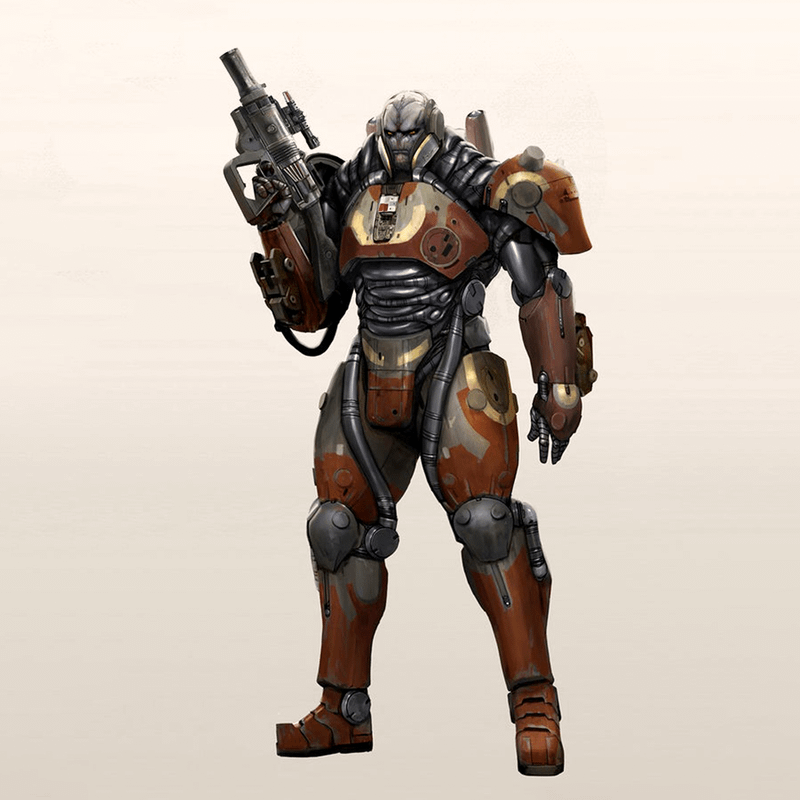
His mace and extendable flail provide exceptional striking range. A large blaster and missile launchers allow him to control space when Cal is too far away to trade blows. These are not just different attack types: they place opponents under pressure at nearly any distance, reinforcing the image of a warrior whose equipment is built around remaining dangerous after the first injury.
Lightsabers in Raider possession carry a different significance. Weapons taken from Jedi opponents act as trophies, rewards, and signs of Rayvis's ability to defeat prestigious enemies. They acquire a new social role when distributed to lieutenants. Their physical form remains recognizable, but their relation to the Jedi Order is transformed.
14 / IDS ANTHROPOLOGY
Honor, debt, longevity, and political responsibility
Rayvis presents a fictional example of an honor system that makes a defeated warrior indebted to a victor. The obligation is meaningful to the participant because it expresses public recognition of competence and provides a stable rule for conduct. That rule is not identical to a legal contract or membership in a formal state. Dagan earns loyalty through a duel, and Rayvis preserves that relationship over changes that would make most human political obligations difficult to maintain.
His imprisonment exposes the limits of interpreting a shared event through one moral vocabulary. Rayvis considers survival in confinement degrading because he was denied a warrior's death. The Jedi decision to spare an incapacitated opponent can instead be read as restraint. These incompatible understandings explain his bitterness, but they do not establish that the Jedi had an obligation to kill him.
Longevity changes how institutions look to him. He remembers the High Republic and lives into the Empire, so public authority appears changeable beside his personal commitment. That perspective makes him interesting as a historian of violence. He has direct experience of people and institutions that Cal knows through ruins. However, lived memory does not guarantee that his interpretation of those institutions is accurate or just.
The Bedlam Raiders complicate the appeal of personal honor. A promise made by one individual leads to an armed organization threatening residents, stealing equipment, and seeking to control routes to Tanalorr. Other people bear the costs of an obligation they never endorsed. Rayvis's commitment can be sincere and internally consistent while producing consequences that cannot be justified solely by reference to his code.
Finally, his character demonstrates why species descriptions should not substitute for individual biography. The Gen'Dai are nomadic and physically resilient; Rayvis is specifically a warrior, prison survivor, raider commander, and personal servant of Dagan. The two levels of analysis are related but not interchangeable. The biological facts help explain what Rayvis can survive. His actions and relationships explain what he chooses to do.
15 / INTERACTIVE HISTORY
A promise carried across centuries
Choose a stage to separate the events of Rayvis's life from the changes in the political order around him. Dates for early encounters are not supplied precisely in the game.
Defeated by Dagan Gera
Rayvis loses a duel, and his honor code establishes a debt to the victor. Their alliance precedes Dagan's fall over Tanalorr.
16 / INTERACTIVE ANTHROPOLOGY
What does the code require?
Select a claim and consider whose interests it protects. These short analyses discuss the game's events; they do not create alternate Canon dialogue or outcomes.
A debt makes sense to its bearer
Rayvis believes Dagan earned his service through combat. That explains his loyalty but does not make every order of Dagan's morally defensible.
17 / INTERACTIVE BOSS DOSSIER
Fight Rayvis on the Shattered Moon
Choose the phase or recovery route for a practical recap. These are gameplay suggestions, not guarantees of success at every difficulty or character build.
Watch the mace and manage range
Parry ordinary swings when you recognize them, evade red-glowing unblockable attacks, and avoid committing to long combos. The mace can extend like a flail. Expect blaster and missile attacks when separated.
Red attack glow
Do not attempt to block an unblockable blow. Step clear of the reach before starting a counterattack.
Short punish, reset
Use a brief opening after an attack sequence instead of trying to continue pressure through his next combo.
Prepare for two health bars
The second phase restores Rayvis's health and increases aggression. Reserve stims for the full fight.
Walkthrough sources: GamesRadar Shattered Moon route and Neoseeker combat breakdown.
18 / COLLECTOR REFERENCE
Collecting this Character
Rayvis first appeared in Star Wars Jedi: Survivor (2023). The licensed game, official promotional art, and published developer artwork offer the strongest verified sources for the character's appearance. Respawn lead concept artist Theo Stylianides has published additional Rayvis design studies that show how the armor restrains the Gen'Dai body.
No officially documented mass-market Rayvis action figure, LEGO minifigure, or named Topps trading card was confirmed for this dossier. Unverified custom figures, fan-made cards, and generic Gen'Dai merchandise should not be presented as licensed character products. Before buying a listing, confirm the figure or card manufacturer, licensing, character name, and product number.
To explore related material, see the IDS games archive and Star Wars card archive. Character art is included for editorial identification, not as an offer to sell or as evidence of a licensed collectible.
19 / SOURCE CRITICISM
Source record and disputed details
Lucasfilm: Star Wars Jedi: Survivor establishes the game and its Canon story. The game's playable scenes, conversations, and tactical records are the primary evidence for Rayvis's duel with Dagan, imprisonment, organization of the Raiders, appearance on Koboh, and final confrontation with Cal.
IGN: Interview with Respawn director Dori Arazi and writer Danny Homan, also excerpted by Jedi News, is evidence for the Gen'Dai design, long-lived perspective, and deliberate connection between warrior conduct and the character's history. Theo Stylianides: Rayvis design portfolio supplies a first-party developer account of the character's anatomy and artwork.
GamesRadar: Shattered Moon walkthrough and Neoseeker: Rayvis encounter document battle sequences and practical combat behavior. The Rayvis entry on Wookieepedia is a secondary index of plot and tactical records, not a replacement for the published game.
Canon boundaries: Rayvis is not Durge. His original birthplace, childhood and precise age are not specified. His imprisonment, release after the Jedi Order's collapse and death during the Shattered Moon battle are established by the game. Interpretations of legal authority, debt, political coercion and honor are IDS analysis, not additional character dialogue or invented history.