
A small-time liar in a dangerous frontier settlement
A life on Koboh
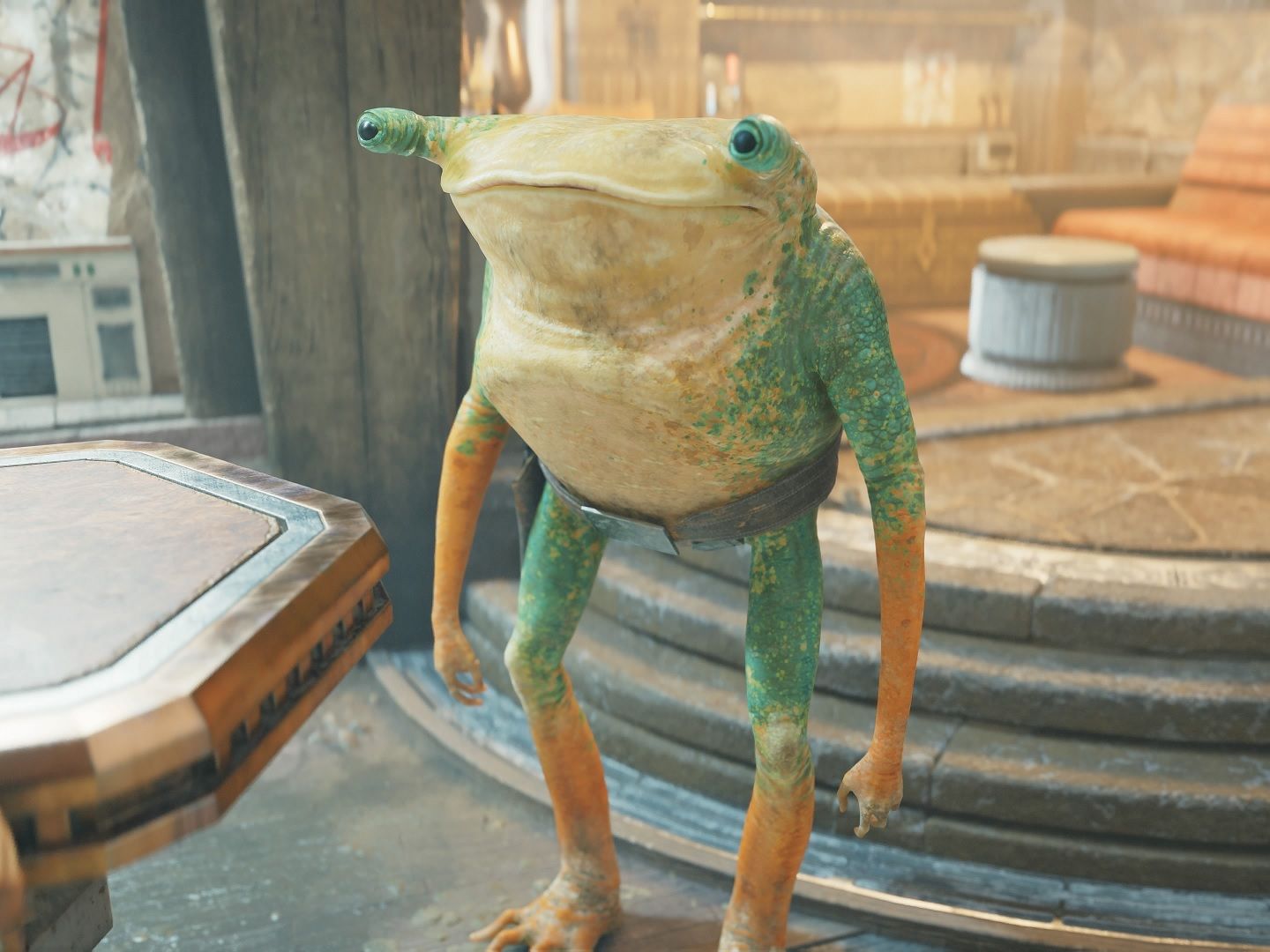
A Lissam-born, frog-like resident of Pyloon's Saloon whose unreliable stories draw the attention of the Bedlam Raiders and the protection of Cal Kestis and Doma Dendra.
The stranger Doma accepted
Turgle came from Lissam and eventually found a place at Rambler's Reach Outpost on Koboh. StarWars.com's official databank describes him as an enthusiastic resident of Pyloon's Saloon who repeatedly gets into trouble. It also says Doma Dendra took him in when he arrived. Those two facts provide the strongest reliable foundation for his identity: he is not simply a randomly generated cantina patron, and his membership in the outpost rests partly on a personal act of welcome.
His frog-like appearance has made him an immediately recognizable figure, but the game's record does not provide a fully established scientific species name. A visual resemblance to a real amphibian cannot substitute for a fictional taxonomic claim. The archive can record his association with Lissam, his current residence and his individual appearance without inventing a species-wide culture.
Turgle likes telling exaggerated stories of his life as an outlaw. Cal Kestis doubts their accuracy, and the dialogue treats his boasts with humor. Yet uncertainty about a person's tales is not the same thing as uncertainty about their existence or right to safety. This distinction becomes important when the Bedlam Raiders arrive.
An artifact that was not what he claimed
When Cal first encounters Rambler's Reach, Rayvis and his Bedlam Raiders have reason to be angry with Turgle. He sold them a purportedly valuable old artifact that turns out to be a fake. Rayvis's interests in the High Republic past and Dagan Gera turn an ordinary fraud into a dangerous dispute. Zeik moves to enforce the raiders' threats with violence.
Cal intervenes and defeats Zeik, protecting Turgle. The confrontation establishes a memorable moral contrast. Turgle may have misrepresented the object, but the gang's response threatens lethal punishment. Recognizing dishonesty does not imply that any retaliation is justified. In a settlement where armed outsiders can choose punishments, ordinary people have little protection from coercion.
The fake artifact also gives the story an archaeological question. Old objects have value because someone believes they are authentic, rare or politically important. The desire to possess them creates opportunities for counterfeiters. For a researcher, authentication requires provenance, material comparison and credible context, not simply a seller's exciting story.

The social life of a cantina
Turgle remains a recurring resident of Pyloon's Saloon. A saloon is a social institution as well as a place to buy food or drinks. Patrons tell stories, look for employment, hear rumors and develop judgments about who is trustworthy. Turgle's repeated presence means players see how a reputation forms through conversation rather than a single mission objective.
His personality can irritate other people. He exaggerates and tries to present himself as more impressive than his recorded actions warrant. That makes him a useful contrast to the grand figures who dominate Star Wars campaigns. Heroes and rulers may be judged by their role in galactic crises; Turgle is judged by whether other locals believe what he says and whether they are willing to tolerate his conduct.
Doma's protection reveals that care can be extended without requiring admiration. A community can insist on greater honesty while refusing to abandon one of its members to an abusive armed group. His story is comic in tone, but the underlying relationship is recognizable: vulnerable people can receive meaningful help from ordinary acquaintances.
A witness to an unfamiliar Jedi
Turgle does not drive the investigation of Tanalorr or command an army. He contributes to the player's understanding of Cal through the opening confrontation on Koboh. Cal's willingness to defend a stranger is visible to the outpost before he has established a long history there. For the residents, the arrival of a Jedi changes the immediate balance of force in a conflict they may not be able to resolve themselves.
The incident also illustrates how the same act is read differently by its participants. Rayvis treats the fake artifact as betrayal, Turgle fears for his life, Cal confronts the threat of excessive violence, and Doma sees a neighbor endangered. A social analysis benefits from holding these viewpoints apart rather than making every character agree on a single explanation.
Later conversations with Turgle continue to supply humor and local perspective, but a dossier should not invent major unpublished quests or promotions for him. His importance comes from the social detail he adds to Koboh and his role in demonstrating that the settlement contains people worth protecting even when they have little military power.
Anthropological assessment: credibility and the right to belong
Turgle's story offers a case study in credibility. Repeated exaggeration reduces how much other people trust a narrator, but disbelief about his life story does not settle every question concerning him. A researcher can verify claims, identify omissions and still record a person's actual social ties. Calling him a liar is not a substitute for tracing when and why a statement was made.
His fabricated artifact also raises a problem common to heritage markets: scarcity and desire can create demand for replicas presented as authentic. The story does not document a real archaeological excavation or a lawful ownership chain. It shows the kind of conflict created when powerful buyers think an object represents access to a valuable past.
The strongest lesson concerns informal membership. Doma took him in, locals know his habits and Cal protects him from the raiders. He belongs to a community through continuing relationships rather than by meeting a standard of honesty or success. This does not remove his responsibility for deception. It explains why consequences should be proportionate and why protection from murder is not a reward reserved for admirable people.
Character chronology
Episodes follow the game's narrative sequence. Where no calendar date exists, none is invented.
Lissam
Comes from his birth world before making a new home on Koboh.
Rambler's Reach
Doma takes Turgle in, and he becomes a familiar saloon patron.
Fake relic
Sells a false artifact to the Bedlam Raiders and angers Rayvis.
Zeik confrontation
Cal intervenes to stop the raiders' threatened punishment.
Pyloon's Saloon
Remains a recurring, sometimes unreliable but socially connected outpost resident.
Community and power
Filter characters by personal community ties, conflicts and plot involvement.
Doma Dendra ↗
Local merchant who took him in when he arrived on Koboh.
STORYCal Kestis ↗
Jedi who intervenes to protect him from the raiders.
POWERRayvis ↗
Leader of the Bedlam Raiders who seeks retaliation for the fake artifact.
COMMUNITYGreez Dritus ↗
Cantina proprietor whose saloon forms the center of Turgle's social life.
POWERZeik ↗
Bedlam Raider veteran ordered to punish Turgle before Cal intervenes.
Anthropological assessment
Select one research framework. These are original site interpretations, not quotations from the game.
Credibility
Test specific statements against evidence, not against an overall impression of a person.
Decision evidence lab
An unreliable seller has provided a counterfeit artifact to an armed group. How should the settlement respond? The answers are interpretive exercises, not literal game dialogue.
Select a response
Review what the story establishes and what remains interpretation.
Are all details directly stated in the game?
No. The sourced events and original IDS social analysis are explicitly separated. Economic or cultural claims beyond the game are framed as questions rather than undisclosed facts.
Do these buttons change a quest?
No. They compare evidence and interpretations within the article.
Collecting this character
In-game screenshots and concept designs are visual references, not evidence of a physical collectible release. Cards, minifigures and figures are only listed when verified. Trading-card photographs come solely from user-provided collection images.
Evidence and sources
- Official StarWars.com Turgle databank ↗
- StarWars.com developer interview featuring Turgle ↗
- Jedi: Survivor story summary ↗
- Turgle species details ↗
- Character screenshot and image provenance ↗
Turgle's frog-like in-game appearance from Jedi: Survivor, illustrated in GamesRadar's character feature. The character image is externally hosted; the source link and text fallback remain if the embed fails.
IDS analysis identifies institutions and social practices visible in the game without treating editorial interpretation as canonical new lore.