

The merchant who holds an outpost together
A life on Koboh
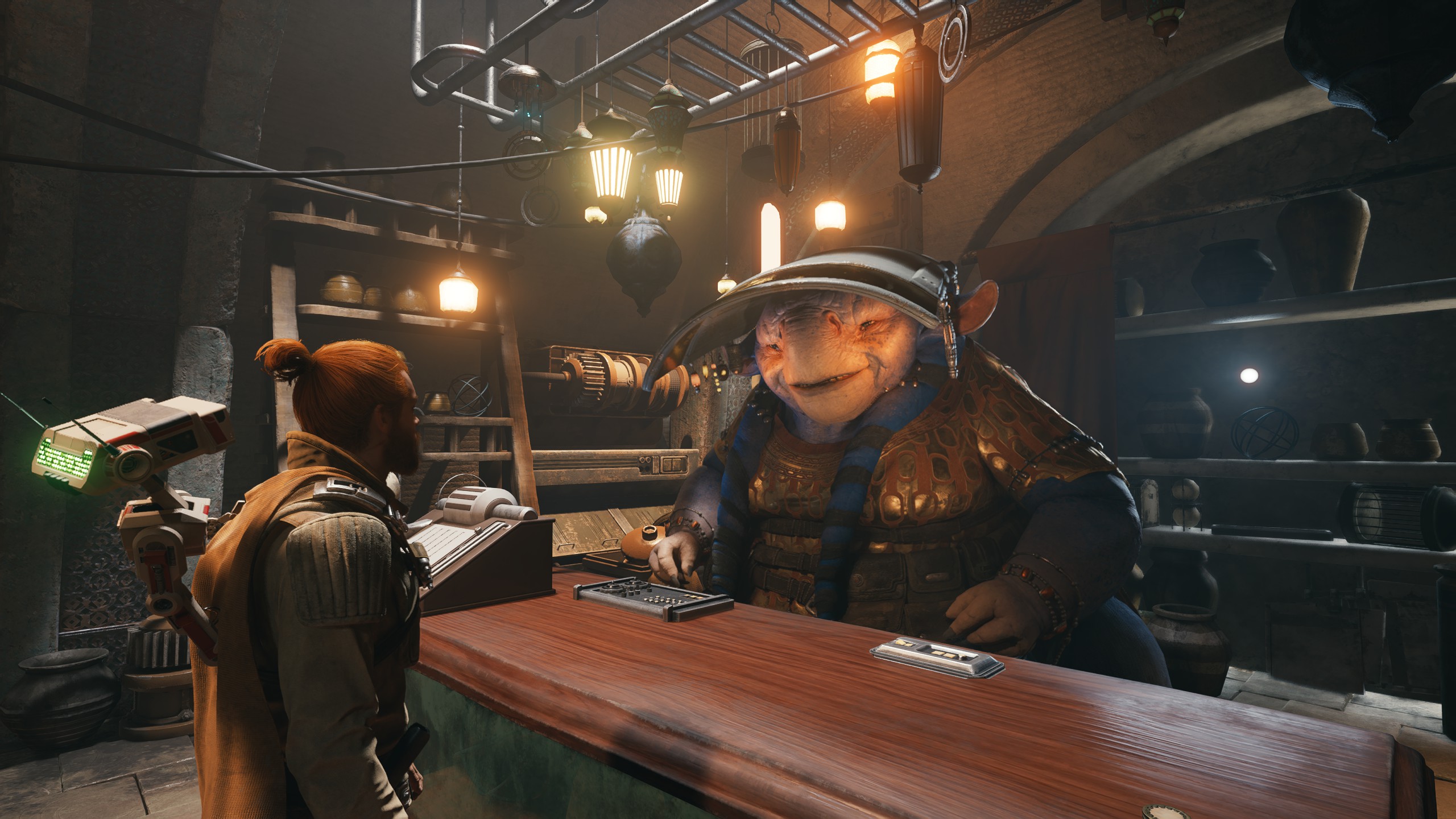
Rambler's Reach unofficial mayor and proprietor of Doma's Outpost Commodities, whose shop and support for vulnerable neighbors anchor civilian life on Koboh.
A shop opposite the cantina
Doma Dendra occupies a central place in Rambler's Reach Outpost, the struggling Koboh settlement near Pyloon's Saloon. She runs Doma's Outpost Commodities, a store that Cal Kestis can enter after reaching the town and confronting its immediate Bedlam Raider trouble. The shop's location is practical and symbolic. Travelers, mechanics, prospectors and residents need supplies, and an accessible merchant helps them participate in settlement life without relying entirely on the authority of outside armed groups.
The game presents her as an unofficial mayor rather than a formally elected planetary executive. That distinction is worth preserving. An influential merchant can exercise real local authority through services, advice and care without possessing a government office. Her role emerges from the community's relationships, not from a document appointing her governor of Koboh.
Her store is also a place the player can return to repeatedly. This makes Doma memorable for reasons unlike the principal plot villains. She does not need to command the Bedlam Raiders or carry a lightsaber to influence how Cal experiences Koboh. A civilian who keeps an institution operating under threat becomes part of the world the story claims is worth protecting.
Turgle and an obligation beyond profit
Official StarWars.com material confirms that Doma took Turgle in after he arrived on Koboh. He was already prone to risky claims and trouble with powerful residents, and Doma gave him a place within the outpost. This establishes a personal relationship that is not reducible to a shop transaction. She can criticize a person's conduct while still accepting an obligation to keep them safe.
When Rayvis and the Bedlam Raiders threaten Turgle over the sale of a fake artifact, the conflict spills into public space. Cal intervenes and defeats the raider Zeik, while the outpost's residents witness what happens when armed outsiders impose punishment. Doma's response demonstrates that her civic standing includes concern for vulnerable members of the community.
Her kindness should not be invented into a complex unrecorded municipal policy. The supported event is specific: she helped a troubled newcomer establish a place in the settlement. An anthropological analysis can ask what that support means for community membership, but it should not claim that she founded a hospital or served as a formal court official without a source.
The economy of Priorite Shards
At Doma's shop, Cal spends Priorite Shards collected during exploration. The merchant sells cosmetic items that change the protagonist's appearance, music tracks and a Mysterious Keycode. The keycode permits access to an additional Stim upgrade in the shop. These are important to players, but the site should distinguish game currency from a canonical statement about Koboh's complete economy.
The shop is a useful reminder that a game's economic design is partly an interface. Players gather shards to purchase a known catalog of rewards. The narrative world contains a larger settlement with needs that are not all captured by one vendor menu. The presence of a single accepted player currency does not prove that every farmer, worker or mechanic on Koboh conducts all trade in Priorite Shards.
Doma's stock also makes material culture visible. Clothing is not merely a numerical reward: it permits players to display identity through outfits, hair and other choices. The music tracks connect consumer purchases to the sound and leisure of the saloon. Even a small in-game store can convey social information when its contents are described accurately.
Commerce under coercion
The Bedlam Raiders' reach creates an insecure environment for Koboh's residents. A business needs customers and predictable movement through the settlement. Raiders who intimidate civilians disrupt more than a single exchange. They affect how people meet, speak openly, recover materials and decide whether a newcomer can safely enter town.
Cal's intervention offers temporary relief, but it does not create a fully documented local government. Doma remains the more consistent everyday source of communal order. Her work continues as the player progresses elsewhere, making her role a contrast to the exceptional acts of a traveling Jedi.
The distinction between military authority and civic influence is central. Rayvis has armed personnel and the ability to threaten immediate punishment. Doma has social standing from repeated transactions and support. Neither category alone settles who is legitimate. The evidence of how each treats residents is necessary to the comparison.
Anthropological assessment: a frontier outpost is a community
Doma's example supports a study of informal governance. Communities do not operate solely through police, courts and appointed officials. People who manage essential services may become important sources of advice and shared expectations. An unofficial leader can establish credibility by repeatedly meeting obligations rather than asserting formal sovereignty.
The relationship with Turgle adds a dimension of social inclusion. A person who annoys neighbors or makes unreliable claims can still be vulnerable to intimidation. Doma's support suggests that membership depends on social decisions rather than an objective test of whether someone deserves to belong. Such support can coexist with criticism of the person's behavior.
Finally, the shop's in-game interface is not the whole culture of Koboh. The merchandise and Priorite Shards are evidence of one visible exchange system. A richer social history would compare the outpost's food supply, prospecting, repair work, trade routes and the threat of the Bedlam Raiders. Doma offers a concrete starting point without pretending that the game supplies a full census or economic history.
Character chronology
Episodes follow the game's narrative sequence. Where no calendar date exists, none is invented.
Rambler's Reach
Establishes her role as proprietor and informal local leader.
Turgle arrives
Offers the troubled newcomer support and a place in the outpost.
Cal reaches Koboh
The Bedlam Raiders threaten Turgle; Cal intervenes.
Outpost Commodities
Cal trades Priorite Shards for cosmetics, music and the Mysterious Keycode.
Continued residence
Doma remains a stable civilian contact while Cal investigates Tanalorr.
Community and power
Filter characters by personal community ties, conflicts and plot involvement.
Turgle ↗
A troublesome friend and newcomer whom Doma took in.
STORYCal Kestis ↗
The Jedi who intervenes when raiders threaten an outpost resident.
COMMUNITYGreez Dritus ↗
Operator of the neighboring saloon that supports community life.
POWERRayvis ↗
The raider leader whose violence threatens the settlement.
COMMUNITYSkoova Stev ↗
The Sakavian fisherman who brings aquatic specimens and maritime stories into Greez's saloon.
POWERZeik ↗
Raider boss at the outpost entrance, a threat to civilian safety.
CREWToa ↗
Twi'lek researcher who brings High Republic history into the saloon.
Anthropological assessment
Select one research framework. These are original site interpretations, not quotations from the game.
Informal authority
Ask how reliable service and trusted relationships can establish leadership outside formal office.
Decision evidence lab
A resident has deceived a dangerous raider. What should an informal community leader prioritize? The answers are interpretive exercises, not literal game dialogue.
Select a response
Review what the story establishes and what remains interpretation.
Are all details directly stated in the game?
No. The sourced events and original IDS social analysis are explicitly separated. Economic or cultural claims beyond the game are framed as questions rather than undisclosed facts.
Do these buttons change a quest?
No. They compare evidence and interpretations within the article.
Collecting this character
In-game screenshots and concept designs are visual references, not evidence of a physical collectible release. Cards, minifigures and figures are only listed when verified. Trading-card photographs come solely from user-provided collection images.
Evidence and sources
- StarWars.com Turgle databank and Doma connection ↗
- GameSpot item and currency guide ↗
- EA official game page ↗
- Doma Dendra developer character presentation ↗
- Character screenshot and image provenance ↗
Doma Dendra at her counter in an in-game Jedi: Survivor screenshot published by The Nerd Stash. The character image is externally hosted; the source link and text fallback remain if the embed fails.
IDS analysis identifies institutions and social practices visible in the game without treating editorial interpretation as canonical new lore.