
FIELD FILE · ALIEN FISHING CULTURES
More than a fish story
Publisher lore, optional in-game testimony, original site analysis and current game mechanics are distinguished throughout. The fish tracker is a convenience for the player and does not write to their game save.
Story, family and work
A fisherman who seems to have an endless supply of stories has a history of maritime labor, promises made across worlds and a working knowledge of species found far from home.
Sakavi Tar: the livelihood behind the legend
Skoova Stev is a Sakavian fisherman from the water-rich, cold world of Sakavi Tar. His often theatrical way of speaking can make his stories sound like pure comic relief, but his history contains serious questions of food supply and labor. The account recorded through his optional conversations in Jedi: Survivor describes a community affected by scarcity and the arrival of outsiders who wanted access to its fisheries. His ambition developed in a setting where aquatic life was not an optional pastime. Fishing was a source of knowledge, food and social obligation.
The official Star Wars Databank identifies him as a master fisherman who once served aboard the Grapnel. Other aspects of his life are reconstructed from conversations the player may hear during the aquarium recruitment activity. These memories are presented through Skoova himself rather than a neutral government archive. An editorial dossier can report what he narrates without treating every dramatic detail as independently corroborated. The storytelling is itself part of his character.
His identity also has to be described accurately. Skoova is a Sakavian, not a Rodian, and his homeworld is Sakavi Tar, not Koboh. A helmet, small frame and amphibious occupational equipment are not sufficient grounds for identifying a fictional species. The official databank and game record provide a better basis for classification than a visual resemblance to a familiar alien.
The Grapnel and the price of an agreement
Skoova's personal account describes an arrangement with a visiting fishing crew: he would help them locate desirable catches away from his home waters, and the crew would avoid taking Sakavi Tar's resources. He later joined their vessel, the Grapnel, and rose to first mate. On one level this resembles a promising maritime career. A capable local worker joins a larger crew, gains access to distant waters and develops specialized expertise. On another, the arrangement placed protection of a vulnerable community in the hands of a captain with interests of his own.
The captain, Wan'yek Whett, is a Besalisk associated with the fishing expedition. Skoova's later recollections describe both interpersonal betrayal and the breaking of the agreement intended to safeguard his homeworld. The details unfold over several conversations rather than in one mandatory cinematics sequence. They should not be collapsed into a single scene the player always watches. This distinction matters because listeners can encounter Skoova's account gradually as they find fish across several planets.
Seen anthropologically, the agreement illustrates the limits of an informal resource-protection pact when there is no trusted authority to enforce it. A crew might promise to avoid a fishery, but neither good faith nor compliance can be assumed simply because someone accepted the terms. The people who depend on a threatened food source carry the consequences of any breach, often without the means to pursue an effective remedy.
Pirates, a purrgil and a changing profession
Skoova's tales describe trouble during his work on the Grapnel, including a dangerous encounter with other seafarers and circumstances that separated him from his crew. StarWars.com's official biography confirms the broad outline: the captain betrayed him, a purrgil saved him, and he eventually made his way toward Koboh. The narrative links fishers, pirates, the sea life of distant worlds and an immense spacefaring animal without turning any of those things into proof that the fisherman commands supernatural powers.
The purrgil episode is particularly revealing as a storytelling device. A being normally associated with vast distances and interstellar migration becomes the means by which a small worker survives a crisis. A narrow account of galactic history, focused only on Jedi and major military fleets, could overlook both the working crew and the ecological relationship that alters its survivor's fortunes. Skoova's recollection lets the game imagine mobility through something other than state transport or commercial starships.
His eventual settlement on Koboh does not mean his earlier life is irrelevant. He arrives with a history of danger, trade, dispute and adaptation. Much of his speech places the present catch alongside recollections of his past. Fishing can therefore be understood as a technical practice, a livelihood and a method of organizing memory.
Meeting Cal Kestis at Foothill Falls
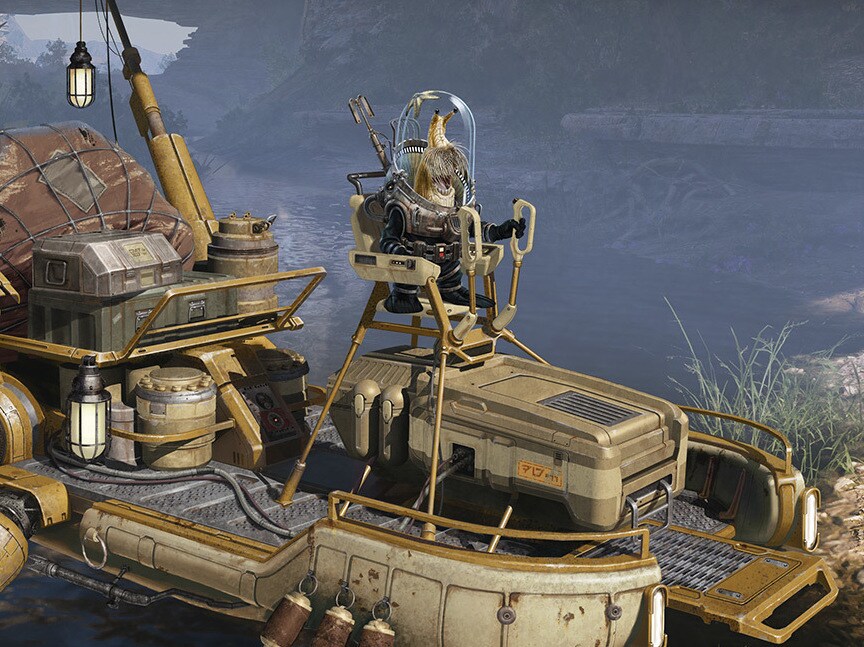
Players first recruit Skoova at Foothill Falls on Koboh, where his distinctive fishing skiff sits near water and a route through the surrounding cliffs. He can be recruited relatively early, after access to that part of the world opens. Guides differ on the earliest chapter at which a player may encounter him because optional exploration and the main route do not always proceed in the same order. It is safer to describe the location and prerequisite access rather than claim that everyone meets him in an identical mission.
Cal asks Skoova to tend the aquarium at Pyloon's Saloon. Skoova initially resists the request with his characteristically extravagant manner but eventually accepts. He then becomes another resident recruited into the settlement's network: Doma operates the shop, Greez maintains the cantina, and Skoova contributes skills that transform a neglected tank into a collection of aquatic species. His task is a distinct optional activity, not a secret main-story route to Tanalorr.
Players do not themselves deploy a fishing rod or fight aquatic creatures to acquire these entries. When Cal finds Skoova at a fishing location and speaks with him, Skoova dives in and catches the specimen. The system recognizes his expertise as the relevant activity while the player supplies exploration and access to locations. That is a meaningful difference between performing work and creating the conditions for someone else's work.
Twelve fish, two planets and a shared aquarium
The aquarium activity includes twelve distinct catches spread across Koboh and Jedha. Each species is associated with a specific environment, from the relatively approachable pond at Foothill Falls to deeper caverns, marshes and locations that require later traversal abilities. Completing all twelve unlocks the Skoova Diving trophy or achievement. An aquarium in a cantina thus gives players a different way to move through the environment than following the next armed antagonist.
The fish are not mere visual decorations in an anthropological reading. Their distribution shows that the game world contains habitats with different conditions and access constraints. Bringing specimens to a central tank raises questions about capture, transport and display, even though the game itself does not provide a detailed fictional conservation code. One should not assume that any real-world aquarium practice is endorsed by the game's simplified collectible system.
Skoova also contributes episodic stories as his collection expands. Conversation, habitat and collecting are designed to reinforce one another. A player who wants to learn his history must spend time with him rather than merely complete a single dialogue prompt. That design makes him an unusual quest giver: the reward is partly a visible aquarium, partly an achievement and partly a slowly assembled personal account.
Anthropological assessment: fisheries, oral history and community labor
Skoova's story offers three research questions. First, who has a recognized right to use a food resource? His account of Sakavi Tar places outsiders, local people and negotiated restrictions in conflict. A promise made between individual fishers may not protect a wider community if no enforceable agreement exists. The significance of this conflict does not depend on inventing a formal treaty or a galactic court case the game never describes.
Second, what kinds of testimony count as historical evidence? Skoova tells highly stylized tales full of vivid events. Those details are part of the game's available record, but his role as narrator should remain visible. A researcher would compare his account with other participants, physical records and the ecological conditions he describes if such evidence were available. Where independent sources are absent, recording that limit is more accurate than rejecting everything he says or treating everything as proven.
Third, what makes a person valuable to a settlement? Skoova has no command over Koboh's armed factions. His expertise and recurring labor nevertheless change a shared civic place. A functioning aquarium gives visitors a reason to return, speak and pay attention to environments beyond the saloon. Skoova's involvement is a small example of an institution built from many practical roles rather than one heroic leader.

Chronology of a fisherman
The story emerges through dialogue, not a full set of dated records. The phases below avoid false precision.
Sakavi Tar
Learns fishing within a community dependent on its aquatic resources.
Negotiation
Joins a visiting crew under a reported agreement to protect Sakavi Tar's fisheries.
The Grapnel
Works aboard Wan'yek Whett's vessel and eventually becomes its first mate.
Betrayal and rescue
Parts from his captain after a crisis; the official databank describes a purrgil rescue.
Foothill Falls
Meets Cal Kestis on Koboh and can be recruited to tend Pyloon's Saloon's aquarium.
Koboh and Jedha
Collects twelve aquatic species, sharing more of his personal history along the way.
Completed aquarium
A full collection unlocks Skoova Diving and displays the gathered specimens at the saloon.
Community and relationships
Cal Kestis ↗
Invites Skoova to operate the aquarium and meets him at fishing locations.
CREWGreez Dritus ↗
Owns the cantina where Skoova works, giving the community a shared gathering space.
CREWTurgle ↗
Another civilian character whose presence makes Rambler's Reach more than a mission hub.
CREWDoma Dendra ↗
Merchant and informal leader whose trading role complements the saloon workers.
STORYZee (ZN-A4) ↗
A different kind of specialist whose work turns recovered objects into usable upgrades.
Wan'yek Whett is an important figure in Skoova's oral history, but no standalone dossier is linked until one exists.
Anthropological assessment
The fisher's labor and stories make Koboh's social world visible beyond its military conflict. Explore which claims come from the primary record and which are original IDS questions.
Resource control. Skoova's arrangement with a visiting crew raises questions about extraction, scarcity and enforcement. The game offers a narrative account, not a documented fishery law. Understanding the difference between a promise, a right and a remedy is part of interpreting his history.
Oral history. His speech, exaggerations and chronology are not obstacles that disqualify him as a witness. They are features of a situated narrative. A careful account asks what his testimony records, why he tells it and what cannot be corroborated.
Labor and belonging. Tending the aquarium is a modest skill compared with the supernatural powers of the Jedi. Yet the saloon depends on such ongoing work to become a livable place rather than a mere checkpoint between battles.
INTERACTIVE PLAYER REFERENCE
Find every fish. Fill the aquarium.
Check off each species as Skoova catches it. The counter updates immediately. This page does not save progress between visits or change your game. Unlocking all twelve in the game awards Skoova Diving.
The same fish may be spelled differently in some guides (for example, Fantailed/Faintailed Laa). These labels follow the documented in-game collection. Full location walkthrough with navigation details ↗
Decision evidence lab
A fishing ship offers to take a worker on board in exchange for leaving their home fishery untouched. Which response most responsibly evaluates this agreement? Choose a frame; these are original analytical responses, not Jedi: Survivor dialogue options.
Choose an interpretation
Compare resource rights, personal testimony and institutional power.
Does this article treat Skoova's entire story as verified history?
No. The official databank confirms his vessel, his rise to first mate, betrayal, purrgil rescue and friendship with Cal. Many additional details appear in Skoova's optional personal account and are attributed accordingly.
Is Skoova a Rodian?
No. The game reference material identifies him as a Sakavian from Sakavi Tar. The visual resemblance to other aliens is not enough to change his species.
Can I reach all fish when I first recruit him?
No. Several locations are gated behind traversal abilities or story access. Finishing the campaign first is a practical option.
Collecting this character
The official Lucasfilm databank illustration and in-game snapshots document Skoova's appearance, skiff, equipment and aquarium work. No commercial card, LEGO minifigure or action figure is claimed without a verified release. Trading-card photographs are displayed only when supplied by the collection owner. The game's 12-fish checklist represents gameplay achievements, not physical merchandise.
References and source limits
- Official StarWars.com Skoova Stev databank ↗
- PowerPyx: twelve fish and location list ↗
- Neoseeker: fishing side quest and encounters ↗
- Skoova's narrated backstory: Wookieepedia references ↗
- Developer game page ↗
- Skoova databank image and profile screenshot ↗
Official material establishes the central biography. The narrated backstory is treated as Skoova's account; site-original anthropological interpretation is distinguished from Canon facts. The fish guide reflects documented game mechanics, not a biological inventory of a real ecosystem. © Lucasfilm visual rights remain with their respective owners.