
ORIGINAL IDS RESEARCH · MAIN STORY / CULTURAL LORE
The Raiders' first public enforcer
Documented gameplay, historical source material and original anthropological analysis are separated, with evidence limits noted.
Life, events and institutions
An enforcer of Rayvis turns a dispute over Turgle's counterfeit artifact into the first boss fight outside Pyloon's Saloon, exposing how the Bedlam Raiders impose power on civilians.
The confrontation outside the saloon
Zeik enters the narrative at a location Cal Kestis has come to regard as a place of safety. Cal travels toward Pyloon's Saloon to reunite with Greez Dritus, only to find the settlement's ordinary entrance occupied by armed Bedlam Raiders. The presence of Zeik and his commander Rayvis makes the outpost's political condition immediately visible. Armed visitors can seize public space, question residents and attempt to impose lethal punishment without any independent court appearing in the scene.
Unlike a generic Raider encountered during exploration, Zeik is named on the boss health bar and is attached to a specific order. His significance derives from the chain of command, not a secret personal ancestry. The game does not provide a reliable birth world, family biography or named species for him. Supplying those details would create a false impression of knowledge.
His prominence early in the game is deliberate. Zeik provides an identifiable face to the Raiders at the moment Cal learns that the group controls more than remote camps. The fight happens before Cal enters the cantina and helps establish why the settlement values anyone willing to restrain the gang.
Why Turgle became a target
The immediate cause is a counterfeit relic. Turgle has represented an artifact as the object Rayvis needs for his search for Dagan Gera, the long-lost High Republic Jedi. The object turns out not to be authentic. Rayvis reacts by ordering punishment, and Zeik is positioned to carry it out. The fake object's importance is thus not confined to archaeology; claims about its identity expose a civilian to an armed organization's wrath.
Cal intervenes to defend Turgle. That intervention need not imply that Turgle's sale was honest. The conflict is over the use of force and the limits of any legitimate sanction. Rayvis then directs Zeik against the Jedi. The action demonstrates how readily a coercive hierarchy redirects violence from one supposed offender to a person who questions the hierarchy itself.
Toa's curiosity about actual High Republic remains provides a sharp contrast elsewhere in the game. A genuine researcher asks how a relic can be understood through its context. In the conflict with Turgle, an object is assigned value by an interested purchaser and a seller, while a powerful gang assumes the ability to punish disappointment with death.
A fighter built around an energy weapon
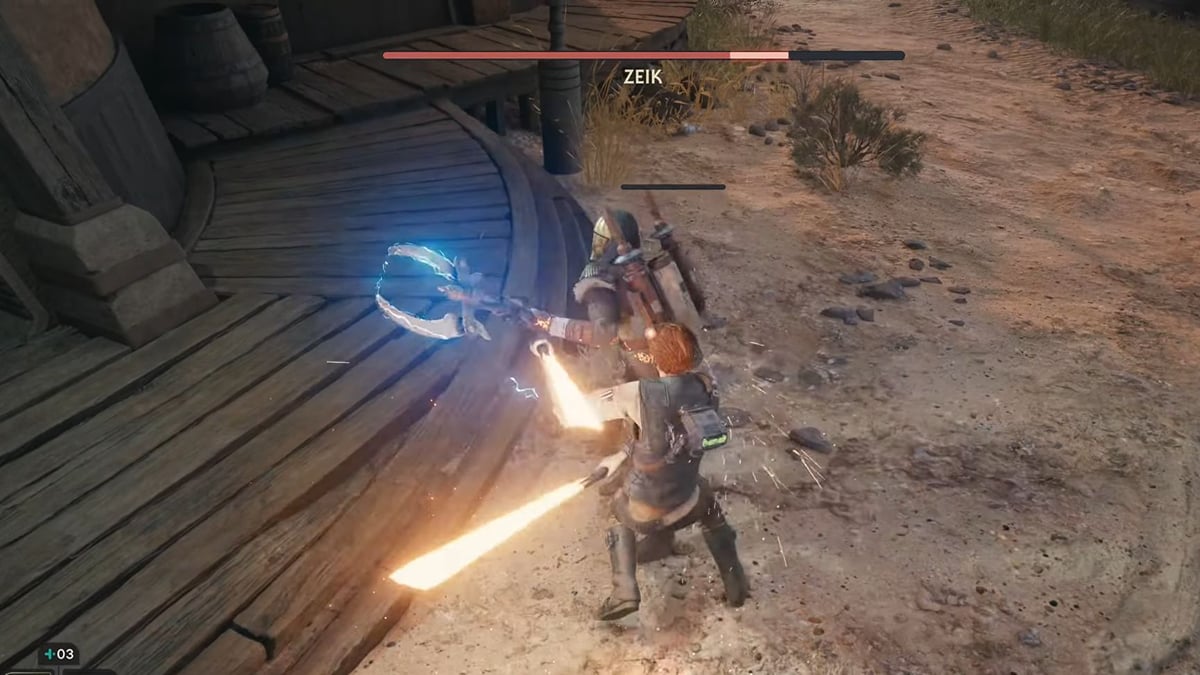
Zeik attacks with a pronged, electrically energized polearm. His style combines quick forward thrusts, lateral attacks and a sudden leaping advance. Published mission guides describe a repeated three-jab combination and a shorter two-hit sequence. Those movements train the player to observe an enemy's opening animation and decide whether to block, parry, reposition or evade.
The weapon is more than an arbitrary special effect. The Bedlam Raiders use specialized melee arms as a visible sign of the organization's equipment and combat practices. Their rank-and-file members are not all technologically identical, and later encounters introduce more heavily equipped fighters. Zeik's place at the beginning of the outpost storyline helps make those later variations legible.
Guides also describe resistance to simple Force Push or Pull solutions. This is a game mechanic, not proof that Zeik has a particular secret supernatural power. A good tactics guide distinguishes a coded combat behavior from the fiction's evidence about the character's training and history.
The boss fight and its end
Many attacks in the fight can be blocked or parried, but the player must watch for moves that cannot safely be met with a conventional guard. Zeik may hop backward before a lunge, shortening the time available for an unprepared response. His combinations can punish someone who attacks before the final swing has finished. This early encounter rewards observation and patience more than arbitrary use of the strongest-looking ability.
Cal defeats and kills Zeik. Rayvis acknowledges the Jedi's skill and withdraws from the immediate confrontation, permitting Cal to enter Pyloon's Saloon. The scene establishes a continuing tension: a military commander can admire a skilled adversary while presiding over an organization that endangers the surrounding civilian community.
Later Bedlam Raiders may use related weapons, but those fighters are not evidence of Zeik's return. His documented story concludes with the fight. The record is better served by a precise chronology than by an invented later Alliance connection or an unsupported survival rumor.
The social power behind the weapon
Zeik occupies the middle of a chain of command. Rayvis chooses whom to punish, while Zeik has the equipment and skill to make a command threatening. The outpost's residents witness the result. In social terms, enforcement is a form of labor performed for someone else, and that labor can make the employer's will appear to be an unavoidable feature of the surrounding landscape.
Rayvis's wider quest for Dagan Gera reaches back to a different era. Zeik serves the present organization without necessarily possessing the leader's extraordinary lifespan or knowledge of every historical detail. It is not safe to assign to Zeik the High Republic biography that belongs to his commander.
Local trade becomes difficult when conflict with an influential buyer can lead to violence. Civilians may withhold information, avoid gatherings or accept unfair demands. Even one public act of intimidation can reveal what sort of future conduct people expect from an organization.
Anthropological assessment: violence as a claim to jurisdiction
The key issue in Zeik's case is jurisdiction: who gets to declare a violation and impose a penalty. A military group can possess the practical capacity to act without possessing legitimate authority. The game contrasts a Raider leader's command with a Jedi's refusal to accept execution as a proportionate answer to a disputed sale.
The scene also warns against describing the community only in terms of heroes and villains. Turgle makes an unreliable claim about an artifact, yet the absence of perfect honesty does not remove his right to protection from arbitrary killing. Zeik is dangerous because of his role in a coercive institution and his own actions, not because of an invented biological explanation.
An honest archive leaves some questions open. We can analyze his boss fight, equipment, command relationship and death. We cannot independently reconstruct his childhood, personal motives or species. The limitation is evidence of the site's editorial boundary, not a deficiency to conceal with generic filler.

Story chronology
Before Cal
Serves as a veteran Bedlam Raider under Rayvis.
False relic
Rayvis discovers that Turgle has sold a counterfeit object.
Outpost threat
Zeik is chosen to execute the threatened punishment.
Jedi intervention
Cal Kestis protects Turgle and is challenged by Zeik.
Boss battle
Cal fights Zeik outside Pyloon's Saloon.
Aftermath
Zeik dies and Rayvis withdraws, permitting Cal to enter.
Connected characters
Rayvis ↗
The Raider leader who orders Zeik to fight.
STORYTurgle ↗
The civilian targeted after a false relic sale.
STORYCal Kestis ↗
The Jedi who intervenes and defeats Zeik.
CREWDoma Dendra ↗
Outpost merchant and social leader.
CREWGreez Dritus ↗
The cantina owner Cal is trying to reach.
POWERUrgost, Fist of Rayvis ↗
A fellow named Raider boss personally trained by Rayvis to use his electrohammer.
Anthropological assessment
Coercive groups may claim authority to enforce judgments even when their threats lack the legitimacy of a judicial process; Zeik's assignment makes that conflict visible.
The game supplies scenes and material practices rather than a complete ethnography. Where a birth world, cultural trait, personal motive or institutional rule is undocumented, this account does not invent one. A reader can examine the choices of a character without generalizing them into the biological nature of an entire alien species.
REQUIRED EARLY-GAME BOSS
How to defeat Zeik
Approach Pyloon's Saloon on your first journey to Greez. Zeik attacks after the dispute involving Rayvis and Turgle. He provides an opportunity to learn basic melee timing before meeting stronger Raider opponents.
Watch the full thrust sequence and defend through the final hit before punishing recovery.
His lateral attacks cover space close to Cal. Parry deliberate beats instead of attacking blindly.
A quick retreat can precede a forward leap. Be prepared to dodge and reposition.
Some moves are unblockable. Respond with movement rather than treating all blows as parryable.
Common errors
Why isn't Force Pull working?
Walkthroughs report resistance to the usual Force displacement effects. Prioritize defensive timing, movement and safe openings.
Do later Raiders mean Zeik comes back?
No. The named character dies in the first encounter. Later fights feature other Raider veterans with some related equipment.
Interactive evidence lab
How should Cal respond to Zeik's melee weapon? Select an interpretation; these buttons do not alter the game.
Select an approach
See an evidence-based explanation.
What is known, and what is interpretation?
Character appearances, quest information and encounters come from the cited game material. Discussion of labor, archaeology or jurisdiction is the site's original anthropological reading.
Collecting this character
In-game images and reference artwork do not establish a physical collectible release. No specific Topps card, LEGO figure or commercial product is claimed without publisher evidence. Character trading-card photographs appear only when supplied by the collection owner.
Sources and verification
- Neoseeker: first Pyloon's Saloon boss ↗
- GamesRadar: Zeik's original boss encounter ↗
- GamePressure: Zeik combat guide ↗
- Zeik character entry ↗
- Hero image source ↗
- Secondary in-game image source ↗
Biographical interpretation is marked where not directly stated in gameplay. The portrait and scene are externally hosted character-specific visuals and display a named fallback if images are unavailable.