
ORIGINAL IDS RESEARCH · MAIN STORY / CULTURAL LORE
Reading the Jedi's lost architecture
Documented gameplay, historical source material and original anthropological analysis are separated, with evidence limits noted.
Life, events and institutions
A civilian Twi'lek researcher in the Basalt Rift helps Cal Kestis discover surviving High Republic Jedi Chambers and introduces a different way of knowing Koboh's past.
The researcher in the forest
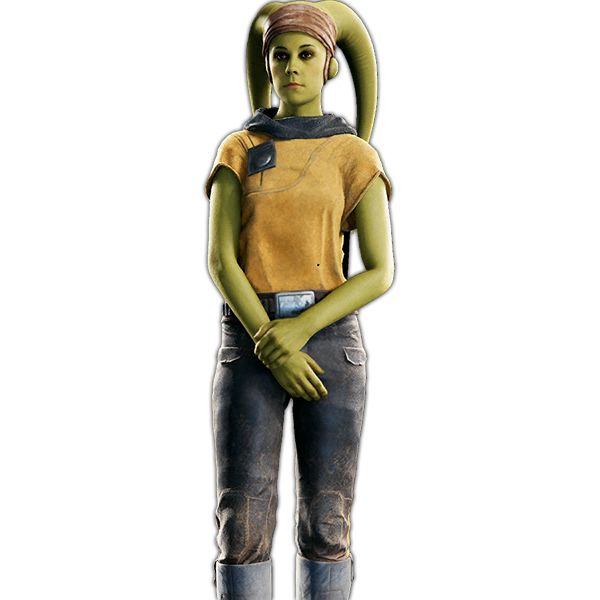
Toa is a green-skinned Twi'lek researcher whom Cal meets during his journey through the Basalt Rift on Koboh. Her work concerns the traces of the High Republic that survive beneath the planet's more recent settlements and raider strongholds. She belongs to the galaxy's civilian scholarly world, not to a hidden Jedi combat order. The usefulness of her knowledge lies in identifying a place that deserves investigation.
Koboh's landscape offers an unusually complicated archaeological setting. Prospectors work among ruins; pirates and Bedlam Raiders compete for equipment; the Empire expands its interests; and some ancient devices remain operational. Toa sees the continuity between these physical traces and a period of Republic history that current residents cannot observe directly.
Her appearance and species identity are documented through the game. Her precise education, birthworld and private household history are not established by the sources used for this dossier. An account of her archaeological role should not manufacture those details simply because she has an interesting profession.
The Chamber of Reason rumor
Toa's most immediate contribution to the player is the Rumor titled 'Explore the High Republic Chamber in the Forest.' Cal can meet her on the mainline route through the Basalt Rift, and she points toward the Chamber of Reason. The task is optional in the sense that it is not part of the final campaign's compulsory route, but it is important to understanding the ancient Jedi architecture scattered around the planet.
The approach involves crossing toward an opening in the forest using a suspended rope. Inside, the player manipulates large orbs and their couplers to form energy bridges and pass through a sequence of designed spatial problems. The puzzle is a representation of past Jedi training, and it also serves a practical gameplay role by awarding an upgrade.
Toa herself does not become a controllable party member who enters the chamber alongside Cal. Her knowledge identifies the place, while the Jedi's traversal and Force abilities make it accessible. The collaboration is therefore asymmetrical but meaningful: one participant supplies research context and another handles the physical obstacle.
A home among the outpost's civilians
Toa can subsequently be recruited to spend time at Pyloon's Saloon, where she continues offering information about Jedi Chambers. The saloon functions as more than a mission menu. Different people contribute different kinds of expertise: Doma sells useful goods nearby, Skoova maintains the aquarium, Zee trades historic Datadiscs, and Toa offers leads about old institutions.
Cal's encounters with these civilians make the frontier settlement more than a site between boss fights. Toa's work sends him back into areas that might otherwise be dismissed as empty rock or dangerous terrain. It also gives him a reason to compare living explanations with inscriptions, mechanisms and the surviving rooms themselves.
Her position in the saloon does not transform her into the proprietor, the city's mayor or the commander of the expedition. She retains the role of a civilian researcher whom a visitor can consult at different stages of exploration.
Zee and testimony from a vanished age
Toa becomes interested in ZN-A4, better known as Zee, the service droid who worked with Jedi Master Santari Khri during the High Republic period. The relationship is exceptional because Zee is a surviving witness, not a modern recording of an ancient event. Her memories give researchers access to descriptions of people and projects otherwise known through fragments.
Compiled game dialogue describes Toa's enthusiasm for Zee and her broader concern when the droid is endangered. She is interested in historical knowledge, but the risk to a functioning individual machine also carries emotional meaning. The available record does not suggest that she would be indifferent to a person or droid simply because it could no longer produce useful data.
A knowledgeable witness is not a complete historical archive. Zee's experiences were shaped by particular locations, duties and associates. Toa's larger project therefore requires evaluating testimony alongside material remains, comparing accounts and naming uncertainties rather than treating every statement of the droid as universally authoritative.
Seven Jedi Chambers across Koboh
The High Republic left seven Jedi Chambers represented in Jedi: Survivor. The Chamber of Duality is part of the main story and introduces Zee. The others are optional tests: Reason, Clarity, Detachment, Fortitude, Connection and Ambidexterity. They lie in different subregions of Koboh, and several require movement or BD-1 abilities gained only after the player has advanced further in the game.
Completing all seven contributes to the Star Tours achievement or trophy and permits an additional map-upgrade interaction at the Alignment Control Center. The upgrade reveals remaining Essences, including perks, skill points and perk slots. These are current-game reward systems, not evidence that the historical Jedi built the chambers for an identical modern scoreboard.
Toa's dialogue is a useful invitation to examine this network, but she is not shown personally excavating every chamber. The checklist included below is a site-produced play aid based on named game locations and walkthroughs. It must not be confused with a canonical diary written by Toa.
Archaeology while the Empire expands
Toa's interest in High Republic achievements appears during a period when the Jedi are persecuted and Imperial control is spreading. The past is therefore politically sensitive. The same architecture that demonstrates a period of Jedi support and confidence can also become valuable to armed actors seeking routes, weapons or a claim to authority.
The story surrounding Dagan Gera complicates any idyllic picture of that historical period. Jedi institutions designed remarkable technologies and also made decisions that later people would contest. Toa can admire their aspirations without possessing enough information to judge every action taken by their members.
Recovering an ancient device or reactivating a training room is not a neutral gesture when contemporary groups compete for powerful technology. A researcher has to consider stewardship, provenance, access and the interests of people who inhabit the surrounding landscape.
Anthropological assessment: ruins as institutional evidence
Toa's life offers a way to interpret the Jedi Chambers as institutional architecture. Rather than treating each room as a disconnected puzzle, the researcher can ask who designed the network, what competencies it rewarded and how its lessons were transmitted among Jedi students. The architecture itself acts as evidence of training practice.
A second theme is the uneven distribution of access. Toa can identify a site yet cannot complete every traversal challenge herself. Cal can physically reach the room yet depends on others to identify its historical significance. Working knowledge, political authority and specialized physical ability belong to different people.
Finally, the researcher must confront the limits of an archive. Zee's statements, ruins, maps and game quests each offer a partial perspective. A careful dossier distinguishes those forms of evidence instead of replacing uncertainty with a romantic story in which all High Republic decisions are assumed correct.

Story chronology
Early fieldwork
Investigates High Republic structures on Koboh.
Basalt Rift
Meets Cal and identifies the Chamber of Reason.
First Rumor
Cal receives the request to explore the chamber in the forest.
Pyloon's Saloon
Toa becomes a recurring civilian research contact.
Zee
Shows interest in the historical droid and the material she can recall.
Other chambers
Points players toward further High Republic discoveries as exploration proceeds.
Connected characters
Zee (ZN-A4) ↗
A working droid who remembers the High Republic firsthand.
STORYCal Kestis ↗
The Jedi who undertakes the chamber explorations.
CREWDoma Dendra ↗
A fellow Koboh civilian who sustains settlement life.
CREWSkoova Stev ↗
Another recruitable specialist sharing the saloon.
CREWGreez Dritus ↗
Owner of Pyloon's Saloon, Toa's later meeting place.
Anthropological assessment
Archaeology depends on preserving context and comparing testimony with material evidence; Toa's work gives Cal a social path into ancient spaces.
The game supplies scenes and material practices rather than a complete ethnography. Where a birth world, cultural trait, personal motive or institutional rule is undocumented, this account does not invent one. A reader can examine the choices of a character without generalizing them into the biological nature of an entire alien species.
INTERACTIVE PLAYER GUIDE
All seven Jedi Chambers
Check off the chambers Cal completes. This in-page counter resets when you leave, and does not affect saved progress in the game. One chamber is compulsory; six are optional.
Toa's first rumor
Find Toa on the Basalt Rift route and ask about the High Republic chamber in the forest. The Chamber of Reason lies beyond a rope-swing crossing. Return to the saloon later to ask her about other chambers.
What does completing all seven unlock?
The Star Tours achievement and an upgrade interaction at the Alignment Control Center that displays remaining Essences on the holomap.
Why is one of the rooms inaccessible?
Some chambers require story-acquired movement, Force or BD-1 abilities. Return when you have unlocked the appropriate traversal skill.
Interactive evidence lab
Which method would produce the most responsible interpretation of the old Jedi chambers? Select an interpretation; these buttons do not alter the game.
Select an approach
See an evidence-based explanation.
What is known, and what is interpretation?
Character appearances, quest information and encounters come from the cited game material. Discussion of labor, archaeology or jurisdiction is the site's original anthropological reading.
Collecting this character
In-game images and reference artwork do not establish a physical collectible release. No specific Topps card, LEGO figure or commercial product is claimed without publisher evidence. Character trading-card photographs appear only when supplied by the collection owner.
Sources and verification
- Push Square: Toa's chamber Rumor ↗
- PowerPyx: all seven chamber locations ↗
- Neoseeker: Toa and Zee at Pyloon's Saloon ↗
- Vulkk: access requirements for all chambers ↗
- Game-Maps: Toa's image and recruitment location ↗
- Wookieepedia: Toa dialogue and background ↗
- Hero image source ↗
- Secondary in-game image source ↗
Biographical interpretation is marked where not directly stated in gameplay. The portrait and scene are externally hosted character-specific visuals and display a named fallback if images are unavailable.