
Longform Smuggler companion dossier
Bowdaar: The full story
Original class-story details and later expansion developments may be spoilers. Editorial exercises are not in-game dialogue. Companion relationships and some outcomes vary by player choices.
Biography and institutions
A Wookiee survivor of 108 years of enslavement whose arena victories enriched his captors, and whose release brings him into a crew where freedom and honor matter.
A century without ownership of his own life
The official Holonet records that Bowdaar spent 108 years in slavery. He was captured as a child and made to fight in arenas across the galaxy, moving between corrupt owners who treated his survival and combat skill as a source of income.
The span of his captivity is a central social fact, not simply an impressive statistic. Each sale transferred control of his movements and labor to another person while denying him the right to decide whether he would fight. His Wookiee identity was used as part of an arena spectacle controlled by outsiders.
Ten thousand victories with no personal fortune
The Holonet credits Bowdaar with ten thousand undefeated arena death matches and nicknames including the Killer from Kashyyyk and Boneshatterer. His victories against rancors, gundarks, Mandalorians and even a Jedi made him an exceptional combatant.
Spectators and owners earned or lost large sums through wagering, but Bowdaar received none of the wealth generated by his labor. A name advertised in an arena can therefore be famous while the individual who carries it remains economically powerless. Reputation is not identical to autonomy.
A moral code learned against the institution
The original Holonet lists Bowdaar's preferences for honorable combat, protection of weak people and opposition to slavery. These beliefs take on particular significance because his own occupational reputation was created through coercion.
A person compelled to fight for others' profit may still develop independent standards about violence. Bowdaar's sense of worth is not defined entirely by his masters. His refusal to endorse exploitation complicates the industry's attempt to reduce him to a dangerous object for gambling.

Nar Shaddaa and the Smuggler's intervention
The Smuggler first encounters Bowdaar during adventures on Nar Shaddaa, a moon where Hutt-associated criminal networks and arena violence place enslaved people within highly visible markets. His eventual place on the XS freighter changes his relationship to work and travel.
The captain's assistance can be important, but Bowdaar should not be written as a person who becomes another individual's property through gratitude. The relationship is meaningful because it can be built on chosen cooperation rather than the coercive ownership that structured his previous life.
Aboard a crew with competing ideas of honor
Corso believes in protecting innocent people but is motivated partly by revenge. Risha guards strategic information and pursues a family inheritance. Akaavi interprets duty through Mandalorian kinship. Guss deflects conflict with scams and jokes. Bowdaar's experience makes freedom an unusually concrete issue in all these disagreements.
The Smuggler may take jobs that involve contraband and profiteering. Bowdaar's dislike of bullying and slavery gives him a perspective from which to challenge the idea that any profitable contract is acceptable. He can be loyal to a captain without endorsing every decision the captain makes.
Eternal Championship and Freedom Fight
On May 3, 2016, SWTOR introduced the Eternal Championship through Game Update 4.4. The official patch notes also announced Freedom Fight, an Alliance Alert in which players can recruit Bowdaar by demonstrating prowess in the championship.
The later arena setting has a deliberate resonance with his earlier captivity. A character who once had to win matches on behalf of owners returns to an organized competition under different political circumstances. Recruitment requirements should be explained in a playable guide rather than assumed to be automatically complete for every character.
What the arenas actually produce
The Holonet's figure of ten thousand victories is usually presented as evidence of extraordinary combat skill. It is also a record of an industry that repeatedly exposed a captive to physical danger for the amusement and financial advantage of others. The operators of the arenas sold spectacle, and wagers allowed people outside the ring to profit from violence they did not have to endure. Bowdaar's labor was central, yet he lacked control over its terms.
His nicknames further transformed a person into a product. A title such as the Killer from Kashyyyk invokes a world and an image that audiences could recognize, but it does not tell them how the person carrying it understood his captivity. Spectators could imagine an invincible monster while overlooking a survivor whose private history involved being bought, sold and separated from ordinary forms of community.
Freedom is more than departure from an arena
Leaving enslavement does not automatically erase its effects. Bowdaar must enter new working relationships after more than a century in which others made decisions about his body and movement. A Smuggler captain who respects his judgment provides a different model of association from an arena owner who purchases his services. The distinction depends on whether Bowdaar may choose to participate and express disagreement.
His opposition to bullying and slavery demonstrates that his moral interests extend beyond winning fights. He is not just concerned with being a powerful fighter himself. He values circumstances in which weaker people can survive without being controlled by the strongest. The Eternal Championship recruitment mission gives players a way to see his arena history in a different context, but it should never be described as proof that the earlier exploitation was acceptable.
Story chronology
Captured and enslaved.
Spends 108 years in captivity, building an unbeaten record.
Encounters the Smuggler and eventually joins the ship.
Reappears in the Eternal Championship setting.
Freedom Fight recruitment introduced with Update 4.4.
Connections and institutions
Corso Riggs
Protector whose frontier code can align with Bowdaar
RELATED DOSSIERRisha
Crew mechanic whose criminal background differs from Bowdaar's experience
RELATED DOSSIERAkaavi Spar
Mandalorian ally who understands cultural honor differently
RELATED DOSSIERGuss Tuno
Former Jedi trainee with another history of contested belonging
Anthropological assessment
Bowdaar's biography demonstrates how forced labor can produce great economic value for owners while preventing workers from retaining its benefits. The distinction between fame and control is central: the arena recognizes his achievements but denies him freedom.
The nicknames imposed on a gladiator create a public persona designed for spectators. Such branding is part of the industry's ability to sell violence while concealing the captive's experiences and personal preferences.
His commitment to protecting weaker people is a response to the power relations he has lived through. It should not be reduced to a species stereotype about Wookiees or to an automatic side effect of physical strength.
Freedom Fight gives the character another relationship with competitive violence. The difference between forced spectacle and a chosen alliance mission changes the moral meaning of a superficially similar activity.
These are original IDS interpretations of fictional communities, not claims about real peoples.
Test an interpretation
These are analytical exercises, not SWTOR dialogue options.
Choose an approach
Select an approach to see its implications.
Evidence checks
How many years was Bowdaar enslaved?
108, according to SWTOR's publisher profile.
Did arena winnings make him wealthy?
No. The Holonet states that others profited from his victories.
Is Bowdaar an optional romance in the original Holonet?
No.
Did Update 4.4 include a Bowdaar Alliance Alert?
Yes. Freedom Fight was announced alongside the Eternal Championship.
Character-specific in-game equipment and alternate companion appearances are historical material culture. No physical collectible or numbered trading card is claimed without verification. Only user-provided trading-card photos are used in IDS collecting sections.
Sources and image credit
- SWTOR Holonet, Bowdaar ↗
- Game Update 4.4: Profit and Plunder ↗
- Bowdaar SWTOR companion database ↗
- Swtorista, Bowdaar appearance ↗
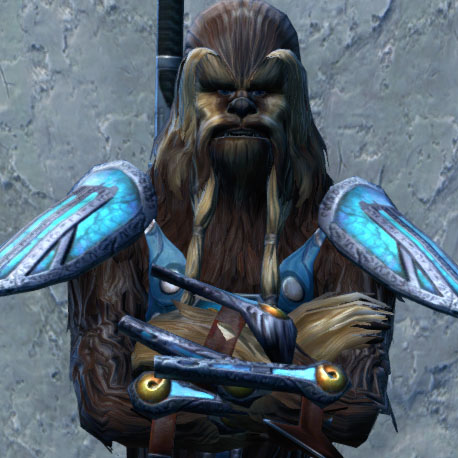
The secondary portrait depicts Bowdaar customization 8, a documented alternate Wookiee appearance with blue armor details.. Original Holonet stat and weapon fields are historical, not current combat recommendations.