
Longform Smuggler companion dossier
Guss Tuno: The full story
Original class-story details and later expansion developments may be spoilers. Editorial exercises are not in-game dialogue. Companion relationships and some outcomes vary by player choices.
Biography and institutions
A Mon Calamari exile who abandoned an uneasy period of Jedi training and survived through comedy, scams and a limited understanding of the Force.
A large family on the ocean world Dac
The official Holonet names Guss Tuno's homeworld as Dac. He grew up within a large Mon Calamari family and was remembered as a prankster whose jokes sometimes produced consequences he did not intend. His tendency toward deception developed before any formal Jedi association.
After he was caught stealing an object belonging to his father, family disapproval contributed to his decision to run away. The event connects economic and moral expectations inside the household to his later identity as a fugitive. His departure should not be treated as a biological explanation for every Mon Calamari's choices.
Nar Shaddaa and an unexpected Master
Guss eventually reached Nar Shaddaa, where Jedi Master Lorenn noticed his weak connection to the Force. Lorenn took him to a nearby Jedi enclave for training, introducing a person accustomed to improvisation and petty scams to a discipline organized around restraint and service.
The Holonet makes clear that Guss did not thrive under those expectations. He felt out of place in the Order and resented being pushed toward a formal role he did not understand or want. His difficult relationship with the institution is different from a classic story of a powerful apprentice corrupted by temptation.
Leaving the Jedi behind
Although Guss disliked his position, the publisher says he did not direct his frustration against Master Lorenn. He left the Order and began a career as a con artist. His partial training became both a memory of an unsuccessful apprenticeship and a source of material useful for misleading people who knew little about Jedi.
Later in-game companion records emphasize that he sometimes used his limited Force knowledge and a lightsaber taken from his old master to bluff dangerous criminals. He often relied on the reputation of the Jedi more than on his own power, exposing how cultural symbols can be exploited when outsiders cannot evaluate expertise.

White Maw pirates and the Smuggler
Guss found employment among the White Maw pirates and eventually became connected to the Smuggler's adventures. His techniques depend upon persuading opponents that he is more powerful or confident than he actually is. This makes him comic, but it also reflects a recurring strategy of survival in dangerous underworld spaces.
The Holonet distinguishes greed and trickery from gratuitous cruelty. He likes collecting credits from wealthy marks but dislikes killing innocent people or risking his life for no reason. His ethical boundaries differ from the Jedi's ideals without turning him into a character who welcomes every form of violence.
A different kind of crew member
Corso knows weapons and interprets disputes through frontier justice. Risha favors careful planning and proprietary knowledge. Akaavi Spar values Mandalorian honor, while Bowdaar rejects the coercive institutions that controlled his life. Guss brings something else: an improvised identity that depends on the audience believing his presentation.
A Smuggler captain can benefit from someone capable of negotiating, bluffing and distracting people, even when that person's stories cannot always be accepted literally. The character serves as a reminder that professional competence includes social reading and improvisation, not only direct combat power.
Shining in the Darkness and a second chance
BioWare's August 11, 2016 press release announced a new Alliance mission focused on recruiting Guss Tuno. The publisher described the Outlander's search as revealing an unlikely Jedi candidate apprenticed to a questionable figure. The game's mission became known as Shining in the Darkness.
The return revisits Guss's earlier problem with Force-user authority rather than erasing it. He has learned to survive through ambiguous status, and a new potential mentor again asks him to negotiate the difference between a claimed identity and actual ability. A current quest guide must specify prerequisites instead of claiming every player receives the alert automatically.
The difference between an emblem and a skill
A lightsaber and the reputation of the Jedi Order can influence how strangers judge a person. Guss's history shows that possession of a recognizable object does not prove mastery of the practices associated with it. A dangerous criminal might be persuaded by a symbol without being able to test the claimant's understanding of the Force, the Jedi Code or formal training. This is why an incomplete apprenticeship can become a resource for someone skilled at bluffing.
The Jedi enclave's norms were much more demanding than the reputation Guss later tried to exploit. Training required sustained practice and service, while an underworld impersonation could succeed through a convincing performance lasting only moments. Comparing those settings demonstrates that professional legitimacy is socially recognized and must be distinguished from the actual ability of the person claiming it.
Leaving one institution and entering another
Guss did not find lasting belonging in his family, his brief Jedi training or his pirate associations. His transitions do not establish that every institution failed for the same reason. Family shame, disagreement with religious instruction and the desire for wealth are separate motives. The character's humor can make this sequence entertaining, but it also carries a continuing question about what a person must change to be accepted.
When the Alliance later searches for him, the possibility of renewed learning emerges alongside his attachment to the underworld. The recruitment story makes a former student's abilities relevant again, but a second chance should not be confused with proof of past achievement. Guss remains a case study in flexible identity: he adapts to new audiences and roles while retaining recognizable tastes, fears and habits.
Story chronology
Raised in a large Mon Calamari family.
Runs away after family conflict.
Meets Jedi Master Lorenn.
Begins and abandons training.
Uses scams and connections with the White Maw pirates.
Joins the captain's crew.
Returns through an announced Alliance recruitment mission.
Connections and institutions
Corso Riggs
Blaster expert who sometimes dislikes Guss's antics
RELATED DOSSIERRisha
Careful planner whose deception has different professional stakes
RELATED DOSSIERBowdaar
Honorable former gladiator whose view of justice differs from Guss
RELATED DOSSIERAkaavi Spar
Mandalorian warrior with stricter expectations of duty
Anthropological assessment
Guss's family history illustrates how a household can regulate membership through expectations and shame. His decision to leave Dac is both a personal action and a change in social standing.
The Jedi enclave represents professional socialization through formal teaching. Guss's failure to settle into that discipline does not necessarily demonstrate moral inferiority; it reveals a poor fit between the institution's expectations and his learned habits.
His scams depend on the difference between a symbol and the skill associated with it. A lightsaber or Jedi title can persuade an observer who lacks the evidence needed to test his claim.
The later Alliance recruitment reconnects his past to a different political organization. His story becomes an inquiry into whether institutions can offer a second opportunity without demanding that every participant have the same kind of talent or temperament.
These are original IDS interpretations of fictional communities, not claims about real peoples.
Test an interpretation
These are analytical exercises, not SWTOR dialogue options.
Choose an approach
Select an approach to see its implications.
Evidence checks
What is Guss Tuno's homeworld?
Dac, according to the SWTOR Holonet.
Who recognized his limited Force ability?
Jedi Master Lorenn.
Did Guss successfully complete Jedi training?
No. He left the Order.
Was an Alliance recruitment announced in August 2016?
Yes. BioWare's August 11, 2016 press release confirms it.
Character-specific in-game equipment and alternate companion appearances are historical material culture. No physical collectible or numbered trading card is claimed without verification. Only user-provided trading-card photos are used in IDS collecting sections.
Sources and image credit
- SWTOR Holonet, Languss Tuno ↗
- BioWare announcement, August 11, 2016 ↗
- Guss Tuno companion and recruitment database ↗
- Swtorista, Plagued Guss cosmetic appearance ↗
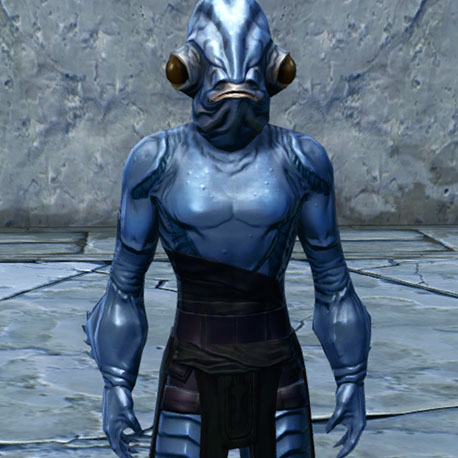
The secondary portrait depicts Plagued Guss, a distinctive optional event cosmetic appearance documented by Swtorista; not the character's default coloration.. Original Holonet stat and weapon fields are historical, not current combat recommendations.