
Drash is one of the young people Boba Fett encounters in Mos Espa after the watermonger Lortha Peel complains that a group of youths has stolen water from him. The confrontation reveals a local economic dispute rather than a simple crime story. Drash and the other Mods say there is little work and that Peel's prices are excessive. Instead of punishing them, Fett reduces what he pays Peel and hires the group into his growing household.
Drash becomes one of the most visible members of the Mods after that recruitment. Her conspicuous cybernetic modifications, dark clothing, weapons, and brightly styled speeder bike distinguish the group from older power networks in Mos Espa. She later fights in defense of Fett's position when the Pyke Syndicate attacks the city, turning a youth group initially treated as a public-order problem into part of the daimyo's armed political coalition.
Biography
Anthropologically, Drash connects class, youth culture, body technology, scarcity, and political recruitment. The water dispute shows that labels such as thief can obscure conflicts over prices and access to necessities. The Mods' visual style turns bodies and vehicles into markers of belonging. Fett's decision to hire them converts marginality into a new form of dependence and status, while their later combat service shows the reciprocal obligation expected from that arrangement. Drash therefore helps explain how political authority can be built through patronage and recognition as well as through direct coercion.
A young Mos Espa Mod whose cybernetic style, anger over unequal access to water, and recruitment into Boba Fett's new regime connect youth subculture to urban inequality and political patronage on Tatooine. During the New Republic era, Drash's role, loyalties, and circumstances change as the story develops. Work, training, displacement, promotion, survival, and personal choices all help explain how Drash reaches the position seen on screen or in the source material. Those changes matter because Drash is not defined by a single title or affiliation.
Relationships & belonging
Drash's historical significance within the New Republic era is local rather than galactic, and that scale is useful. Her story shows conditions on Tatooine after the fall of Jabba the Hutt and the Galactic Empire without centering Jedi, senators, or fleet commanders. Economic precarity among urban youth becomes connected to a struggle over who will govern Mos Espa. By joining Fett's household and later defending the city, Drash demonstrates how changes in political authority can recruit people whose earlier relationship to power was defined mainly by exclusion and policing.
The current canon sources do not identify close relatives for Drash. Most of Drash's important social ties are instead formed through Boba Fett's daimyo retinue. Command relationships, alliances, mentorship, friendship, rivalry, dependence, and betrayal can matter as much as kinship. These bonds help explain where Drash finds loyalty, support, pressure, and belonging.
Identity & social position
Drash's identity is communicated strongly through appearance and group style. The Mods use conspicuous cybernetic body modification, fashionable clothing, customized scooters, and a coordinated visual language that separates them from many established Tatooine groups. Those choices mark membership in a youth subculture, but the story does not establish that cybernetic modification represents a separate species, ethnicity, or religion. Drash remains best understood as a human Mos Espa resident whose social identity is produced through peer affiliation, style, work, and urban reputation.
Drash is Human, with Tatooine (Mos Espa; residence) serving as the documented homeworld or formative-home context. Mos Espa Mod youth culture provides an important cultural context for Drash. Drash's social identity is shaped by more than species or birthplace: occupation, reputation, institutional membership, status, and changing relationships all affect how the character is understood by others.
Institutions & power
Several institutions shape Drash's position. Lortha Peel controls access to an essential commodity through private commerce. Boba Fett claims political authority as Mos Espa's daimyo and has the power to settle disputes, set terms, employ armed followers, and demand loyalty. The Pyke Syndicate represents an external criminal-political organization attempting to control the territory through spice traffic and violence. Drash's movement among these institutions shows how formal authority, commerce, organized crime, and local street groups overlap rather than occupying separate social worlds.
Drash serves as Mod gang member · Daimyo enforcer / defender within Boba Fett's daimyo retinue. The current canon sources do not establish a separate military rank for Drash. That position determines access to information, authority, resources, mobility, and the ability to give or resist orders. The institution surrounding Drash is therefore part of the character's story, not just a background affiliation.
Beliefs & worldview
No formal religious affiliation or articulated creed is documented for Drash. Her worldview is clearer through repeated choices than through doctrine. She resists what she and the Mods describe as exploitative water pricing, remains closely aligned with her peer group, accepts Boba Fett's offer of work, and later fights alongside his coalition. These actions support cautious discussion of solidarity, reciprocity, loyalty, and resistance to local exploitation without assigning beliefs that the story never states.
The current canon sources do not identify a formal religious affiliation for Drash. The character's worldview is clearer in choices, loyalties, methods, and ideas about duty than in any stated creed. As Mod gang member · Daimyo enforcer / defender connected to Boba Fett's daimyo retinue, Drash acts inside a particular political and institutional culture, and those commitments help explain how the character responds to authority, conflict, and other people.
Material life
Material culture is central to Drash's characterization. Her cybernetic modifications make technology part of the body rather than merely equipment carried outside it. The Mods' customized scooters provide mobility and collective visibility, while clothing, weapons, mechanical components, and the streets of Mos Espa create a recognizable social setting. Water itself is also a material resource with political meaning because unequal access and price become the immediate cause of the dispute that brings Drash into Fett's service.
Drash's work as Mod gang member · Daimyo enforcer / defender is carried out through the material world of Boba Fett's daimyo retinue. Clothing, weapons, tools, vehicles, communications systems, workspaces, and other everyday objects make that role visible and practical. These objects can signal authority, extend physical ability, restrict movement, support labor, or reveal dependence on the larger institution around the character.
Historical significance
Drash enters the story through a dispute over water in Mos Espa. Lortha Peel presents the Mods as thieves, but the youths answer that they cannot afford his prices and have no work. Boba Fett's response changes Drash's biography immediately: he does not treat her only as an offender, pays Peel less than he demands, and recruits the group. From that point, Drash moves from a marginal street group into the daimyo's household and participates directly in the political conflict surrounding Fett's rule.
Drash's story belongs to the New Republic era. The character's importance comes from the effects of those actions on the people, institutions, and conflicts around them, whether or not Drash holds the galaxy's highest political or military office. Later alliances, losses, memories, and institutional changes can carry those consequences beyond the character's immediate appearances.
Anthropological assessment
Drash's strongest documented relationships are peer relationships within the Mods and the new ties created through service to Boba Fett. The group already functions as a social unit before Fett hires them, suggesting solidarity built through shared style, mobility, and economic circumstances. Recruitment adds a patron-client relationship to that peer network. Fennec Shand and the other members of Fett's retinue become allies in a larger coalition, while the Pyke Syndicate becomes a direct armed opponent during the struggle for Mos Espa.
Drash is especially useful for examining how individual choices are shaped by social position rather than occurring in isolation. Connections to Boba Fett's daimyo retinue, the work of Mod gang member · Daimyo enforcer / defender, and the character's documented relationships show how authority, loyalty, reputation, and access to resources are produced through institutions and everyday interaction. The character also helps reveal how larger political systems become personal: rules are enforced by particular people, identities are negotiated in specific relationships, and material settings make differences in rank and power visible.
Material fandom · Collector reference
Collecting this Character
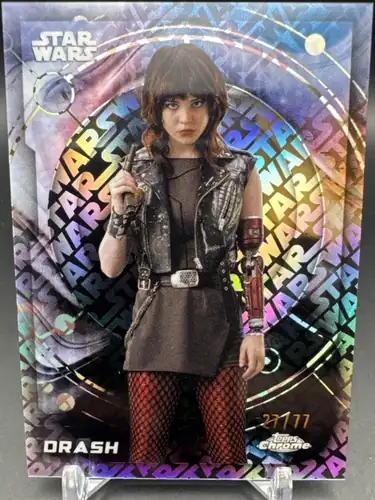

2026 Topps Chrome Star Wars #89 Drash Star Wars Logofractor /77
Collector-supplied front and back photographs of Drash #89. This Hobby-exclusive Star Wars Logofractor parallel is serial-numbered 27/77.