
General Armitage Hux grew up in the remnants of the Galactic Empire and helped build the First Order into a formidable military power. He championed harsh stormtrooper training, commanded Starkiller Base, and competed with Kylo Ren for Supreme Leader Snoke's approval. After Ren took control, Hux secretly aided the Resistance because he wanted his rival to fail. His betrayal did not mean that he rejected the authoritarian ideals he had spent his career enforcing.
Armitage and the Imperial legacy of Brendol Hux
Armitage is the son of Brendol Hux, an officer connected to the Imperial Academy system. Brendol's interest in military training and his later work with Imperial remnants gave the younger Hux early access to an institution that regarded obedience as essential to political order. His childhood was not a voluntary adult decision to join the First Order; he was raised among people preparing to preserve Imperial authority after the Emperor's defeat.
His father's methods became part of the First Order's wider thinking about recruitment. The effort to build a loyal army reached into the childhood of prospective soldiers and treated family and civilian identities as obstacles to military conditioning. Armitage later claimed authority through an organization that had shaped him before he was old enough to meaningfully choose another life.
Stormtrooper training and the loss of childhood autonomy
Hux supported the First Order program of taking children from their families and training them as stormtroopers. Their assigned designations, uniforms, and regulated behavior were meant to make them appear interchangeable. The system could produce disciplined troops while restricting the personal choices that ordinarily help people form relationships outside military service.
FN-2187's refusal to kill villagers on Jakku exposed the limits of that program. The soldier later known as Finn escaped the First Order despite years of indoctrination. Hux and Captain Phasma could punish deviations and demand reports, but they could not guarantee that every person trained under their authority would accept the institution's account of right and wrong.
Snoke, Kylo Ren, and competition for authority
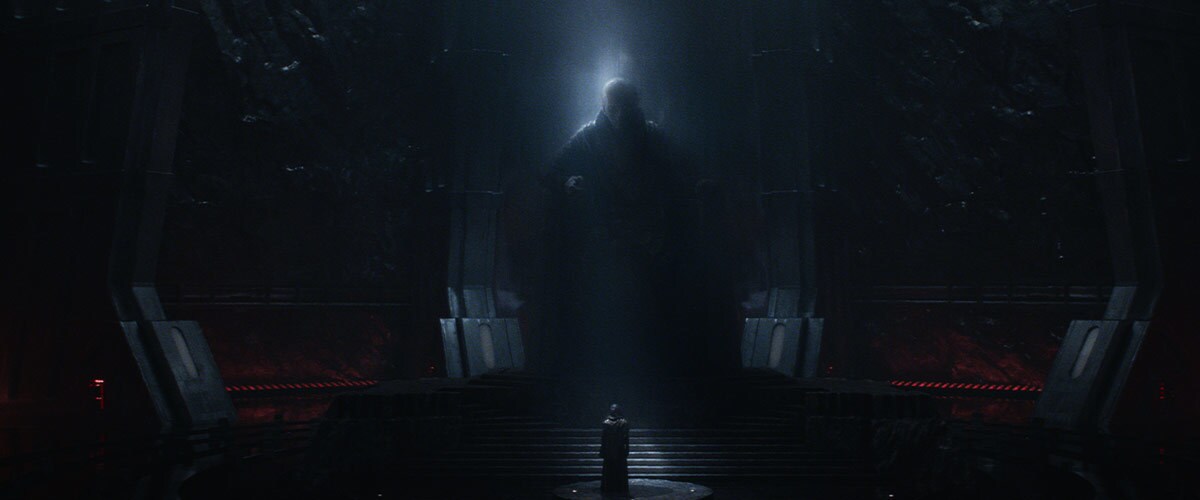
Hux's rise through the military gave him responsibility for ships, soldiers, and the operation of large weapons systems. Yet Supreme Leader Snoke also favored Kylo Ren, a powerful Force-user who did not follow the same military chain of command. Both men sought prestige and greater influence over the First Order, and each viewed the other's position as a threat.
The rivalry did not weaken their shared commitment to suppressing the Resistance. Hux resented Kylo's access to Snoke, while Kylo treated ordinary officers as subordinate to his personal authority. Snoke could use their competition to preserve his own position, rewarding or humiliating either official without creating dependable rules for resolving their disagreements.
Starkiller Base and the destruction of the Hosnian system
Hux commanded Starkiller Base, a weapon built into an ice-covered planet and capable of destroying multiple worlds from an enormous distance. The project combined industrial labor, energy capture, military command, and propaganda. Its purpose was not merely to defeat a fleet; it was designed to terrorize entire political communities into submission.
Before the weapon fired, Hux addressed massed First Order troops and denounced the New Republic. The speech connected the destruction of civilian worlds to a claim that the First Order was restoring rightful government. Starkiller Base then devastated the Hosnian system, including the Republic's political center. The attack was meant to make further organized resistance appear futile.
When the Resistance attacked Starkiller Base, Hux had to report the weapon's vulnerability and eventual destruction to Snoke. The loss exposed a contradiction in his military ideology: a state built around overwhelming technological superiority can become vulnerable when its leaders assume that terrifying appearances guarantee security.
D'Qar and a pursuit that devastated the Resistance
Hux later commanded First Order forces pursuing the Resistance during its evacuation of D'Qar. Poe Dameron's attack on the dreadnought destroyed a major warship but cost the Resistance many bombers. Hux's fleet then tracked the surviving Resistance vessels through hyperspace, preventing what the defenders had expected to be a safe escape.
The prolonged pursuit reduced the Resistance's fuel reserves and forced Vice Admiral Holdo to devise an evacuation using transports. Hux's officers had resources far beyond those of their opponents, but the Resistance's decisions still threatened to deny them a complete victory. The eventual sacrifice of the cruiser Raddus disrupted the First Order formation and gave more survivors a chance to escape.
Kylo Ren becomes Supreme Leader
When Kylo killed Snoke, Hux briefly encountered a chance to change the balance of power. Ren awakened before him and asserted the office of Supreme Leader. Hux accepted the new hierarchy under threat, despite their continuing hostility. His uniform and title still conferred command, but the person at the top of the organization could override him through personal force.
The First Order's campaign on Crait continued under Ren's direction. Hux saw that access to military resources did not necessarily grant him influence over strategic decisions. He could command soldiers, operate ships, and enforce discipline, yet remained vulnerable to public humiliation by the leader who had replaced Snoke.

An informant motivated by hatred of Kylo Ren
After the reappearance of Emperor Palpatine, Hux secretly provided intelligence to the Resistance. He helped Finn, Poe, and Chewbacca escape from First Order custody, then accepted a blaster wound as part of an attempt to make their departure resemble a failed pursuit rather than deliberate assistance.
When Finn asked why he was helping them, Hux explained that he wanted Kylo Ren to lose. The explanation distinguishes his behavior from the commitments of a genuine Resistance convert. Hux opposed one ruler's success because he hated that ruler. His earlier support for child conscription and planetary destruction did not disappear simply because he briefly assisted their enemies.
Allegiant General Pryde identifies the spy
Allegiant General Enric Pryde held senior authority within the forces serving the First Order and the returning Emperor. He recognized the weakness in Hux's explanation of how the prisoners escaped. Instead of allowing a prolonged investigation, Pryde shot and killed Hux, eliminating a senior officer who had become a security liability.
Hux died within the authoritarian institution to which he had devoted his life. His career had depended on harsh penalties for disobedience and on treating subordinates as expendable. When he was the suspected traitor, those same principles offered him no procedural protection.
Uniforms, rallies, and the material display of power
Hux's severe First Order uniform, high-ranking insignia, and public appearance before assembled stormtroopers communicated discipline and rank. Starkiller Base and the Resurgent-class Star Destroyers supplied a backdrop of technological power intended to make the First Order look unavoidable.
Those symbols depended on labor, recruitment, energy systems, crews, and political decisions. A rally could make a commander seem personally responsible for the might of a whole state, but it also concealed how many people had been compelled to perform the work necessary for the state to function.
Anthropological assessment: rivalry inside authoritarian rule
Hux's history reveals how powerful institutions can shape both the public behavior and personal ambitions of people raised within them. He embraced the ideology of military discipline and attempted to make obedience normal for a generation of soldiers taken from their families. At the same time, his own position was never secure enough to protect him from a superior's arbitrary demands.
His betrayal demonstrates that opposition to a leader is not necessarily opposition to the political system that leader controls. Hux wanted Ren defeated and was willing to help the Resistance achieve that outcome. He did not seek an accountable republic or the liberation of the children trained as stormtroopers. His death at Pryde's hands exposes the dangers of a chain of command that recognizes power more readily than the rights of its members.
Lucasfilm Databank: General Hux · Kylo Ren · Finn · Supreme Leader Snoke · First Order
Material fandom · Collector reference
Collecting this Character
View the General Hux collecting page: reviewed cards, figures, Funko and other formats

Disney100 Cosmos Armitage Hux
Disney100 Cosmos card featuring Armitage Hux. This photograph was supplied directly for the IDS collection.
Explore related Star Wars media
Browse Star Wars books and collectibles related to this character.
Search Amazon for General Hux ↗As an Amazon Associate I earn from qualifying purchases. Check the product, maker and edition before buying; searches may include unrelated items.