

SWTOR companion case file · Multiple continuities within playthroughs
Investigating Kaliyo Djannis
This investigation separates the publisher's biography from contradictory in-universe statements and player-dependent outcomes. Educational decisions are not copied game dialogue.
The history behind Firebrand
A Rattataki mercenary with contradictory personal histories joins Imperial Intelligence, pursues her own agendas, and later challenges the Eternal Empire as Firebrand.
A biography that refuses a single official version
Kaliyo Djannis presents a special problem for any reliable character archive: the original SWTOR Holonet explicitly says that accounts of her early life contradict one another. Even its statement about Rattatak is qualified as a presumed homeworld. A reference page that gives her an exact childhood chronology without supporting evidence would create certainty the publisher has not provided.
The original biography describes a CorSec criminal report containing an image of Kaliyo with Exchange gangster Vanus Cruor. It then traces her through work as a freelance enforcer or assassin, periods of imprisonment and connections to an anarchist cell. These records establish a pattern of movement through criminal networks, but they cannot answer every question about how she first entered those circles.
BioWare's 2012 Companions 101 feature offers a somewhat fuller characterization: Kaliyo was raised on Rattatak and learned to admire displays of strength, glory and power. That developer feature is valuable evidence, yet it also reminds readers that her own explanations are often self-serving. The distinction between what the narrative says and what the character claims should remain visible.
This uncertainty is part of her cultural significance. Authorities often attempt to make a mobile person legible through reports, associates and aliases. Kaliyo intentionally makes those categories unstable, while treating her reputation for danger as a resource in negotiations with prospective employers.
Hutta: a hired gun meets Imperial Intelligence
The Imperial Agent meets Kaliyo on Hutta while she works for Nemro the Hutt. The 2012 developer account says she is becoming bored with that employment and recognizes that the Agent's apparent identity conceals something more complex. Her decision to join is therefore not framed as patriotic service to the Sith Empire.
Lead writer Alexander Freed explained that Kaliyo sees two opportunities in the Agent. She may be able to exploit a diligent officer for money and adventure, or she may have found a capable and manipulative rival whose company offers a new challenge. The difference matters: cooperation can emerge from opportunism without either side sharing a political philosophy.
The partnership gives an intelligence service access to someone comfortable in underworld environments while giving Kaliyo protection, income and organizational resources. Neither side must be naïve about the other. The Agent's work requires secrecy, whereas Kaliyo enjoys provoking the people who believe they control her.
Her arrival also disrupts familiar expectations about loyalty in team-based games. She can fight beside a government agent while treating duty to that government as a joke. The official Holonet notes her dislike of obedience, sincerity and sacrifice for the greater good, which helps explain why mission success does not imply a stable oath of allegiance.
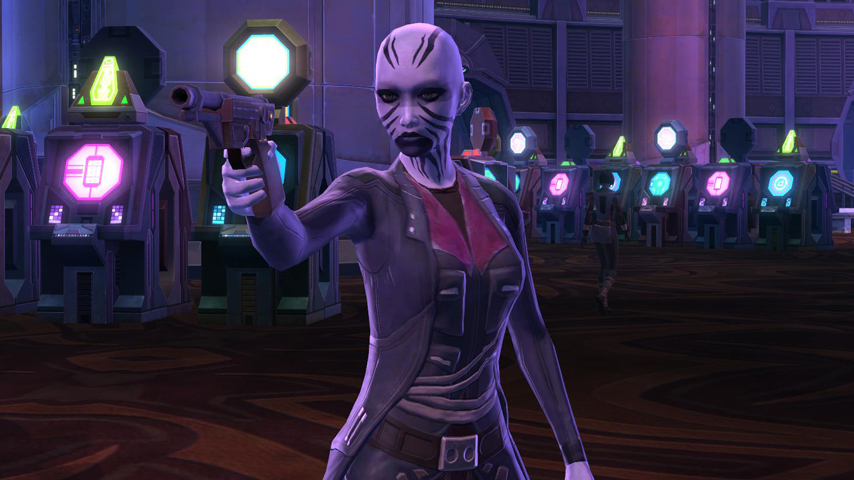
Aboard the X-70B Phantom: trust and manipulation
The original Agent crew gradually expands beyond Kaliyo. BioWare's developer interview describes her relationships with the other recruits in revealing terms. Vector Hyllus, whose Killik Joiner identity initially unsettles her, eventually earns a kind of wary respect because she cannot easily provoke him. The diplomatic strategy he uses is less vulnerable to her preferred form of manipulation.
Doctor Lokin is a different case. Both he and Kaliyo understand deception, and the developer frames their conversations as an uneasy contest between two people suspicious of each other's stories. The tension lies in competing expertise rather than simple hostility.
She initially sees Raina Temple as someone who can be manipulated, while the developer account notes that Temple understands more than Kaliyo assumes. SCORPIO produces still another response: Kaliyo avoids thinking about the self-improving security droid. This is a relationship between two characters who each dislike subordination but express autonomy in profoundly different ways.
These contrasts give Kaliyo a distinct place in the ensemble. She is not merely the first combat companion who can be exchanged for a more powerful recruit. Her reactions reveal the different ways crew members make themselves trustworthy, dangerous, difficult to read, or resistant to emotional pressure.
Romance and the difference between attraction and commitment
An Imperial Agent can pursue an optional romantic relationship with Kaliyo. The publisher's 2012 feature stresses that her previous relationships are troubled and that she often treats personal bonds as useful only while they benefit her. It would therefore be inaccurate to describe her as invariably committed to the Agent in every possible story.
Her reputation as an unreliable partner does not mean the game presents no meaningful emotional stakes. Instead, it places intimacy inside the same environment of uncertainty and self-interest that shapes her work. A person who shares danger with a colleague may still have very different expectations about honesty, attachment and promises.
The Agent's player choices can affect the way the relationship unfolds, but an archive should not invent a canonical outcome or assume a given romance is always active during later expansion chapters. A character's age, appearance customization and relationship flags are separate game variables.
Likewise, the original companion's weapons and crew-skill statistics are historical records of older mechanics. They can illuminate the design of her launch-era role without serving as present-day combat-build recommendations.
Firebrand: Anarchy in Paradise
After the Eternal Empire disrupts the older powers, Kaliyo becomes Firebrand, an infamous saboteur opposing Zakuul. The official Fallen Empire chapter guide identifies Firebrand as the central ally of Chapter X, Anarchy in Paradise, and states that she intends to attack the Eternal Empire's seat of power by whatever means are necessary.
The chapter's central question is not simply whether the player dislikes Arcann. It asks what the Outlander will tolerate from an ally whose methods may damage civilians, infrastructure or political trust. The Alliance wants effective resistance, while Firebrand's priorities can include destruction for reasons other than broad coalition strategy.
BioWare's public description says that decisions made during this confrontation have consequences inside the Alliance. This is a reminder that the story's choice-based structure matters. Neither unrestricted sabotage nor full restraint should be recorded as the sole universal outcome.
Firebrand offers a particularly sharp example of resistance that does not automatically become an ethical model. Opposing an oppressive government may be compatible with destructive practices that create new victims. The game's story allows those questions to be explored through the Outlander's response.
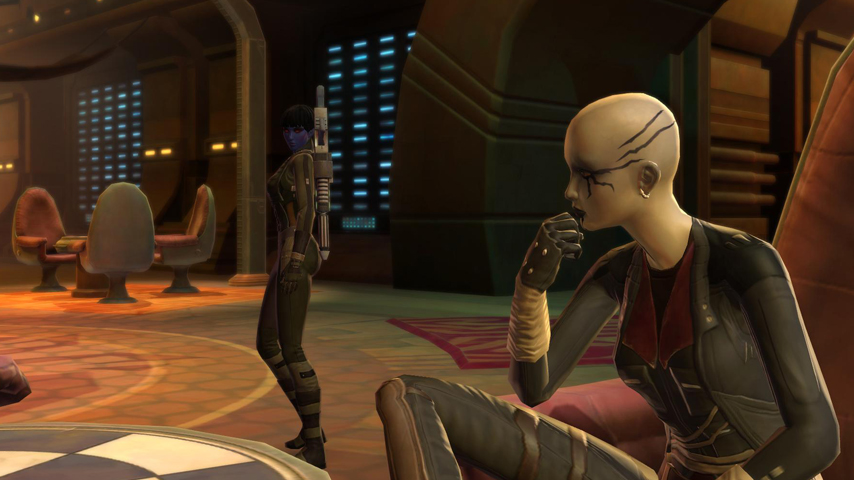
Profit and Plunder: the consequences of a prior disagreement
Fallen Empire Chapter XIII, Profit and Plunder, features a heist involving Gault Rennow and Vette. The official publisher chapter description also names a major decision concerning Jorgan and Firebrand Kaliyo, explicitly linking that later event to questions of loyalty and earlier operations.
This means Kaliyo's storyline cannot be told as a fixed sequence of successful missions with guaranteed reconciliation. Earlier choices may affect the relationship between Alliance command and combat specialists. A companion who resists organizational limits creates risks for the wider team as well as herself.
Her narrative also connects three separate parts of SWTOR: the Imperial Agent's clandestine work, the new Alliance formed by the Outlander, and the ongoing war against the Eternal Throne. The political environment changes, but the tension between tactical cooperation and personal autonomy remains.
The result is a character whose contradictions are not incidental flavor. She can be useful, funny, violent, emotionally elusive and politically disruptive within the same story. A detailed dossier should describe those tensions rather than flatten them into either a trustworthy hero or a single-note villain.
Event sequence
Timeline
CorSec records and other accounts associate Kaliyo with criminal syndicates, captivity, and violent anarchist networks.
Works for Nemro and meets the undercover Imperial Agent.
Joins the Agent's crew, clashing with different crew members over trust and authority.
Travels with an intelligence professional without developing consistent allegiance to the Empire.
Operating as Firebrand, joins the struggle against Zakuul in Anarchy in Paradise.
Profit and Plunder contains an important decision involving Firebrand and Major Jorgan.
Connected roles and conflicts
People and institutions
SCORPIO
Self-improving security droid whose autonomy makes Kaliyo uneasy
RELATED DOSSIERAric Jorgan
Havoc Squad commander implicated in a later Alliance decision
RELATED DOSSIERGault Rennow
Underworld expert in the later treasury operation
RELATED DOSSIERVette
Gault's partner in the Profit and Plunder heist
IMPERIAL AGENT CREWMATEVector Hyllus
Killik Joiner and diplomat whose loyalty to the hive offers a different model of identity.
IMPERIAL AGENT CREWMATEDoctor Eckard Lokin
Veteran Imperial geneticist whose long career combines medical expertise and classified research.
IMPERIAL AGENT CREWMATERaina Temple
CEDF ensign with hidden personnel records, high-stakes family history and Imperial loyalties.
IDS anthropological analysis
Institutions and uncertainty
Kaliyo's unstable past demonstrates the limits of administrative biography. Police and intelligence files can document contacts and recorded offenses, but they may not capture the reasons for a person's movement through changing networks. In a character who deliberately manipulates others, the mismatch between record and narrative is especially pronounced.
Her collaboration with Imperial Intelligence illustrates transactional loyalty. Money, resources and new challenges can support cooperation without creating ideological agreement. This is not the same as a soldier's duty or a diplomat's long-term commitment to an organization.
The crew's different responses to Kaliyo reveal practical definitions of trust. Vector's resistance to provocation, Lokin's competing deception and SCORPIO's unpredictable autonomy prevent the group from forming a simple hierarchy of good and bad personalities.
Finally, Firebrand shows that revolt and legitimate authority are not automatic opposites. A destructive campaign against an empire can still raise questions about harm to civilians, control of weapons and responsibility to allies. The game uses this conflict to test how far coalition leaders should go in accommodating a useful but unreliable participant.
These are IDS interpretations of fictional institutions, not source claims about real Rattataki communities.
Interactive fieldwork
Choose an interpretation
Imagine a coalition trying to use an effective but unreliable saboteur. These hypothetical responses are analytical exercises, not SWTOR dialogue choices.
Pick an approach
Choose a position to explore its consequences.
Test the evidence
Is Kaliyo's birthplace definitely confirmed?
No. The Holonet uses Rattatak as a presumed homeworld, even though a later publisher feature describes being raised there.
Does she join Imperial Intelligence because she believes in Imperial duty?
The 2012 writer interview says she values resources, income and the challenge posed by the Agent, not patriotic obedience.
Is Firebrand introduced in Fallen Empire Chapter X?
Yes. The official chapter guide calls her the central ally of Anarchy in Paradise.
Is Kaliyo's fate identical in every game?
No. Fallout from player choices affects her later Alliance story.
Game and material culture
Collecting this character
Kaliyo appears in a variety of in-game customization and equipment appearances; the two supporting screenshots are from the official developer gallery and should not be mistaken for an unchanged base model. No specific physical card, figure or numbered collectible is asserted without product documentation. Only card images provided by the collector appear in IDS collecting sections.
Evidence register
Primary sources
- Publisher Holonet profile, Kaliyo Djannis ↗
- Official SWTOR 2012 interview with Agent lead writer Alexander Freed ↗
- Publisher Fallen Empire chapter descriptions ↗
- Official SWTOR Imperial Agent overview ↗
Artwork: official SWTOR Fallen Empire card and the official 2012 Companions 101 article; character appearance varies with cosmetic customization. The editor's institutional interpretations and decision scenarios are original IDS analysis.