
Representative but fragmented
A Senate of many worlds, a chancellor, layered sovereignty, powerful bureaucracies, and growing tension between deliberation and effective action.
Government · Representation · Sovereignty · Power
Star Wars politics is not one system repeated across eras. Power moves through senates, chancellors, emperors, queens, governors, councils, clans, corporations, militaries, resistance coalitions, and local authorities. This hub follows how political institutions claim legitimacy, represent populations, make decisions, distribute power, survive crises, and transform when one regime gives way to another.
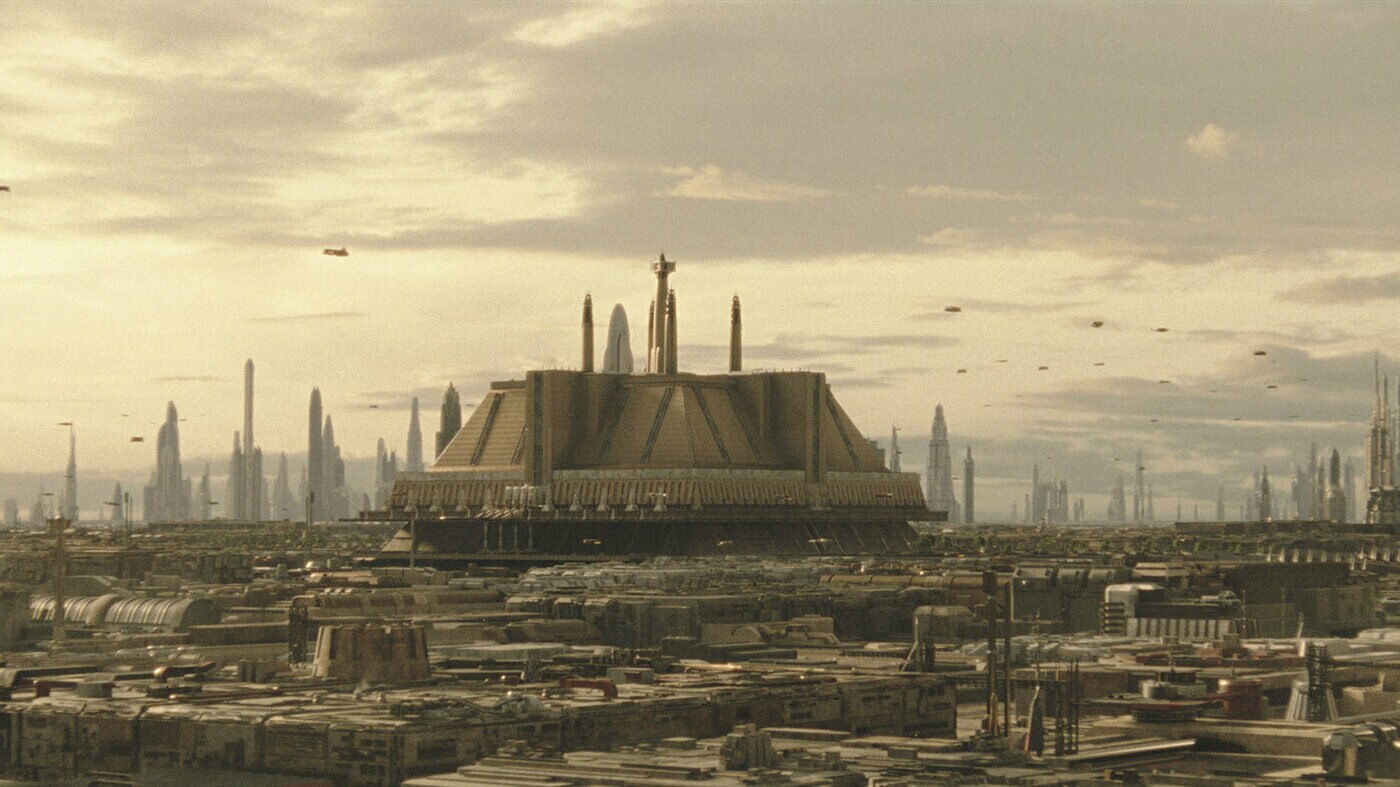
Political map
Political power becomes durable when institutions can represent populations, make rules, collect information, move resources, appoint officials, command force, resolve disputes, and persuade people that their authority is legitimate.
Representation
The Galactic Senate represents many worlds through delegates who speak on behalf of planetary populations and political units. That sounds straightforward, but representation raises difficult questions. A senator may represent a world with multiple cultures, unequal social groups, or internal political divisions. Corporate interests can also enter political institutions, complicating the boundary between public representation and commercial power.
Representation is therefore not just about holding a seat. It is about who selected the representative, whose interests they prioritize, what information reaches them, and whether distant populations believe the institution speaks for them.
Executive power
The Republic's Supreme Chancellor operates inside a representative political system whose formal power is constrained by the Senate and law. Palpatine gradually expands that office through crisis and war, eventually transforming chancellorship into imperial sovereignty. The Emperor no longer depends on the same representative structure for political authority.
The important change is institutional, not merely personal. An office designed to coordinate a republic becomes the foundation for centralized rule. Star Wars repeatedly shows how authority can be transformed by changing the rules around an existing position rather than inventing an entirely new bureaucracy overnight.
Bureaucracy
Senates and emperors are visible, but ordinary political power is often exercised through clerks, ministry staff, military administrators, inspectors, governors, intelligence officers, border officials, prison personnel, corporate managers, and local civil servants. These people turn policy into routines.
Bureaucracy matters because it allows authority to operate at galactic scale. Records, forms, ranks, jurisdictions, offices, reporting chains, and standardized procedures make distant populations governable. They can also create delay, corruption, rigidity, or opportunities for resistance from inside the system.
Planetary sovereignty
Worlds maintain local political systems while participating in larger galactic institutions. Naboo has an elected monarch, advisory structures, security forces, and Gungan political institutions while also belonging to the Galactic Republic. Other planets are governed through councils, hereditary houses, governors, clans, corporations, or local magistrates.
This creates layered sovereignty. Galactic authorities may control trade rules, war powers, or interplanetary policy while local institutions regulate land, policing, succession, social services, or customary practice. Political conflict often emerges when one level claims authority over another.
Monarchy & aristocracy
Naboo complicates familiar assumptions about monarchy because its queens can be elected. Padmé Amidala serves first as Queen and later as Senator. Elsewhere, noble houses, royal families, inherited titles, clan leadership, and dynastic status operate according to different traditions.
Political form therefore cannot be inferred from titles alone. A queen may be elected, a senator may come from an elite family, a clan leader may depend on collective recognition, and an emperor may emerge from a formerly constitutional office. Legitimacy depends on the institution behind the title.
Emergency powers
During the Clone Wars, the Galactic Senate grants Palpatine emergency powers. Those powers are justified as temporary responses to extraordinary danger, but the war allows executive authority to accumulate while ordinary limits weaken. The Senate survives for a time, yet its relative power declines.
Emergency rule is therefore central to the Republic's transformation. A political system may formally preserve institutions while changing the balance among them. The key question is not only whether emergency authority was granted, but whether there is a credible mechanism for giving it back.
Diplomacy
Diplomacy connects planets, senators, monarchies, corporations, neutral systems, resistance groups, and rival governments. Negotiation can address trade, war, recognition, alliances, prisoners, migration, or access to resources. Diplomatic authority depends on whether a representative is recognized as capable of binding the group they speak for.
Neutrality is also political. Mandalore's attempts to remain outside the Clone Wars, for example, do not remove it from galactic politics. Neutral systems must constantly negotiate with stronger powers that have incentives to draw them into conflict.
Legitimacy
Governments use elections, law, tradition, military victory, ritual, ancestry, public service, ideology, fear, prosperity, and claims of security to justify authority. Different political systems rely on different combinations. The Republic presents itself through representation and law. The Empire emphasizes order, security, hierarchy, and coercive capacity.
Legitimacy is not the same as popularity. A regime can retain institutional authority while facing widespread resentment, and a resistance movement can gain moral authority before it controls territory. Political stability depends partly on whether people continue to treat institutions as binding.
Layered government
The Republic is best understood as a layered political system rather than a single centralized state. Planetary governments retain substantial authority while senators participate in galactic decision-making. Trade organizations, local police, regional institutions, the Jedi Order, and corporate authorities further complicate the landscape.
This helps explain why the Senate can be powerful yet unable to act quickly on local crises. Central institutions depend on negotiation among members whose legal systems, economies, cultures, and political interests differ.
Authoritarian rule
After reorganizing the Republic into the Empire, Palpatine accumulates supreme political authority while military and regional officials gain greater direct control over populations. The Senate remains for a time, but its power continues to erode until the Emperor dissolves it entirely and relies more heavily on regional governors and the military.
Authoritarian government therefore involves more than one ruler at the top. It depends on administrative chains, surveillance, military enforcement, censorship, political classification, control over information, and institutions capable of implementing centralized decisions.
Coalitions & opposition
The Rebel Alliance is a political coalition as well as a military organization. Different cells, leaders, worlds, and ideological positions have to agree on strategy, command, diplomacy, and the political order they hope to create after victory. Mon Mothma's role is therefore not simply military leadership but coalition-building.
Political opposition becomes durable when it can coordinate across difference. Resistance organizations need procedures for making decisions, resolving disagreements, allocating resources, and defining common goals even before they control a state.
Regime change
The Empire grows out of the Republic rather than replacing it from nothing. It inherits personnel, records, offices, military assets, infrastructure, political geography, and administrative habits. The New Republic likewise emerges from the Rebel Alliance while inheriting the task of governing a galaxy shaped by Imperial institutions and war.
Regime change is therefore both symbolic and bureaucratic. Flags, titles, and constitutional claims can change quickly. Rebuilding courts, ministries, militaries, tax systems, archives, transport networks, and political trust takes much longer.
Regime comparison
IDS compares documented institutions and political relationships without reducing the galaxy to simple labels.
A Senate of many worlds, a chancellor, layered sovereignty, powerful bureaucracies, and growing tension between deliberation and effective action.
Executive supremacy, regional governors, military enforcement, intelligence institutions, controlled media, and declining representative power.
Multiple resistance groups coordinate military and political action while trying to build legitimacy for a restored democratic order.
The Senate is restored, Mon Mothma becomes chancellor, the military is reduced, and institutions attempt to separate the new government from Imperial rule.
Evidence trail
Official StarWars.com sources describe the Galactic Senate as the representative governing body of the Republic, show its power eroding after emergency powers were granted to Palpatine, describe the Empire's shift toward the Emperor and regional governors, identify Mon Mothma as the first elected New Republic chancellor in two decades, and describe the New Republic as restoring the Senate after the Rebel victory.
Connected archive
Jurisdiction, policing, prisons, surveillance, borders, punishment, and legal continuity.
EconomyWho controls resources?Trade, taxation, corporations, labor, military production, debt, extraction, and inequality.
InformationWho controls the political story?News, propaganda, archives, records, surveillance, messaging, and public memory.
MethodPolitics as social organizationConnect legitimacy, institutions, hierarchy, kinship, culture, violence, material resources, and historical change.