
Kinship and rescue
The central journey is organized around family obligation, while the Ewoks expand that obligation through alliance and hospitality.
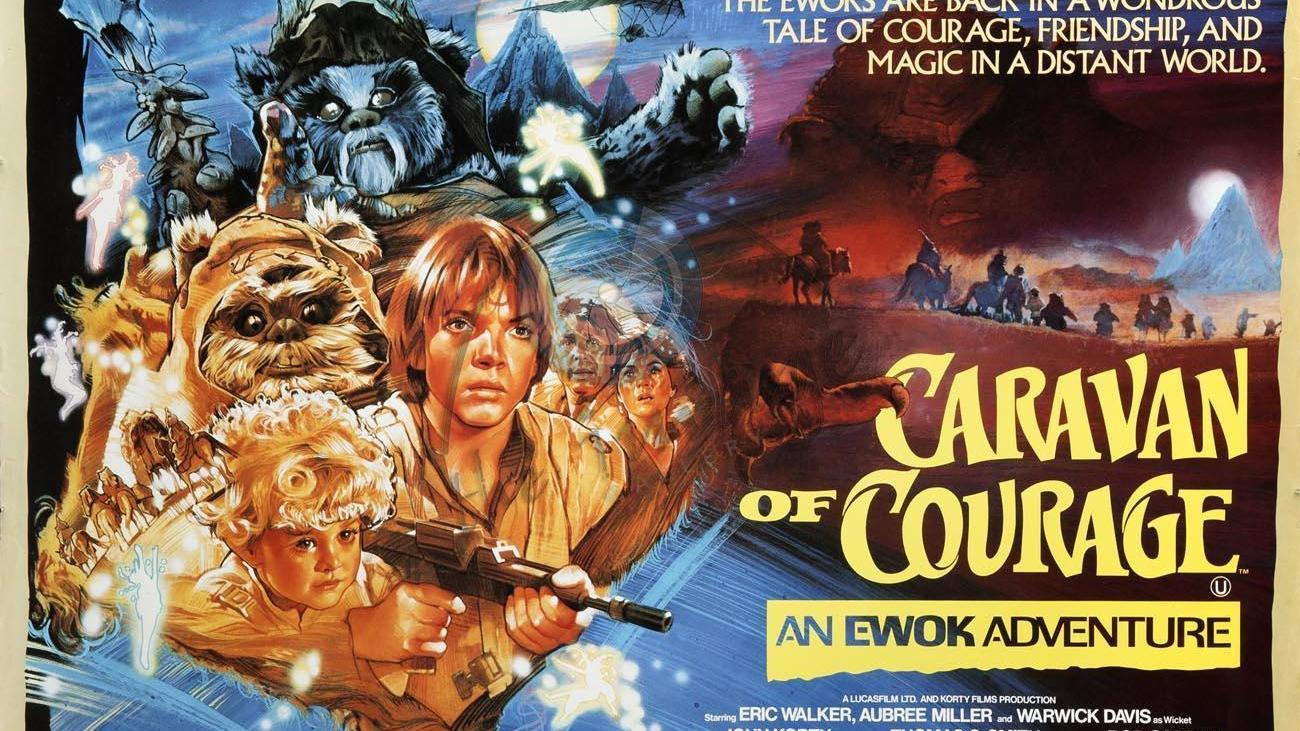
Vintage television film · Legends
A stranded human family and an Ewok caravan turn Endor into a story about kinship, local knowledge, ritual, and cross-cultural cooperation.
Screen archive
1984
Caravan of Courage: An Ewok Adventure begins when the Towani family's starcruiser crashes on the forest moon of Endor. Parents Catarine and Jeremitt Towani are separated from their children, teenage Mace and young Cindel, after the family becomes scattered in the unfamiliar environment. The parents are captured by the giant Gorax, a powerful creature that lives in a distant mountain stronghold. Mace and Cindel survive near the wreck but have little knowledge of the moon's landscapes, animals, or peoples. Their situation changes when Ewoks discover them. The children initially experience the Ewoks as unfamiliar beings whose language and customs they do not understand, while the Ewoks are equally uncertain about the human strangers. The film builds its story from the gradual process by which fear is replaced by communication and practical cooperation.
Cindel develops a particularly strong relationship with Wicket W. Warrick. Because she is younger and less defensive than Mace, she is more willing to accept care from the Ewok household. Mace remains suspicious and focused on finding his parents. The Ewoks bring the children into their village, where healing, food, family life, and local knowledge become central to survival. Deej Warrick and the other adults recognize that the children's family is missing and begin investigating what happened. The story spends time on domestic life that Return of the Jedi only briefly suggests. The Ewoks are not shown simply as a military ally waiting to help outsiders. They have households, parents and children, healers, ritual specialists, material practices, and their own reasons for deciding whether to risk themselves for strangers.
The Ewok shaman Logray uses ritual and magical objects to determine that Catarine and Jeremitt are alive but held by the Gorax. Rescuing them will require a journey beyond the ordinary range of village life. A caravan is organized, bringing together Deej, Wicket, Weechee, Widdle, Logray, Mace, and Cindel. Before they depart, the travelers receive symbolic objects associated with the dangers ahead. The expedition resembles a rite of passage as much as a rescue mission. Mace and Cindel are not merely transported to their parents. They must learn how to travel with people whose knowledge systems, equipment, and interpretations of danger differ from their own. Mace in particular has to abandon the assumption that his technological background makes him more capable than the Ewoks who understand Endor.
The caravan crosses forests, plains, and other hazardous environments while encountering creatures and obstacles. Each stage emphasizes dependence on local ecological knowledge. The Ewoks know which paths are dangerous, how to interpret signs, and how to use the materials available around them. Cindel's trust in Wicket deepens, and Mace slowly begins accepting that his own strength and determination are insufficient without the group. The film presents survival as distributed competence. No single person has everything needed to complete the journey. The humans have certain forms of technology and personal motivation, while the Ewoks bring environmental knowledge, ritual understanding, and community organization.
One of the expedition's challenges involves the pool of the Wisties, small luminous beings associated with Ewok magical traditions. The Wisties and other supernatural elements are treated as ordinary parts of the Ewoks' lived world rather than as phenomena requiring external scientific explanation. Mace initially reacts from the assumptions of an outsider, but the journey repeatedly demonstrates that dismissing Ewok categories can be dangerous. The children's participation therefore includes cultural learning as well as physical travel. They do not need to become Ewoks or fully understand every belief. They do need to recognize that local people possess knowledge that has practical consequences for the expedition.
The group eventually reaches the Gorax's mountain territory. The landscape itself becomes more threatening as they approach the creature's stronghold. The rescue requires climbing, entering unfamiliar structures, and confronting traps and animals. Mace's desire to reach his parents pushes him toward impulsive action, but success still depends on the caravan moving together. When they locate Catarine and Jeremitt, the family reunion occurs before the danger has ended. The Gorax returns, forcing the travelers into a direct confrontation. The scale difference between the creature and the rescuers makes ordinary combat difficult. The group uses coordinated action and the environment to survive rather than relying on superior weapons.
The Gorax is ultimately defeated after a struggle near the mountain ledges. The victory frees the Towani parents and allows the family to leave the stronghold. The rescue validates the original decision of the Ewok community to treat the stranded children as people worthy of assistance even though they were outsiders. That choice has now created reciprocal bonds. Mace and Cindel's understanding of Endor has changed from an unknown and frightening crash site into a social landscape populated by people with whom they share history and obligations. The Towani parents also owe their survival to a community they had no relationship with before the crash.
The return to the Ewok village transforms the meaning of the expedition. What began as a problem belonging to one human family became a collective project. The caravan members return with a shared story that can be remembered by both communities. Cindel and Wicket's friendship is especially important because it develops without complete linguistic or cultural sameness. Care, play, danger, and mutual recognition create the relationship. Mace's development follows a different path. He moves from distrust and frustration toward acknowledgment that the Ewoks are capable partners rather than primitive helpers. The film's central social change is therefore not only the restoration of the Towani household but the creation of a cross-cultural alliance.
Caravan of Courage also expands the representation of Endor beyond the events of the Galactic Civil War. There are no stormtrooper patrols or Rebel commandos driving the plot. The moon is shown through its own environments, households, dangerous creatures, sacred objects, and travel routes. The result makes the Ewoks visible as a society with concerns that exist independently of galactic politics. The film does not provide a complete ethnography of that society, and its fantasy conventions simplify some cultural differences, but it gives viewers more sustained access to Ewok family life and cosmology than the theatrical films do.
The film ends with the Towani family reunited and the immediate threat defeated. Its resolution is deliberately intimate. No government falls and no major military battle determines the future of the galaxy. The important outcome is that a family survives because another community chose to extend care beyond its own members. The journey turns hospitality into obligation, strangers into allies, and local knowledge into the decisive resource of the story. For the wider Star Wars archive, Caravan of Courage is valuable precisely because its scale is smaller. It shows how kinship, ritual, environmental knowledge, childhood, and community cooperation can carry a Star Wars story even when Jedi, Sith, the Empire, and the Rebellion are almost entirely absent.
IDS anthropology
The central journey is organized around family obligation, while the Ewoks expand that obligation through alliance and hospitality.
The caravan survives because Ewoks understand Endor's landscapes, animals, hazards, and practical resources better than the stranded outsiders.
Talismans, tests, and staged challenges turn travel into a rite of passage in which younger characters acquire competence and social recognition.
Human and Ewok participants build trust despite language and cultural differences, showing cooperation through shared action rather than complete mutual understanding.
Connected archive
Mentioned in this file