
IDS Film Hub · Episode VI · 1983
Return of the Jedi
One screen story, connected to the larger Imperial Dark Sector archive through anthropology, characters, institutions, places, events, and lore.
Story record
Movie summary
1983 · Episode VI
Return of the Jedi begins with several members of the Rebel Alliance converging on Tatooine to rescue Han Solo from Jabba the Hutt. C-3PO and R2-D2 enter Jabba's palace first as apparent gifts from Luke Skywalker. Leia arrives disguised as the bounty hunter Boushh with Chewbacca as a prisoner and succeeds in releasing Han from carbonite, but Jabba captures them before they can escape. Luke then enters the palace openly and attempts to negotiate. Jabba rejects his claims to be a Jedi and drops him into the rancor pit. Luke kills the creature but is sentenced, along with Han and Chewbacca, to execution at the Great Pit of Carkoon. The rescue ultimately depends on coordination that has been prepared in advance. R2-D2 launches Luke's hidden lightsaber to him, Lando reveals himself among Jabba's guards, and the prisoners fight their way free aboard the sail barges.
During the battle Leia kills Jabba by using the chain that binds her to strangle him, turning an instrument of captivity against the crime lord. Boba Fett is knocked into the sarlacc during the confusion. Han, still struggling with impaired vision after carbon freezing, helps Lando survive above the pit. Luke destroys Jabba's sail barge and the group leaves Tatooine. The sequence resolves Han's capture from the previous film while also showing a system of authority outside Imperial government. Jabba's power depends on guards, debt, reputation, enslavement, bounty hunters, entertainment, and fear. The Rebel heroes cannot appeal to law or state institutions to free Han. They enter the criminal court directly and rely on deception, personal loyalty, and coordinated force. Once Han is safe, Luke separates from his friends to return to Dagobah and complete unfinished business with Yoda.
Yoda is dying when Luke arrives. He confirms that Darth Vader is indeed Luke's father and tells him that his training will not be complete until he confronts Vader. Yoda then dies and becomes one with the Force. Obi-Wan's spirit appears and explains that Anakin Skywalker fell to the dark side and became Vader. Luke also learns that Leia is his twin sister. The revelation changes Luke's understanding of family again: the person with whom he has fought beside the Rebellion is also the sibling hidden from Vader and the Emperor at birth. Obi-Wan insists that Vader is more machine than man and cannot be redeemed, but Luke is not convinced. His next choices are shaped by the belief that some part of Anakin remains. He rejoins the Rebel fleet carrying both a new responsibility toward Leia and a plan to face Vader without simply killing him.
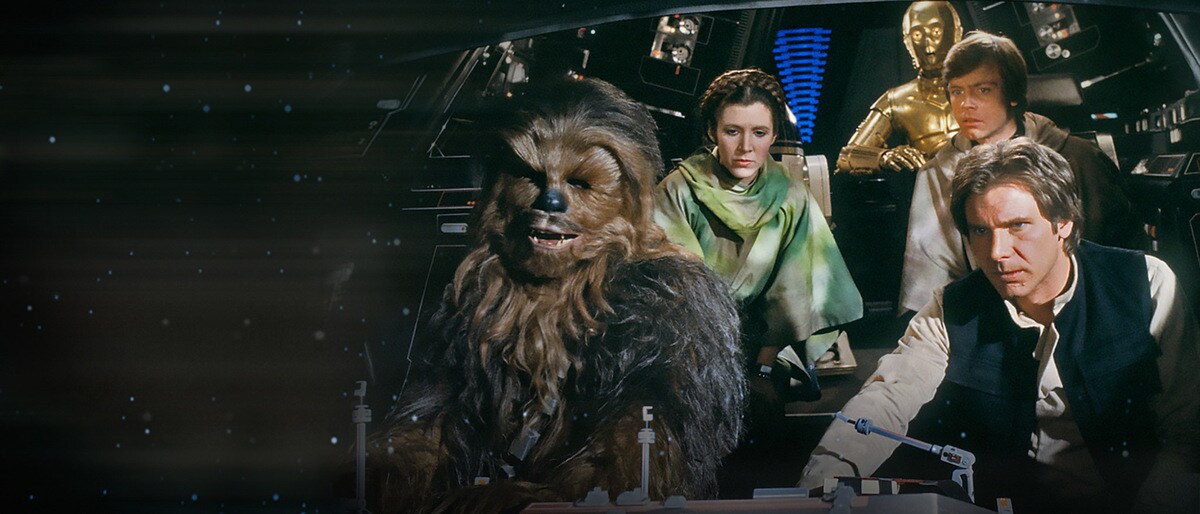
The Rebel Alliance has learned that the Empire is constructing a second Death Star in orbit around the forest moon of Endor. The station is protected by an energy shield projected from the moon. More importantly, Emperor Palpatine himself is aboard, creating an opportunity to strike the Empire's political and military leadership at once. The Alliance plans a coordinated operation. Han will lead a ground team to destroy the shield generator, while Lando commands the Millennium Falcon in the fleet assault. Luke, Leia, Chewbacca, R2-D2, and C-3PO join Han's strike team. They steal an Imperial shuttle and use captured codes to enter the Endor system. Vader senses Luke's presence during the approach but allows the shuttle to pass, bringing the family conflict physically inside the larger military campaign.
On Endor, the Rebel team encounters Imperial scouts and becomes separated. Leia chases two scout troopers on speeder bikes and meets Wicket, an Ewok. The Ewoks initially capture Luke, Han, Chewbacca, and the droids. Because they interpret C-3PO as a divine figure, the protocol droid becomes an unexpected mediator. Luke uses the Force to reinforce the impression, and C-3PO recounts the Rebels' struggle against the Empire. The Ewok community eventually accepts the visitors and agrees to help. Luke tells Leia that she is his sister and that Vader is their father. He also explains that he must surrender himself because Vader can sense him and may endanger the mission. Leia wants him to remain, but Luke believes confronting Vader is necessary both for the war and for the possibility of recovering Anakin.
Luke turns himself over to Imperial forces and is taken to Vader. He tells Vader that he senses conflict in him and believes the Emperor has not completely destroyed his former self. Vader rejects the claim and brings Luke to the Death Star. Palpatine reveals that the Rebels have been drawn into a trap. The station is operational enough to fire its superlaser, and an Imperial fleet is waiting to prevent the Rebel ships from escaping. On Endor, Han's team is captured near the shield generator. The Emperor's plan depends on the assumption that the Rebellion can be destroyed by manipulating its intelligence and concentrating its forces in one place. What he does not anticipate is the depth of the Rebels' local alliance with the Ewoks or the choices Vader will make once Luke is placed in mortal danger.
The Ewoks attack the Imperial troops surrounding the captured strike team. Their weapons are technologically simple compared with stormtrooper armor and walkers, but their knowledge of the forest, traps, mobility, and numbers changes the ground battle. The Rebels regain weapons and continue toward the bunker. Chewbacca and Ewoks capture an AT-ST, which Han uses in a deception that draws bunker personnel outside. Inside the station, Palpatine tries to provoke Luke into killing him in anger. Vader blocks Luke's strike, and father and son duel while the space battle continues outside. When Vader senses that Leia might be turned to the dark side, Luke attacks with renewed fury and cuts off Vader's mechanical hand. He then looks at Vader's severed machinery and his own artificial hand and realizes how close he is to repeating his father's path.
Luke throws away his lightsaber and refuses to kill Vader or replace him as Palpatine's apprentice. The Emperor responds with Force lightning, torturing Luke while Vader watches. Luke calls to his father for help. Vader finally chooses to intervene, lifting Palpatine and throwing him into the station's reactor shaft. The Emperor dies, but Vader is fatally injured by the lightning and the damage to his life-support systems. Luke drags him toward a shuttle. Vader asks Luke to remove his mask so he can see his son with his own eyes. As Anakin Skywalker, he tells Luke that Luke was right about him and asks him to tell Leia. Anakin dies shortly afterward. The central family conflict ends not through Luke defeating Vader by force, but through Luke refusing the Emperor's terms and Vader rejecting the role he has served for decades.
On Endor, Han's team destroys the shield generator, allowing the Rebel fleet to attack the Death Star's interior. Lando and Wedge Antilles fly through the station and destroy its main reactor. Luke escapes aboard a shuttle with Anakin's body moments before the Death Star explodes. The battle kills Palpatine, Vader, and much of the station's Imperial command while destroying another major military asset. Yet the ground victory has depended heavily on Ewok participation, and the space victory requires a coalition of pilots and ships rather than a single hero. The film repeatedly moves between these scales. Luke's private confrontation matters because it removes the Emperor, while the broader political victory requires the coordinated work of the Rebel fleet and the Endor strike force.
After the battle, Luke burns Anakin's armor on a funeral pyre, creating a private ritual separate from the larger celebration. Across the galaxy, news of the Emperor's death triggers public celebrations against Imperial symbols. On Endor, Rebels and Ewoks celebrate together. Han learns that Luke is Leia's brother, resolving his mistaken jealousy about their bond. Luke sees the Force spirits of Obi-Wan, Yoda, and Anakin watching over the gathering. Return of the Jedi closes the original trilogy with the collapse of the Empire's central leadership but not the disappearance of every Imperial institution. What has changed most decisively is the political possibility of transition. The Rebellion has survived long enough to move from resistance toward government, Luke has become a Jedi without simply reproducing the choices of his teachers, and Anakin's final act demonstrates that institutional identity can be broken even after decades of participation in violence.
IDS anthropology
Anthropological analysis
The full IDS long-form analysis is included directly on this film page.
01 · Central reading
What an anthropology lens changes
Return of the Jedi is built around alliances that the Empire consistently underestimates. Political victory depends on relationships across very different communities, while Luke's confrontation with Vader and Palpatine turns kinship into an alternative to Sith succession.
This review does not score the film. It asks what kinds of social relations the story makes visible: who has authority, how institutions reproduce themselves, what counts as family, how belief is organized, who performs necessary labor, how violence is justified, and how people attach meaning to places and objects. The aim is to connect character decisions to the systems around them without pretending that one interpretive framework exhausts what the film can mean.
02 · Anthropology lens
Jabba and patronage power
Jabba's palace is a political economy organized around personal rule. Access, entertainment, punishment, debt, and status all flow through the Hutt leader and his household. His authority is not bureaucratic in the Imperial sense. It is relational, theatrical, and enforced through retainers, fear, and control over bodies.
What makes this especially important in Return of the Jedi is that authority is never only a matter of who gives an order. Power has to move through institutions, recognized offices, information systems, material resources, and relationships that persuade or compel other people to act. The film repeatedly distinguishes formal legitimacy from practical capacity: a government may possess law without control, a commander may possess rank without autonomy, and a resistance movement may lack legal recognition while still exercising real political coordination. Reading the sequence this way shifts attention from individual intention to institutional conditions. It asks who can convert a decision into action, who can challenge that decision, which groups are excluded from the process, and what happens when public rules and lived experience stop matching one another.
03 · Anthropology lens
Ewoks and coalition politics
The Rebels initially misunderstand the Ewoks, then depend on them. The alliance works because the local community possesses knowledge of terrain, mobility, and resources that the technologically superior Empire discounts. The film therefore places military success inside an intergroup coalition rather than attributing victory only to the central heroes.
What makes this especially important in Return of the Jedi is that authority is never only a matter of who gives an order. Power has to move through institutions, recognized offices, information systems, material resources, and relationships that persuade or compel other people to act. The film repeatedly distinguishes formal legitimacy from practical capacity: a government may possess law without control, a commander may possess rank without autonomy, and a resistance movement may lack legal recognition while still exercising real political coordination. Reading the sequence this way shifts attention from individual intention to institutional conditions. It asks who can convert a decision into action, who can challenge that decision, which groups are excluded from the process, and what happens when public rules and lived experience stop matching one another.
04 · Anthropology lens
Kinship against succession
Palpatine imagines Luke as a replacement for Vader within a Sith structure of succession. Luke instead insists on his connection to his father and refuses the Emperor's terms. Vader's final action is therefore both political and familial. He breaks the chain of Sith reproduction by prioritizing a kin relationship over obedience to his master.
In Return of the Jedi, this relationship matters because kinship and belonging create obligations that formal institutions cannot fully control. Family, mentorship, adoption, friendship, descent, and chosen partnership each establish different claims about care, loyalty, inheritance, and responsibility. Those claims become politically significant when they collide with military orders, religious discipline, class position, state violence, or expectations about succession. The anthropology lens therefore treats relationships as social structures rather than private emotion alone. A person may belong to several communities at once, and those communities can demand incompatible actions. The resulting conflicts help explain why characters sometimes resist the roles assigned to them and why a change in relationship can reorganize identity more deeply than a change in title.
05 · Anthropology lens
Death, mourning, and funeral ritual
Vader's death is followed by Luke's private cremation of his body. The funeral separates Anakin from the Imperial identity represented by the armor while giving Luke a ritual act through which to mourn and reinterpret his father. The later communal celebration links private loss to public political transformation.
The religious dimension of Return of the Jedi is most revealing when belief is treated as organized practice rather than vague spirituality. Knowledge has teachers, texts, rituals, sacred places, rules of transmission, and institutions that decide who may interpret or inherit it. Religious authority can therefore conflict with family obligation, military necessity, political leadership, or personal experience. The film also shows that traditions survive unevenly: some practices remain institutionalized, others are carried by isolated practitioners, objects, memories, or stories after the original organization has weakened. This makes belief part of social history. It shapes how characters understand death, duty, legitimate power, the body, and the future, while disagreements inside the same tradition reveal that religion is never a single automatic response.
06 · Anthropology lens
Imperial spectacle and vulnerability
The second Death Star is designed as a demonstration of overwhelming Imperial capacity. Palpatine also stages Luke's encounter as a display of his own control. Yet both forms of spectacle depend on hidden assumptions about obedience, technological invulnerability, and the inability of weaker groups to coordinate.
This theme deepens the anthropology of Return of the Jedi because the scene connects individual choice to a wider social environment. Characters act through institutions, relationships, objects, inherited expectations, and unequal access to information or resources. The question is therefore not only why one person behaves as they do, but what social arrangements make that behavior possible, rewarding, dangerous, or difficult to refuse. Looking at those arrangements also reveals variation inside groups that the plot can otherwise make appear uniform. People who share a government, religion, military, species identity, or homeworld do not automatically share the same interests. The film becomes more interesting when those differences are kept visible and when personal decisions are read alongside the systems that shape their consequences.
07 · Anthropology lens
Celebration and political transition
The final celebrations show the fall of central Imperial authority as a social event experienced in multiple places. Political change becomes visible through crowds, symbols, music, and public emotion. The film does not explain the institutions that will follow, which makes the ending a moment of transition rather than a completed political settlement.
This theme deepens the anthropology of Return of the Jedi because the scene connects individual choice to a wider social environment. Characters act through institutions, relationships, objects, inherited expectations, and unequal access to information or resources. The question is therefore not only why one person behaves as they do, but what social arrangements make that behavior possible, rewarding, dangerous, or difficult to refuse. Looking at those arrangements also reveals variation inside groups that the plot can otherwise make appear uniform. People who share a government, religion, military, species identity, or homeworld do not automatically share the same interests. The film becomes more interesting when those differences are kept visible and when personal decisions are read alongside the systems that shape their consequences.
08 · Synthesis
What the film reveals when the lenses are connected
Taken together, the major lenses in this review — Jabba and patronage power, Ewoks and coalition politics, Kinship against succession, Death, mourning, and funeral ritual, Imperial spectacle and vulnerability, and Celebration and political transition — show why Return of the Jedi works as more than a sequence of plot events. Return of the Jedi is built around alliances that the Empire consistently underestimates. Political victory depends on relationships across very different communities, while Luke's confrontation with Vader and Palpatine turns kinship into an alternative to Sith succession. The recurring pattern is that large historical changes become real through ordinary social mechanisms. Institutions classify people, families create competing obligations, religious traditions authorize some forms of knowledge, labor and technology make political projects possible, and places shape who can move or act safely. The film also leaves tensions unresolved, which is analytically useful. Social systems rarely change all at once, and a victory, revelation, or regime shift does not erase the institutions and memories that came before it. For IDS, the value of the film lies in following those continuities and contradictions instead of reducing the story to a single political message.
09 · Method
How IDS is reading this film
The analysis treats Star Wars as a fictional social world rather than evidence about any real population. Anthropological concepts are used as questions, not as claims that fictional societies map directly onto real cultures. The review distinguishes events shown or established by the story from IDS interpretation about institutions, kinship, belief, political economy, identity, material culture, and historical change. That distinction matters because interpretation should make the source material more legible without quietly turning analysis into additional canon.
People in this story
Character list
Open existing IDS dossiers or search the archive for additional coverage.