
IDS Film Hub · Episode VII · 2015
The Force Awakens
One screen story, connected to the larger Imperial Dark Sector archive through anthropology, characters, institutions, places, events, and lore.
Story record
Movie summary
2015 · Episode VII
The Force Awakens begins roughly three decades after the Battle of Endor in a galaxy where the old Empire has fallen but political stability has not become permanent. The New Republic exists, yet a militarized movement called the First Order has grown from Imperial remnants beyond the Republic's immediate control. General Leia Organa leads the Resistance, a separate military organization monitoring the First Order because she believes the threat is more serious than the Republic's government is willing to acknowledge. Resistance pilot Poe Dameron travels to the desert world Jakku to receive a fragment of a map that may reveal the location of Luke Skywalker, who disappeared after a disaster involving a new generation of Jedi. First Order forces led by Kylo Ren attack the village. Poe hides the map inside his astromech BB-8 before being captured, while the droid escapes into the desert with information both sides consider strategically important.
Among the First Order stormtroopers participating in the Jakku assault is FN-2187. After witnessing civilian killings and the death of a fellow trooper, he experiences a moral break with the institution that raised and conditioned him. He refuses to fire during the massacre and later decides to escape. Poe is brought aboard a Star Destroyer, where Kylo Ren uses the Force to extract information from him and learns that the map is in a droid. FN-2187 frees Poe because he needs a pilot, and Poe gives him the name Finn. They escape in a TIE fighter but crash on Jakku. Poe appears to have died, and Finn finds himself alone. The sequence establishes Finn's identity as something contested rather than fixed. The First Order assigned him a number and military role, but his first major independent choice is to reject both and begin constructing a different social identity.
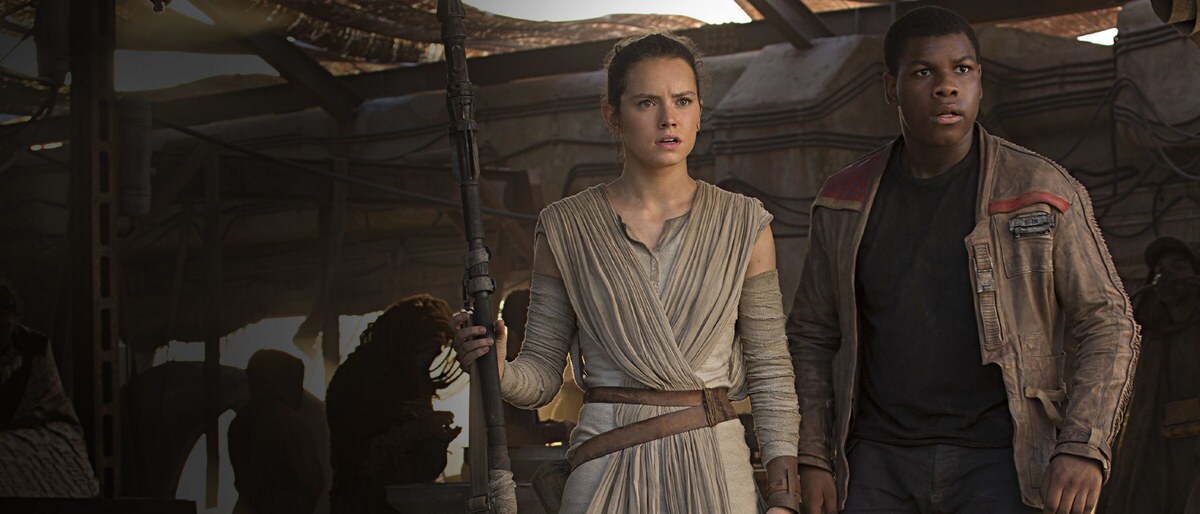
BB-8 encounters Rey, a young scavenger who survives by stripping useful technology from wrecked Imperial and Rebel ships and trading components for food. Rey lives alone and waits for family she believes may return. When she meets Finn, he lies and says he is part of the Resistance. First Order troops locate them, forcing Rey, Finn, and BB-8 to flee aboard an old freighter they discover in a junkyard: the Millennium Falcon. The ship is soon captured by a larger freighter belonging to Han Solo and Chewbacca, who have returned to smuggling after personal losses separated Han from Leia. Han recognizes the map's importance and explains that stories Rey once regarded as legend are real. Luke Skywalker, the Jedi, and the Force all existed. This information changes Rey's relationship to the past by turning distant cultural memory into something immediate and connected to the people now around her.
Han brings the group to Takodana to meet the ancient pirate and tavern keeper Maz Kanata, hoping she can help BB-8 reach the Resistance. Maz's castle functions as a crossroads for travelers, smugglers, spies, and people with multiple loyalties. There Rey discovers Luke Skywalker's old lightsaber in a storage chamber. Touching it produces a series of visions involving the past and possible future. Maz encourages Rey to accept that the family she waits for on Jakku is not coming back and to recognize that belonging may lie ahead rather than behind. Rey refuses the lightsaber and runs into the forest. Finn, meanwhile, plans to leave the conflict entirely because he believes the First Order cannot be defeated. Their different responses reflect two forms of fear: Rey fears accepting a new identity, while Finn fears returning to the institution he has only just escaped.
The First Order unveils Starkiller Base, a planet converted into a superweapon capable of absorbing stellar energy and firing across interstellar distances. General Hux addresses assembled troops before the weapon destroys the Hosnian system, including the current seat of the New Republic government and fleet. The attack eliminates the political center that might have coordinated a broad response to the First Order. Soon afterward First Order forces attack Takodana. Finn uses Luke's lightsaber in combat, Han and Chewbacca fight alongside arriving Resistance pilots, and Kylo Ren captures Rey. Leia arrives after the battle and reunites with Han. The meeting is emotionally restrained but reveals that their son, Ben Solo, became Kylo Ren after training with Luke. Han left and returned to smuggling, while Leia returned more deeply to political and military work. Their family history is now inseparable from the larger conflict.
At Starkiller Base, Kylo interrogates Rey and attempts to extract the map from her mind. Rey unexpectedly resists and begins discovering her own Force sensitivity. She later uses a Jedi mind trick on a stormtrooper and escapes detention. At the Resistance base, Finn claims he can help disable Starkiller Base because he knows its systems, though he later admits his First Order job was in sanitation rather than high-level military operations. Leia, Han, Chewbacca, and Resistance officers plan a combined attack. Han, Chewbacca, and Finn infiltrate the installation while Poe leads fighter forces. Finn's real motivation is rescuing Rey, but the mission becomes strategically important when the infiltrators capture Captain Phasma and force her to lower the base's defensive shields. Their actions again connect personal loyalty to institutional warfare: a rescue attempt creates the opening required for a larger military strike.
Inside the base Han confronts Kylo Ren on a bridge over a vast energy shaft. He calls him Ben and asks him to come home. Kylo admits that he feels conflict and says he knows what he has to do. For a moment he appears to offer Han his lightsaber, then ignites it through his father's body. Han falls into the shaft as Chewbacca fires on Kylo in rage. The killing is an attempt by Kylo to sever his remaining attachment to his family and prove commitment to the dark side, but the act does not eliminate his emotional conflict. Chewbacca detonates explosives that damage the oscillator controlling Starkiller Base, allowing Poe and the Resistance pilots to attack more effectively. Finn and Rey encounter Kylo in the snowy forest as the planet begins destabilizing.
Kylo incapacitates Rey and duels Finn, who uses Luke's lightsaber despite lacking Jedi training. Finn fights with determination but is severely wounded. The lightsaber then flies past Kylo and into Rey's hand. Rey initially struggles against him, then centers herself in the Force and gains the advantage. Before she can continue, the collapsing planet splits the ground between them. Chewbacca rescues Rey and Finn aboard the Falcon. Poe destroys the oscillator, and the Resistance fighters escape before Starkiller Base explodes. Supreme Leader Snoke orders General Hux to retrieve Kylo so his training can be completed. Like the destruction of the first Death Star, the loss of the weapon is a dramatic blow to an authoritarian power, but the political situation is more complicated because the New Republic's central government has already been destroyed.
Back at the Resistance base, Rey reunites with Finn, now unconscious but alive. R2-D2, inactive for years, awakens and provides the missing section of the map that BB-8 carries. Together the droids reveal Luke's location. Rey departs in the Millennium Falcon with Chewbacca and R2-D2, travels to the remote oceanic world Ahch-To, and climbs the stone steps of an isolated island. At the summit she finds Luke Skywalker. Without dialogue, she holds out his old lightsaber. The gesture carries several histories at once: Luke's lost relationship to the Jedi, Rey's emerging connection to the Force, the failure of Luke's previous attempt to rebuild the Order, and the Resistance's hope that his return might restore something the galaxy has lost.
The Force Awakens closes with nearly every central character between identities. Finn has rejected being a stormtrooper but has not yet defined a broader political role. Rey has left Jakku and stopped waiting physically for her family, but she still does not understand her origins. Han has died while trying to reclaim his son. Leia remains the leader of a Resistance whose political environment has become far more dangerous after the destruction of the Republic capital. Kylo has killed his father without resolving the conflict inside himself. Luke is alive but absent from galactic events. The film therefore restarts the saga not by recreating the exact political order of the original trilogy but by showing how unfinished institutions, family memory, abandoned responsibilities, and inherited stories create a new conflict for people who grew up after the Empire's apparent defeat.
IDS anthropology
Anthropological analysis
The full IDS long-form analysis is included directly on this film page.
01 · Central reading
What an anthropology lens changes
The Force Awakens is deeply concerned with what later generations inherit from conflicts they did not start. Rey lives among the material remains of war, Finn is raised by a military institution, Kylo Ren treats family history as ideology, and the New Republic's destruction reveals the fragility of political reconstruction.
This review does not score the film. It asks what kinds of social relations the story makes visible: who has authority, how institutions reproduce themselves, what counts as family, how belief is organized, who performs necessary labor, how violence is justified, and how people attach meaning to places and objects. The aim is to connect character decisions to the systems around them without pretending that one interpretive framework exhausts what the film can mean.
02 · Anthropology lens
Scavenging and postwar material culture
Rey's life on Jakku is organized around salvaging the wreckage of a previous war. Imperial and Rebel machines become resources to be dismantled, traded, and repurposed. The battlefield has become an economy. This is one of the clearest Star Wars examples of how material remains outlive the political systems that produced them.
The Force Awakens also makes this theme useful for material anthropology because political life depends on things being built, moved, repaired, bought, extracted, and maintained. Weapons, ships, droids, fuel, housing, sacred objects, uniforms, factories, and transport systems distribute possibilities unevenly across the galaxy. The characters who control those resources do not necessarily perform the labor that keeps them functioning, and the people who do that work are often pushed to the edge of the story. Following the material chain makes inequality easier to see. It connects spectacular events to ordinary work, infrastructure, property, and supply. It also shows why the same object can mean something different depending on who owns it, who repairs it, who is allowed to use it, and what institution gives it value.
03 · Anthropology lens
Stormtrooper socialization and desertion
Finn's break with the First Order makes military socialization visible. He has been assigned a number, trained for obedience, and denied an ordinary family life. His desertion is not simply a change of opinion. It requires the creation of a new name, new relationships, and a social identity outside the institution that raised him.
The conflict in The Force Awakens becomes more legible when warfare is treated as a social system instead of a sequence of battles. Armies require recruitment, classification, discipline, intelligence, transport, communications, medical support, supply, and stories that justify risk and sacrifice. Occupation and resistance also reach beyond soldiers because civilians must adapt to searches, shortages, checkpoints, surveillance, displacement, destroyed infrastructure, and changing definitions of loyalty. This perspective helps explain why military power can remain present even when no battle is occurring. It is embedded in routines and institutions. The film's dramatic violence is therefore only the visible edge of a much larger system that organizes bodies, labor, movement, information, and memory.
04 · Anthropology lens
Memory, myth, and generational distance
Rey initially treats Luke Skywalker as a story from the past. Han's confirmation that the stories are real shows how historical events become mythologized within living memory. The film repeatedly asks how younger people orient themselves toward inherited narratives they know only through fragments, objects, reputations, and rumors.
The Force Awakens treats identity as something produced through recognition, memory, classification, and material signs rather than as a fixed inner essence. Names, uniforms, ancestry, scars, masks, reputations, occupations, and institutional records all tell other people how a person is supposed to be understood. Those labels can provide belonging and authority, but they can also restrict movement or preserve a version of the past that a character no longer accepts. This is why memory becomes political. Communities decide which stories to repeat, which failures to hide, and which figures become models for later generations. The film's characters inherit those stories unevenly, and their attempts to accept, reject, or reinterpret them become part of the larger struggle over social identity.
05 · Anthropology lens
New Republic fragility
The destruction of the Hosnian system removes the Republic's political center with extraordinary speed. The event suggests that institutional restoration after the Empire did not eliminate vulnerability. The Resistance's semi-independent position also shows that formal government and anti-First Order mobilization are not identical.
What makes this especially important in The Force Awakens is that authority is never only a matter of who gives an order. Power has to move through institutions, recognized offices, information systems, material resources, and relationships that persuade or compel other people to act. The film repeatedly distinguishes formal legitimacy from practical capacity: a government may possess law without control, a commander may possess rank without autonomy, and a resistance movement may lack legal recognition while still exercising real political coordination. Reading the sequence this way shifts attention from individual intention to institutional conditions. It asks who can convert a decision into action, who can challenge that decision, which groups are excluded from the process, and what happens when public rules and lived experience stop matching one another.
06 · Anthropology lens
Kylo Ren and inherited identity
Kylo Ren builds his identity through selective inheritance. He treats Vader as an ancestral model while rejecting Anakin's final return. Family history becomes political material that can be curated, misunderstood, or weaponized. His mask and collection of Vader's remains turn ancestry into a form of material practice.
The Force Awakens treats identity as something produced through recognition, memory, classification, and material signs rather than as a fixed inner essence. Names, uniforms, ancestry, scars, masks, reputations, occupations, and institutional records all tell other people how a person is supposed to be understood. Those labels can provide belonging and authority, but they can also restrict movement or preserve a version of the past that a character no longer accepts. This is why memory becomes political. Communities decide which stories to repeat, which failures to hide, and which figures become models for later generations. The film's characters inherit those stories unevenly, and their attempts to accept, reject, or reinterpret them become part of the larger struggle over social identity.
07 · Anthropology lens
Chosen belonging
Rey, Finn, Han, Chewbacca, BB-8, and Poe form relationships that cut across origin and status. The film contrasts institutions that assign identity with relationships that are chosen and negotiated. Its emotional structure repeatedly asks whether belonging is inherited, imposed, or built through mutual recognition.
In The Force Awakens, this relationship matters because kinship and belonging create obligations that formal institutions cannot fully control. Family, mentorship, adoption, friendship, descent, and chosen partnership each establish different claims about care, loyalty, inheritance, and responsibility. Those claims become politically significant when they collide with military orders, religious discipline, class position, state violence, or expectations about succession. The anthropology lens therefore treats relationships as social structures rather than private emotion alone. A person may belong to several communities at once, and those communities can demand incompatible actions. The resulting conflicts help explain why characters sometimes resist the roles assigned to them and why a change in relationship can reorganize identity more deeply than a change in title.
08 · Synthesis
What the film reveals when the lenses are connected
Taken together, the major lenses in this review — Scavenging and postwar material culture, Stormtrooper socialization and desertion, Memory, myth, and generational distance, New Republic fragility, Kylo Ren and inherited identity, and Chosen belonging — show why The Force Awakens works as more than a sequence of plot events. The Force Awakens is deeply concerned with what later generations inherit from conflicts they did not start. Rey lives among the material remains of war, Finn is raised by a military institution, Kylo Ren treats family history as ideology, and the New Republic's destruction reveals the fragility of political reconstruction. The recurring pattern is that large historical changes become real through ordinary social mechanisms. Institutions classify people, families create competing obligations, religious traditions authorize some forms of knowledge, labor and technology make political projects possible, and places shape who can move or act safely. The film also leaves tensions unresolved, which is analytically useful. Social systems rarely change all at once, and a victory, revelation, or regime shift does not erase the institutions and memories that came before it. For IDS, the value of the film lies in following those continuities and contradictions instead of reducing the story to a single political message.
09 · Method
How IDS is reading this film
The analysis treats Star Wars as a fictional social world rather than evidence about any real population. Anthropological concepts are used as questions, not as claims that fictional societies map directly onto real cultures. The review distinguishes events shown or established by the story from IDS interpretation about institutions, kinship, belief, political economy, identity, material culture, and historical change. That distinction matters because interpretation should make the source material more legible without quietly turning analysis into additional canon.
People in this story
Character list
Open existing IDS dossiers or search the archive for additional coverage.