
- Date
- 3962 BBY
- Location
- Nazzri system
- Region
- Mid Rim
- Outcome
- Mandalorian victory
- Evidence
- Atlas route
Historical narrative and evidence
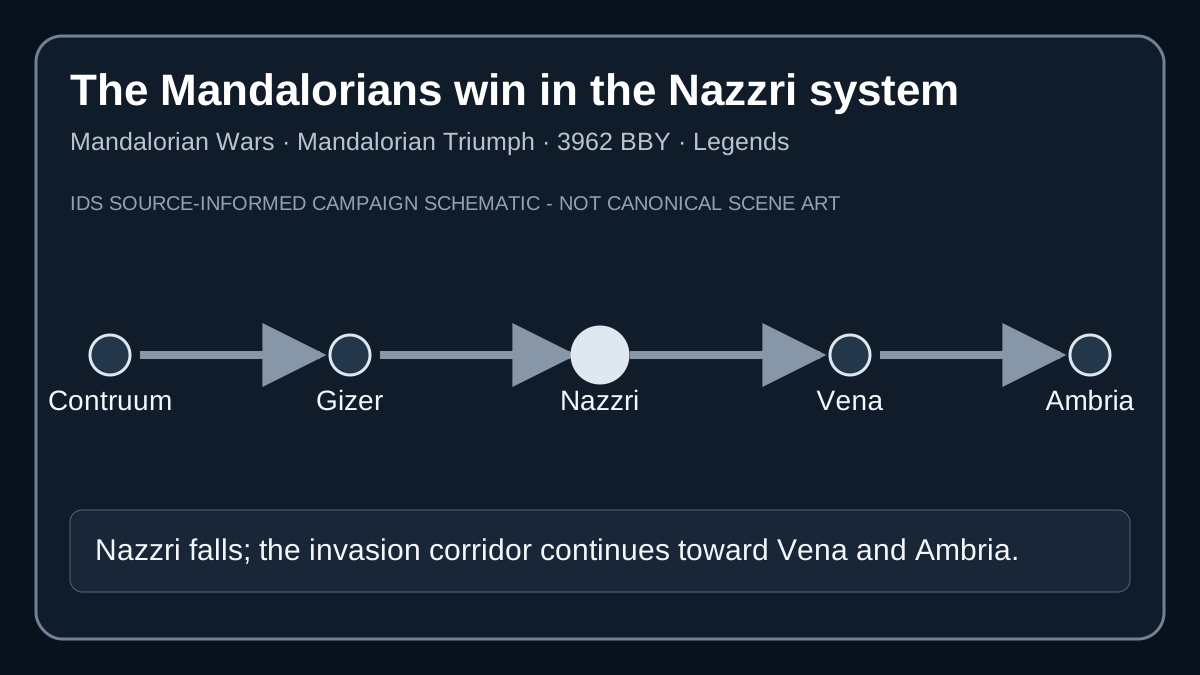
The Mandalorian Neo-Crusaders and Galactic Republic fought in the Nazzri system in 3962 BBY. The battle formed part of the Mandalorian Triumph, the large Coreward offensive that eventually reached Duro. Nazzri followed the Mandalorian victory at Gizer and preceded the documented fighting at Vena and Ambria.
A corridor built from repeated victories
Nazzri demonstrates the cumulative nature of the Triumph. The Mandalorians did not need every battle to be independently decisive. They needed enough victories in sequence to keep routes open and prevent the Republic from creating a stable defensive barrier.
Seen on its own, Nazzri can look minor. Seen with Gizer, Vena, and Ambria, it becomes part of a sustained pattern of penetration. That pattern is what made the broader offensive dangerous.
The archive preserves strategy better than experience
Later historical sources preserve Nazzri mainly as a location on a campaign map. We therefore know more about where it fits than about what people experienced there. The absence of a battle narrative is not permission to fill in names, formations, or casualties.
IDS treats this as a source-limit case. The page exists because the event is part of the chronology, but the wording remains tied to what the surviving evidence can support.
Anthropological assessment
Nazzri is useful for studying how warfare turns geography into hierarchy. Systems closer to major routes acquire strategic importance because armies and governments depend on movement between them. The social value of a place can therefore change rapidly when a conflict makes its location militarily useful.
For the Republic, the repeated losses also created an institutional problem. A government that claims an enormous territory must convince member worlds that it can still reach and defend them. Every lost node weakened that promise, even when the battle itself remained obscure.
Evidence check
What is firmly established?
The date or date range, location, continuity, broad combatants, outcome, and campaign placement are retained only where the cited Legends sources support them.
What has IDS deliberately not invented?
Unnamed commanders, exact force sizes, casualty totals, dialogue, tactical phases, and civilian experiences are omitted whenever the surviving sources do not establish them.
Why use a schematic instead of borrowed battle art?
For events without a verified source-specific illustration, this page uses an original labeled reconstruction rather than presenting unrelated comic or game art as though it depicts the battle.
Editorial field note · 3962 BBY · Legends
How to interpret the Nazzri engagement
Recorded outcome: Mandalorian victory. The event belongs to the advance through connected systems. Read this outcome alongside the wider conflict rather than assuming that a single battle describes every front.
Historical method: Campaign maps and later summaries can establish a place in the war without preserving individual commanders, tactical formations, civilian testimony or a precise sequence of hours. Where the published account is limited, a detailed scene reconstruction would mislead readers.
Test the evidence: what can this entry establish?
It supports the documented event and its stated outcome. It cannot, by itself, establish casualty numbers, spoken orders or the motives of unnamed participants. Compare adjacent entries and their citations before inferring broader causes.
Explore a connected campaign event →
This field note distinguishes source-backed chronology from analytical interpretation; see the references below.
Historical judgment · Legends · Source literacy
Test your interpretation of this battle
Answer both questions for a score, specific corrections and an explanation of what the record can establish.
Source method: This assessment follows the references in this entry. A later campaign map can document a system and a result without documenting conversations, exact numbers or undocumented motives.
Sources and further reading
- The Essential Atlas, Daniel Wallace and Jason Fry (2009), Mandalorian Wars chronology and campaign mapping.
- The Essential Guide to Warfare, Jason Fry (2012), where applicable to later in-universe military-historical accounts.
About these links: Publisher and Lucasfilm records identify the referenced editions. A book description or game listing is not a scene-by-scene record of this battle; map placements, dialogue, casualty claims and historical interpretations must be checked against the original pages or gameplay.