
- Date
- 3962 BBY
- Location
- Gizer system
- Region
- Mid Rim
- Outcome
- Mandalorian victory
- Next
- Nazzri
Historical narrative and evidence
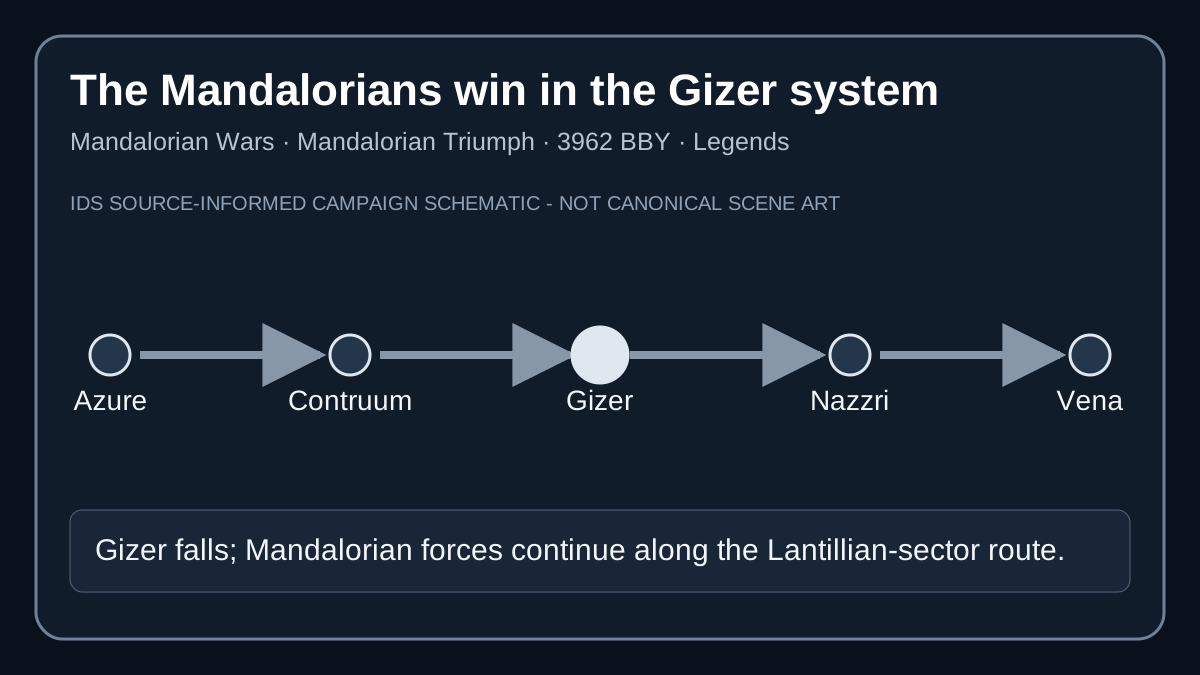
The Battle of the Gizer system took place in 3962 BBY during the Mandalorian Triumph. After moving through Azure and Contruum, Neo-Crusader forces defeated the Republic at Gizer and continued toward Nazzri. The system lay in the Mid Rim's Lantillian sector, placing the battle inside the wider Coreward pressure of the invasion.
The value of sequence
Gizer is best understood as a connective event. Its importance is not that later sources describe a spectacular engagement. They do not. Its importance is that the Mandalorian force remained capable of moving from one contested system to the next without being stopped.
Campaigns succeed when movement, supply, and combat reinforce one another. A force that wins but becomes isolated may still lose strategically. At Gizer, the documented outcome instead fits a continuing chain of Mandalorian movement toward the inner galaxy.
Why retain a sparse page?
A comprehensive timeline should not erase events simply because later storytelling devoted little space to them. Doing so would privilege famous characters and cinematic scenes over the less visible military geography that made major outcomes possible.
The better solution is proportional treatment. Gizer receives a clear account of what is known, a statement of what remains unknown, and links to the surrounding operations. It does not receive invented officers or imagined battlefield drama.
Anthropological assessment
Gizer illustrates how states experience war through networks rather than isolated worlds. A system's military meaning can come from where it sits in relation to other systems. Control of a route changes which communities can be supplied, reinforced, evacuated, or threatened.
This network perspective also helps explain why the Mandalorian Triumph produced political shock. The invasion demonstrated that the Republic's territorial depth could be converted into a sequence of penetrable corridors. Distance alone did not guarantee security.
Evidence check
What is firmly established?
The date or date range, location, continuity, broad combatants, outcome, and campaign placement are retained only where the cited Legends sources support them.
What has IDS deliberately not invented?
Unnamed commanders, exact force sizes, casualty totals, dialogue, tactical phases, and civilian experiences are omitted whenever the surviving sources do not establish them.
Why use a schematic instead of borrowed battle art?
For events without a verified source-specific illustration, this page uses an original labeled reconstruction rather than presenting unrelated comic or game art as though it depicts the battle.
Editorial field note · 3962 BBY · Legends
How to interpret the Gizer engagement
Recorded outcome: Mandalorian victory. The event belongs to the expanding campaign network. Read this outcome alongside the wider conflict rather than assuming that a single battle describes every front.
Historical method: Campaign maps and later summaries can establish a place in the war without preserving individual commanders, tactical formations, civilian testimony or a precise sequence of hours. Where the published account is limited, a detailed scene reconstruction would mislead readers.
Test the evidence: what can this entry establish?
It supports the documented event and its stated outcome. It cannot, by itself, establish casualty numbers, spoken orders or the motives of unnamed participants. Compare adjacent entries and their citations before inferring broader causes.
Explore a connected campaign event →
This field note distinguishes source-backed chronology from analytical interpretation; see the references below.
Historical judgment · Legends · Source literacy
Test your interpretation of this battle
Answer both questions for a score, specific corrections and an explanation of what the record can establish.
Source method: This assessment follows the references in this entry. A later campaign map can document a system and a result without documenting conversations, exact numbers or undocumented motives.
Sources and further reading
- The Essential Atlas, Daniel Wallace and Jason Fry (2009), Mandalorian Wars chronology and campaign mapping.
- The Essential Guide to Warfare, Jason Fry (2012), where applicable to later in-universe military-historical accounts.
About these links: Publisher and Lucasfilm records identify the referenced editions. A book description or game listing is not a scene-by-scene record of this battle; map placements, dialogue, casualty claims and historical interpretations must be checked against the original pages or gameplay.