
- Region
- Cron Cluster
- Initiator
- Aleema Keto
- Immediate deaths
- Aleema · Crado · Jedi pursuers
- Consequence
- Ossus threatened
At Kemplex Nine, Aleema Keto attempted to use technology associated with Naga Sadow to destroy pursuing Jedi forces. The weapon destabilized a star. In the densely packed Cron Cluster, the destruction propagated, producing a chain reaction far beyond the tactical objective Aleema had intended. She died in the catastrophe along with Crado and Jedi including Dace Diath, Shoaneb Culu, and Qrrrl Toq. The energy wave then raced toward Ossus.
3996 BBY · Legends · Evidence and cultural history
Cron Supernova: who destroyed the cluster?
What the sources establish
During the Legends conflict at Kemplex Nine, Aleema Keto used technology derived from Naga Sadow's Sith ship to attack pursuing Jedi. The attempt triggered destruction far beyond her tactical objective, killing Aleema and members of the pursuing force while the energy threatened Ossus. The disaster reshaped the Cron Cluster into the region later known as the Cron Drift.
What can be misunderstood
The Canon reference Nexus of Power gives a different historical tradition: Naga Sadow is named as the figure responsible for the Cron Supernova. That claim belongs to a separate continuity and should never overwrite the Legends comics' Aleema Keto account. Even within Legends, this is not evidence that anyone measured or intentionally planned each stage of the cluster-wide chain reaction. The story is about an attack escaping the scale of its objective.
Who caused the Cron Supernova in each continuity?
Legends identifies Aleema Keto in 3996 BBY. A distinct Canon historical account attributes the event to Naga Sadow approximately 4,000 years before the Imperial era. They are not identical eyewitness histories.
Source tradition: Tales of the Jedi — The Sith War #4–5; The Essential Atlas; Nexus of Power (Canon account). Read the publisher record / sourced reference →. The hero is an original IDS conceptual drawing, not licensed comic art. For stories reconstructed through later reference books, original page/panel verification is still needed.
A tactical plan becomes a system-scale disaster
Aleema intended to destroy enemies pursuing her. The technology she activated operated at a scale she could not safely control.
This is the defining danger of high-consequence systems: a tool can be strategically attractive precisely because its maximum effects exceed the user's ability to contain them.
Dense stellar geography amplifies the catastrophe
The Cron Cluster contained stars close enough in the narrative for one destabilization to contribute to a cascading sequence.
Local geography therefore transformed one weapon use into regional destruction.
The disaster kills attacker and pursuer alike
Aleema's death exposes the collapse of the distinction between weapon user and target. Crado and several Jedi also died, making the event a shared catastrophe rather than a clean military victory.
Weapons that cannot discriminate between user, combatant, and environment undermine the strategic logic that motivated their use.
Exar Kun turns disaster into opportunity
The outgoing energy threatened Ossus, forcing the Jedi to evacuate archives and artifacts. Kun recognized that emergency movement created an opening for theft and attack.
Catastrophe therefore produced a second layer of intentional violence: one actor's uncontrolled disaster became another actor's planned opportunity.
A war leaves permanent astronomical geography
The destroyed cluster became a lasting feature of the galactic map. Later travelers encountered the material consequence of a conflict whose political participants were long dead.
Like Denarii Nova, the event turns military history into environmental history at stellar scale.
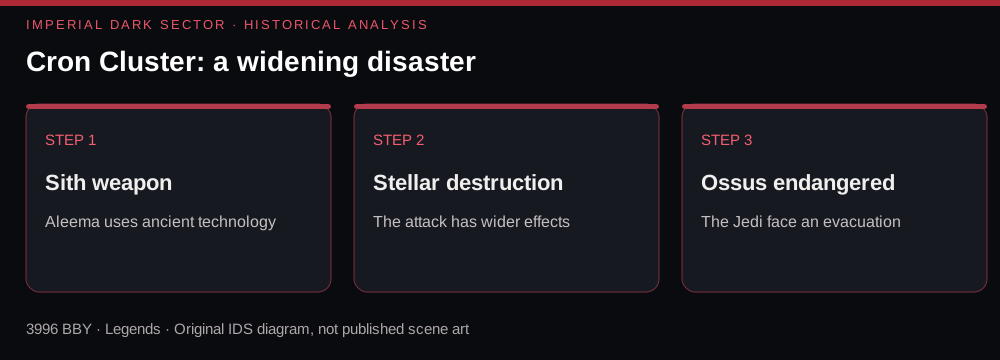
Event sequence
Aleema activates ancient Sith stellar technology.
The Cron Cluster erupts in chain-reaction destruction.
Aleema, Crado, and several Jedi die.
Ossus becomes endangered.
Jedi evacuation and Sith attack converge in the Battle of Ossus.
Explore this entry
Did Exar Kun trick Aleema?
Legends accounts emphasize manipulation and incomplete understanding surrounding the weapon. Aleema was willing to use catastrophic power but did not survive its consequences.
Why did the disaster threaten Ossus?
The outgoing stellar energy propagated from the Cron Cluster toward the Jedi world, making emergency evacuation necessary.
Why is this more than a battle event?
Because it permanently changed astronomical geography. Political violence became a feature of the physical galaxy.
Anthropological assessment
The Cron Supernova shows technological risk at a scale where ordinary ideas of battlefield proportionality collapse. The user cannot meaningfully separate target, environment, and future populations affected by the transformed region.
It also demonstrates opportunistic politics: emergencies create openings because normal institutional routines—security, archives, transportation, command—are disrupted at the same moment.
Primary comic / historical analysis
A deliberate strike escapes every planned boundary
Aleema Keto used ancient Sith-related technology at Kemplex Nine in an attempt to destroy pursuing opponents. Instead of a controllable tactical success, the attack destabilized stellar bodies within the Cron Cluster and unleashed a catastrophe on a scale that exceeded the commander's immediate objectives. Aleema died along with Crado and several Jedi pursuers. The later threat to Ossus made the disaster important not simply as a failure at one target, but as the beginning of another phase of the war.
The destruction placed the Jedi library world under pressure to evacuate people and preserve irreplaceable knowledge. Exar Kun recognized that evacuation would weaken defenses and create an opportunity to steal relics. Thus the uncontrolled effects of Aleema's action produced conditions another Sith leader chose to exploit. The specific stellar physics belong to Star Wars metaphysics and should not be presented as a scientifically derived mechanism. What the source reliably depicts is a weapon activated for a limited purpose producing effects the user could not contain.
What a destructive instrument cannot choose
The expanding catastrophe killed its initiator and others beyond the intended opponents. It eliminated the distinction between the user of a weapon and people inside its wider field of effect. A technology that cannot be limited to its intended targets undermines the strategic logic motivating its use.
A disaster changes the meaning of an archive
Ossus's libraries and relics became movable or endangered objects rather than secure institutions. Evacuation forced choices among life, historical materials and the time needed to remove them. The Sith then turned that vulnerability into an attack.
Did Exar Kun himself trigger the supernova as a precise plan to destroy Ossus?
Aleema Keto activated the ancient technology in an attempt to attack pursuers; the resulting chain reaction threatened Ossus. Kun subsequently exploited that situation. The initial disaster and the following raid should be kept distinct.
Issue evidence: Tales of the Jedi: The Sith War #4, 'Jedi Holocaust' (1995). The narrative distinguishes the comic's directly depicted action from historical consequences and IDS interpretation. Publication year is not the in-universe year; 3996/3997 BBY labels belong to Legends.
Sources and further reading
- Tales of the Jedi – The Sith War.
- The Essential Atlas.
- The New Essential Chronology.