
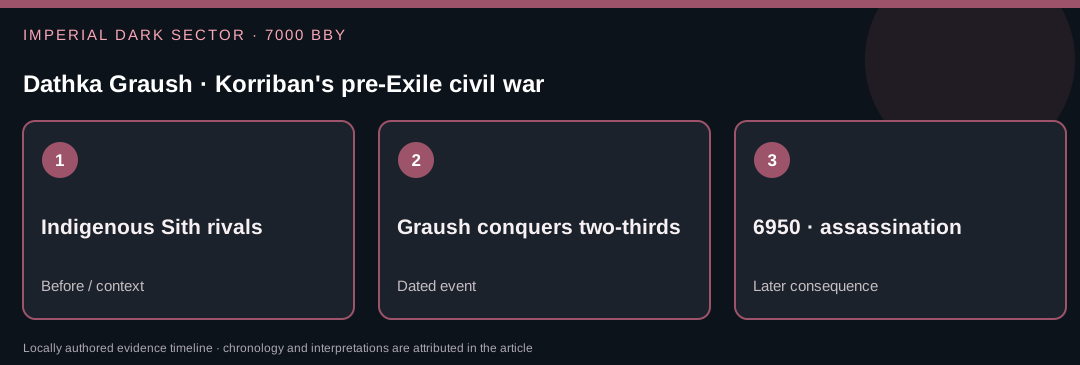
In 7000 BBY, the Sith sorcerer Dathka Graush initiated one of Korriban’s recurring civil wars. His forces devastated most population centers on the planet, and Graush ultimately emerged as King of the Sith. At the height of his rule, roughly two-thirds of Korriban submitted to him.
Korriban destroys itself from within
The war was not an invasion by the Jedi or Republic. It was an internal Sith struggle among competing rulers.
Most of Korriban's cities were destroyed in the conflict.
Dathka Graush
Graush used fear, brutality, Sith sorcery, and alchemy to dominate rivals.
His reputation was extreme even by the standards of a society repeatedly described as violent.
Sorcery and the dead
Graush perfected the Tsaiwinokka Hoyakut spell, which allowed him to animate corpses as servants bound through the dark side.
He also replaced his own heart with a Force-imbued crystal according to later stories.
A dynasty that could not stabilize Korriban
Graush was eventually assassinated by his own followers.
His fall left a violent political landscape that later Dark Jedi Exiles would encounter after the Hundred-Year Darkness.
Anthropological assessment
Graush’s civil war shows that the Sith world the Exiles later encountered was not politically unified. Its institutions had been shaped by dynastic violence long before the arrival of fallen Jedi from the Republic.
It also illustrates how rulers use supernatural claims as political technology. Sorcery, resurrection, and personal transformation reinforced Graush's image as a king whose authority exceeded ordinary political power.
7000 BBY · Legends · Source and continuity dossier
Dathka Graush · Korriban's pre-Exile civil war
Documented account
Dathka Graush was a member of the Sith species, ruling centuries of local Sith history prior to the arrival of the Dark Jedi Exiles. The Essential Atlas places the beginning of his Korriban civil war in 7000 BBY. His forces devastated major settlements and eventually brought roughly two-thirds of the planet under his kingship. Later descriptions associate his rule with undead armies animated by Sith sorcery.
Anthropological interpretation
Graush's war belongs to the history of indigenous Sith political competition. His kingship demonstrates that complex sovereignty, social ranks, royal power, and Force traditions did not depend on the later outside conquerors. The destruction of city centers would also have affected communities living outside the fortified sites, even though the sources give no household-level demographic totals.
Dates, continuity and historical caution
An older roleplaying reference called Graush a Dark Lord of the Sith, but later chronology makes Ajunta Pall the first Dark Lord of the Exile-derived Sith Order in 6900 BBY. Graush is properly discussed here as a Sith king. The two histories overlap only because later authors revised titles and dates.
Test the evidence: Did Ajunta Pall command Dathka Graush's 7000 BBY civil war?
Correction and insight: No. Graush was an indigenous Sith ruler a century before the Exiles' arrival.
Publication trail: The Essential Atlas; Korriban: Planet of Lost Souls (2003); Book of Sith continuity notes. Public reference: Check this Legends source history →. Original publications may require independent print issue or page verification.
Sources and further reading
- Daniel Wallace and Jason Fry, The Essential Atlas, 2009.
- “Korriban: Planet of Lost Souls.”
- Dathka Graush/Legends, Wookieepedia