
In 6950 BBY, the fifty-year reign of Dathka Graush came to an end when his own followers assassinated him. Graush had conquered roughly two-thirds of Korriban through a brutal civil war, used Sith sorcery to animate the dead, and ruled a society already fractured by dynastic violence. His death left the Graush dynasty fragmented only fifty years before the exiled Dark Jedi reached Korriban.
A ruler killed by his own followers
Graush's methods were considered extreme even within a political culture already marked by violence.
His assassination ended personal rule without producing a stable unified successor regime.
The Heart of Graush
Graush had replaced his heart with a dark-side crystal according to later accounts.
The artifact was entombed with him and became a container for spirits tied to his sorcery.
A fragmented Korriban awaits the Exiles
The Graush dynasty did not disappear instantly, but its authority fractured.
When the Dark Jedi arrived decades later, they encountered a Sith society with older rulers, priesthoods, warrior castes, and competing traditions.
Anthropological assessment
Graush's death shows the fragility of states built heavily around personal terror. Once the ruler who concentrates power disappears, institutions may not be strong enough to preserve unity.
It also matters for later Sith history because the Exiles did not conquer an empty world. They entered a society whose political order had already been destabilized by generations of internal violence.
6950 BBY · Legends · Source and continuity dossier
Dathka Graush's death · the surviving archives
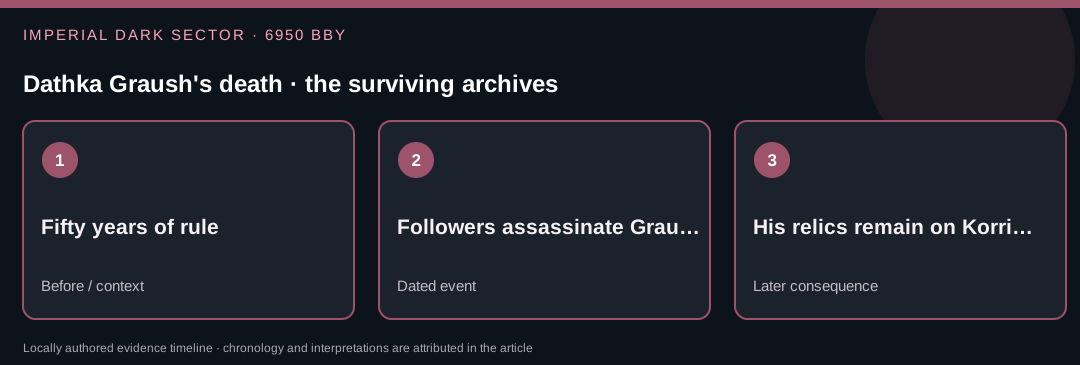
Documented account
After fifty years of domination and terror, Dathka Graush was assassinated by members of his own following around 6950 BBY. Legends describes the sorcerer replacing his natural heart with a crystal and binding spirits to his undead soldiers through dark-side rituals. His tomb and the Heart of Graush survived as objects associated with power long after the political coalition that supported him collapsed.
Anthropological interpretation
The killing of a king by insiders shows that terror is not the same as durable loyalty. He could subjugate large areas of Korriban, yet his own followers ultimately judged his rule intolerable. Burial goods, protective rituals, and concealed artifacts became part of his posthumous authority. An archaeological record is sometimes the only visible trace of a once-powerful regime.
Dates, continuity and historical caution
Graush's date is prior to the Battle of Corbos and before the Exiles reached Korriban. Book of Sith distinguishes him from Hakagram Graush, whom Ajunta Pall later overthrew. Claims about a magical crystal extending life belong to Legends narrative, not independent real-world proof of immortality.
Test the evidence: Was Dathka Graush the Sith king killed by Ajunta Pall in 6900 BBY?
Correction and insight: No. Graush died around 6950 BBY; Ajunta Pall overthrew Hakagram Graush later.
Publication trail: Korriban: Planet of Lost Souls (2003); The Essential Atlas; Book of Sith: Secrets from the Dark Side. Public reference: Check this Legends source history →. Original publications may require independent print issue or page verification.
Sources and further reading
- “Korriban: Planet of Lost Souls.”
- The Essential Atlas.
- Dathka Graush/Legends, Wookieepedia