
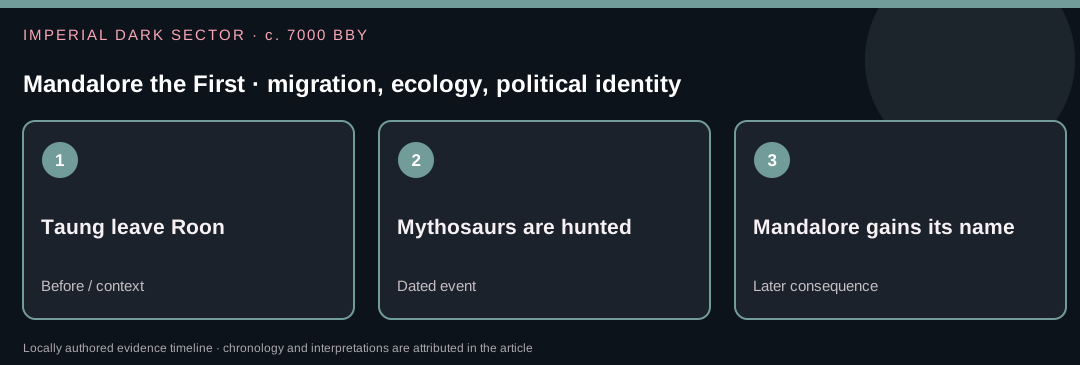
Around 7000 BBY, Mandalore the First led Taung followers from Roon to an Outer Rim world dominated by enormous mythosaurs. The Taung conquered the planet, hunted the giant creatures to extinction, and named their new home Manda'yaim, later rendered in Basic as Mandalore. The migrants increasingly identified themselves as Mandalorians.
From Coruscant to Roon to Mandalore
The Taung traced their deeper exile to ancient conflict with Human Zhell on Coruscant.
After a long period on Roon, Mandalore the First led them to a new world.
The destruction of the mythosaurs
Mythosaurs were the dominant giant creatures of the planet before Taung settlement.
The Taung killed them as part of conquering and claiming the world.
A leader’s name becomes a planetary identity
Manda'yaim meant the home of the Mand'alor, tying place directly to political leadership.
The title Mandalore became associated with the leader of the clans, while the people became Mando'ade or Mandalorians.
The roots of the Mandalorian Crusaders
Later tradition associated the beginning of the Mandalorian Crusades with this early period.
Mandalore the Conqueror rather than Mandalore the First is identified as the first actual leader of the Crusaders in some later chronology.
Anthropological assessment
The settlement of Mandalore shows how migration, conquest, ecology, and political naming can combine to create a new ethnic identity.
The Taung did not merely relocate. They remade themselves around a new world and a title of leadership, while the extinction of the mythosaurs became part of the martial memory that defined later Mandalorian culture.
c. 7000 BBY · Legends · Source and continuity dossier
Mandalore the First · migration, ecology, political identity
Documented account
In Legends, the Taung had lived on Coruscant and later Roon before a leader remembered as Mandalore the First led followers to an Outer Rim world around 7000 BBY. The settlers fought and hunted immense mythosaurs, which the tradition says were exterminated. The settlement became known as Mandalore, and its leader's title passed to successors.
Anthropological interpretation
A migratory foundation story creates a shared identity by joining an ancestor, a place and symbols. Mythosaur skulls became emblematic of later Mandalorian culture, but the narrative also records ecological violence as part of territorial occupation. The planet was not politically empty simply because the settlers renamed it and made it their home.
Dates, continuity and historical caution
The Taung origin and the dating c. 7000 BBY belong to Legends and are partly retrospective legend. Later Mandalorian society included many species, so Taung ancestry should not be asserted as a genetic definition of every future Mandalorian. The exact number of mythosaurs and battles is not known.
Test the evidence: Does Mandalorian identity remain limited to Taung ancestry for all later eras?
Correction and insight: No. Later leaders adopted people from other species; Mandalorian affiliation developed as a cultural and political identity.
Publication trail: The Essential Guide to Warfare; The New Essential Chronology; official StarWars.com Essential Guide to Warfare Author's Cut: Ancient Coruscant. Public reference: Check this Legends source history →. Original publications may require independent print issue or page verification.
Sources and further reading
- The Essential Guide to Warfare.
- Mandalore the First, Wookieepedia
- Mandalore/Legends, Wookieepedia