
In 25,805 BBY, the Tython system went to war. Hadiya, a Twi'lek political leader from Shikaakwa, consolidated the Nine Houses, expanded beyond her homeworld, and challenged the authority of the Je'daii Order. The Je'daii intervened against her. What followed included political purges, secret military mobilization, the bombing of civilian-populated industrial domes on Nox, a full invasion of Tython, the death of Je'daii Council leader Telaat, and the assassination of Hadiya by the undercover Ranger Daegen Lok.
The source tradition
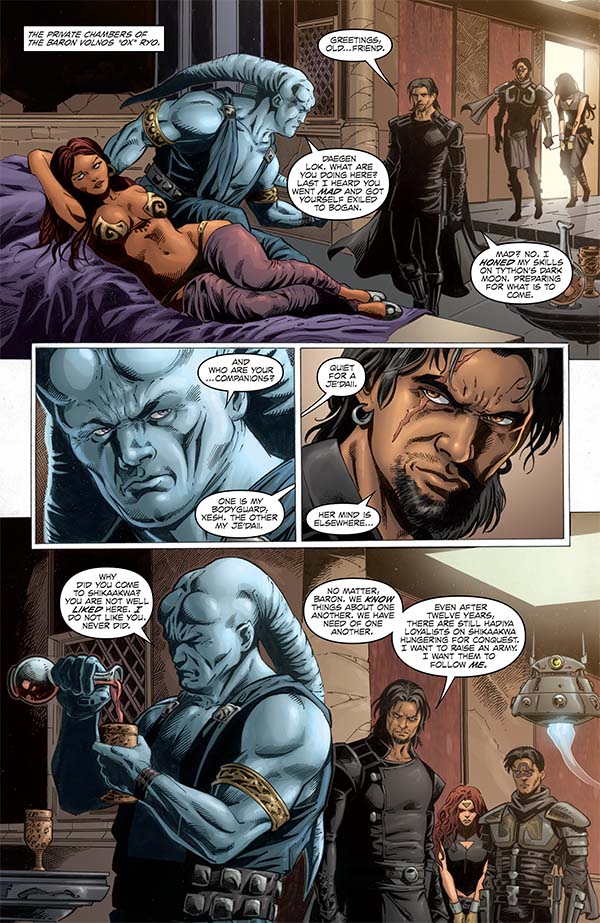
The Despot War was first mentioned in Star Wars: Dawn of the Jedi 0 and depicted in flashback in Dawn of the Jedi: Force Storm #1. Later issues, especially The Prisoner of Bogan, expanded the roles of Hadiya, Daegen Lok, Volnos Ryo, and the surviving political networks. Tim Lebbon's novel Dawn of the Jedi: Into the Void supplied additional context, including the bombing of Nox and the deep resentment that remained after the war.
Together, these sources make the Despot War one of the best-documented political conflicts in the Je'daii period.

Shikaakwa and the Nine Houses
Hadiya rose on Shikaakwa, a settled world governed through the Nine Houses and their aristocratic power networks. She did not begin by invading Tython. She first consolidated authority at home.
Sources describe her using both persuasion and force. Her lieutenants included Bakko, Ka'un Damm, Shri-Lan, and Gav Vannar. When the leader of Clan Ryo refused to submit, Hadiya had him and his eldest son killed. The surviving son, Volnos Ryo, inherited the title of baron under the shadow of that violence.
Political unification therefore proceeded through a mix of coalition, charisma, coercion, and exemplary punishment.
Why people supported Hadiya
Hadiya was not supported only by frightened aristocrats. Into the Void describes substantial popular enthusiasm for her among ordinary inhabitants of the Settled Worlds. She promised security, wealth, and freedom from Je'daii intervention.
That matters because authoritarian movements are often misunderstood when they are explained only through fear. Hadiya could be violent and still attract people who believed her program addressed real grievances.
The Je'daii had spent millennia acting as mediators, protectors, and Force-guided arbiters across the system. To supporters, that role could look paternalistic. Hadiya turned resentment of unelected Force-users into political energy.
Who gave the Je'daii authority?
The Je'daii saw themselves as guardians of balance. Hadiya presented them as an elite institution imposing its interpretation of the Force on people who had not chosen its authority.
This was not merely propaganda invented from nothing. The Order really did intervene in disputes across the Settled Worlds. Its legitimacy rested on tradition, Force ability, expertise, and a belief that imbalance threatened everyone.
The war therefore raised a constitutional problem before any formal galactic constitution existed: who had the right to decide when Je'daii intervention was legitimate?
The Je'daii choose a side
When Hadiya threatened the established order, the Je'daii aligned themselves with aristocrats and other opponents who resisted her consolidation. The Order understood this as defense against conquest.
Yet alliance changed perception. Once the Je'daii fought beside established elites, Hadiya could portray them as defenders of privilege rather than neutral guardians of balance.
An institution can believe it is acting impartially while its alliances communicate something very different to the population watching it.
The bombing of Nox
One of the darkest episodes occurred on Nox. Three manufacturing domes supplied Hadiya's forces with weapons and military equipment. The Je'daii warned the domes to stop production and announced that they would be attacked.
The warnings did not prevent mass death. Many inhabitants remained when Je'daii forces bombarded and destroyed the manufacturing centers. Later inhabitants of Nox remembered the destruction with bitterness, and anti-Je'daii feeling remained strong more than a decade later.
This episode complicates any simple heroic account of the war. The Je'daii could identify a legitimate military target and still produce a civilian catastrophe.
Warning civilians does not erase responsibility
The Nox attack is also important for the anthropology of war. Military actors often distinguish between intentional targeting and foreseeable civilian harm. Communities that experience bombardment may care far less about that legal or strategic distinction.
For survivors, the salient fact is that an institution claiming to preserve balance destroyed their cities and killed neighbors. Political memory follows lived experience, not the attacking side's internal justification.
The Je'daii won the military argument and lost legitimacy among parts of Nox.
Hadiya invades Tython
After a period of smaller clashes, Hadiya revealed the scale of her preparations and launched a full invasion of Tython. The Despot Army included volunteers and conscripts drawn from across the Settled Worlds and substantially outnumbered the Je'daii.
Hadiya's forces had been armed in secret, partly through the Nox manufacturing network. The surprise attack forced an institution accustomed to mediation, training, and localized intervention into a major conventional war.
The transformation was institutional. Je'daii Rangers and Masters became commanders. Sacred spaces became military objectives.
Rajivari becomes a general
Je'daii Master Rajivari emerged as one of the principal military leaders of the defense. His service in the war earned him the title “General,” a revealing marker of how conflict changes institutional roles.
A teacher or spiritual authority who becomes a general carries military habits back into the institution after the fighting ends. The Je'daii victory therefore did not simply restore the old order. War changed the people who survived it.
Rajivari would later become even more important in Jedi institutional history, making his Despot War experience part of a longer political biography.
The death of Telaat
Telaat, Temple Master of Akar Kesh and leader of the Je'daii Council, was killed during Hadiya's invasion. Ketu succeeded him.
Leadership death during war can accelerate institutional change. A successor inherits not only an office but a crisis, new alliances, military expectations, and the need to interpret the previous leader's death.
Ketu's later teaching about the Despot War shows how quickly recent violence became institutional memory.
Daegen Lok goes undercover
Daegen Lok, a Je'daii Ranger, infiltrated Hadiya's forces by presenting himself as a defector. His ruthlessness impressed the queen. He rose to the rank of general and eventually became her lover.
Espionage required him to perform the identity of a committed supporter convincingly enough to enter Hadiya's inner circle. That meant crossing ordinary institutional boundaries between enemy and ally.
Such operations create moral ambiguity even when they succeed. Lok's later instability cannot be reduced to the war alone, but his biography shows how violence, deception, prestige, and trauma became intertwined.
The assassination of Hadiya
During the assault on Kaleth, Lok finally moved against Hadiya. Later accounts place the assassination in her private quarters after Lok had become deeply embedded in her command structure.
Hadiya woke during the attack and scarred Lok before he used the Force to kill her. Her death broke the political center of the Despot Army.
The army then fragmented through infighting and succession disputes. A movement organized heavily around one ruler proved difficult to sustain once that ruler was gone.
Victory at enormous cost
Later summaries attribute staggering losses to the conflict, including roughly one hundred thousand Tythan dead and more than a million casualties among Hadiya's forces. Exact ancient casualty totals should always be treated cautiously, but the narrative is unambiguous that the war was catastrophic.
Many surviving members of the Despot Army returned to worlds that rejected or banished them. Others carried resentment against the Je'daii. Military defeat did not erase the political grievances that had made Hadiya's movement possible.
The Je'daii win, but the legitimacy problem remains
Hadiya was dead and the system remained outside her control, so the Je'daii had won strategically. Yet the war left the Order with a legitimacy problem.
The bombing of Nox, alliance with aristocrats, mass casualties, and continued public resentment demonstrated that possessing extraordinary Force abilities did not guarantee political consent.
This distinction becomes increasingly important as the Je'daii tradition moves toward the later Jedi. Moral authority, spiritual knowledge, military capacity, and democratic legitimacy are not the same thing.
How the Order remembered the war
Twelve years later, Je'daii students were already being taught the Despot War as institutional history. Ketu framed the conflict around Hadiya's rejection of the Je'daii and the costs of victory.
Yet younger students could also inherit hatred of Hadiya without having experienced the war. That is how collective memory reproduces conflict: children learn emotional positions toward events that occurred before they were born.
The Je'daii classroom became one of the places where the meaning of the war was reconstructed.
Charisma, resentment, war, and institutional legitimacy
The Despot War is valuable anthropologically because no major actor can be understood through a single category. Hadiya was an authoritarian conqueror who also mobilized genuine grievances. The Je'daii defended communities against her expansion but also used devastating force. Aristocrats resisted domination while defending their own inherited privileges. Commoners could volunteer for a brutal army because they believed it represented liberation.
Conflict transforms these contradictions into simplified wartime identities: loyalist, traitor, Je'daii, despot, aristocrat, rebel. The historical task is to restore the social complexity that propaganda strips away.
The war's deepest legacy was not simply who controlled Tython. It was a crisis over who had the right to govern, intervene, use violence, and define balance for everyone else.
Canon versus Legends
Where the Despot War fits
Sources and further reading
- John Ostrander and Jan Duursema, Star Wars: Dawn of the Jedi 0, Dark Horse Comics, 2012.
- John Ostrander and Jan Duursema, Dawn of the Jedi: Force Storm #1, Dark Horse Comics, 2012.
- Tim Lebbon, Dawn of the Jedi: Into the Void, Del Rey, 2013.
- John Ostrander and Jan Duursema, Dawn of the Jedi: The Prisoner of Bogan #1–5, Dark Horse Comics, 2012–2013.
- Force Storm #1, Dark Horse
- Despot War, Wookieepedia
- Bombing of Nox, Wookieepedia