
In the chronology usually rendered as 26,053 BBY, a group of Morodins established an agricultural colony on Varonat. Their purpose was practical: support a growing population on their distant homeworld by producing food elsewhere. The Morodins brought food stores, used nutrient-rich biochemical secretions, and deliberately converted enormous grasslands into edible plant communities. Over time, their intervention produced the vast Great Jungle for which Varonat would later become famous.
The original source
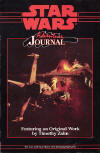
The Morodin history comes from the supplemental role-playing material accompanying Timothy Zahn's “First Contact” in Star Wars Adventure Journal 1, published by West End Games in February 1994. Peter M. Schweighofer supplied additional game material and Mike Vilardi illustrated the story.
“First Contact” itself takes place in the New Republic era, but the background material reaches far into pre-Republic history. That source explains that the Morodins once possessed advanced agricultural knowledge and organic spacecraft, established the Varonat colony to relieve food pressure on their homeworld, and reshaped the local ecosystem through deliberate biochemical cultivation.
Who were the Morodins?
Morodins were enormous sentient herbivores described as combining reptilian and slug-like features. They could rear upward several meters, possessed manipulative forelimbs, and produced nutrient-rich slime through glands along the underside of the body.
That slime was not merely waste. Morodins altered its chemical composition through diet and used patterned movement across fields to influence plant growth. Their agricultural practice depended on biochemical knowledge, memory, route planning, and repeated environmental management.
Later outsiders saw a large slow-moving creature and assumed “animal.” The Morodin evidence shows how badly morphology can mislead when observers decide in advance what intelligence is supposed to look like.
Why establish a colony?
The colony existed to solve a food problem. Legends material says the Morodin homeworld faced growing demand, and Varonat offered broad plains that could be converted into productive agricultural land.
This was therefore not exploratory settlement for its own sake. It was an economic project connecting two worlds through food production and transport. Varonat functioned as a specialized agricultural landscape within a wider Morodin system.
The colony also shows that ancient interstellar settlement did not always resemble later Human expansion. The Morodins brought their own biological technologies and farming practices rather than reproducing a standard industrial colony template.
The Great Jungle was made
One of the most important facts in the dossier is that the Great Jungle was not simply “nature.” Varonat originally contained immense plains. The Morodins transformed a vast region through cultivation, selective feeding, nutrient deposition, and long-term experimentation with plant life.
The resulting jungle became so extensive that later populations treated it as the defining natural landscape of the planet. Yet its form was partly historical and cultural.
This is a classic example of niche construction: organisms actively modify an environment in ways that alter the conditions under which they and other species live. When the organisms doing the modification are sentient and organized, the distinction between ecology and material culture becomes even less useful.
Nutrient slime as technology
Morodin slime is easy to describe biologically, but functionally it was part of a technological system. The Morodins controlled where they deposited it, varied its properties through diet, and organized their movement into complex maze-like patterns associated with different cultivation tasks.
That makes the slime comparable to fertilizer, soil amendment, irrigation, selective breeding, and field mapping at once. The technology is embodied rather than external.
Later observers who looked only for machines missed the fact that Morodin bodies themselves were part of the agricultural infrastructure.
Agriculture as learned knowledge
Morodin field patterns also functioned as teaching systems. Later descriptions say older Morodins used the maze-like routes as intellectual exercises for younger individuals, helping transmit knowledge about fertilization and crop management.
This matters because it turns the landscape into a classroom. Agricultural expertise was not stored only in written manuals or devices. It was reproduced through embodied practice, memory, route-following, and intergenerational instruction.
A field can therefore be both productive space and educational institution.
Organic starships
The colony shipped food back to the Morodin homeworld aboard organic space vessels that were grown rather than conventionally manufactured. The exact biology and propulsion of these vessels is not described in enough detail to reconstruct them confidently, but their existence establishes a technological tradition very different from later metal-hulled starships.
This is another warning against equating technology with familiar industrial forms. A grown spacecraft is still technology if its development requires specialized knowledge, controlled reproduction, materials management, and skilled operation.
Morodin civilization combined biotechnology, agriculture, and interstellar logistics long before later outsiders recognized the Varonat population as sentient.
The homeworld disaster
At some point after the colony was established, an ecological disaster struck the Morodin homeworld. The catastrophe prevented the Morodins there from continuing to grow the organic vessels that maintained contact with Varonat.
The result was isolation. The agricultural colony could no longer function as originally intended because the interplanetary system it served had broken down.
Yet the Varonat Morodins survived. What began as an outpost became the primary surviving Morodin population known to later galactic society.
A colony becomes a homeland
Once contact failed, Varonat stopped being simply a production site for another world. Generations of Morodins remained, adapted their practices to local conditions, and continued modifying Varonat's flora to meet their own needs.
This is a familiar colonial transformation. A place founded as an extension of a distant homeland becomes the homeland of descendants who may never have seen the place their ancestors came from.
By the New Republic era, the original Morodin homeworld had effectively vanished from practical memory, while Varonat had become the species' known center.
The myth of pristine wilderness
Thousands of years later, outsiders saw the Great Jungle as a wild environment. That perception erased the labor that created it. The jungle was biologically alive, but it was also a long-term product of Morodin environmental management.
This is one of the strongest environmental-anthropology themes in Star Wars Legends. Landscapes described as “natural” may actually be historical products shaped by burning, cultivation, selective propagation, irrigation, hunting, soil modification, or other sustained practices.
Removing the people who shaped a landscape from its history can make human or sentient labor disappear into the category of nature.
Later Human settlers misunderstand the Morodins
Much later, Human colonists from Salliche established settlements on Varonat. They valued the Great Jungle's apparent fertility but did not understand the Morodins' role in maintaining it.
When Morodins moved through fields and deposited nutrient slime, Humans often interpreted them as animals damaging crops. Communication failed, and the Morodins were chased away or hunted.
This is not simply a story about poor translation. It is a story about classification. Once the Humans decided the Morodins were wildlife rather than people, their behavior became easy to interpret as nuisance behavior instead of agricultural intervention.
Sentience and the politics of recognition
The Morodins show how political status can depend on whether outsiders recognize a population as sentient. If a group is classified as an animal species, hunting, land seizure, and destruction of cultivation practices can be normalized. If the same group is recognized as a people, those acts become questions of rights, sovereignty, and violence.
The mistake therefore has material consequences. Classification determines who may own land, who may speak politically, whose knowledge counts, and whose death is treated as a crime.
This theme fits IDS particularly well because it connects biology, anthropology, law, and colonial history.
From misunderstanding to exploitation
By the New Republic era, criminals discovered that Morodin-fertilized aleudrupe plants could be chemically useful for producing powerful blaster fuel. A hunting-safari business provided cover for the operation.
The same population whose ecological knowledge had created the Great Jungle was therefore treated simultaneously as wildlife to be hunted and as an unwitting component in an extractive industrial process.
This is a stark example of how indigenous knowledge and ecological labor can be exploited while the people responsible for that knowledge are denied recognition.
Environmental engineering, colonialism, and memory
The Varonat dossier complicates several common assumptions. The first is that technological sophistication must look mechanical. Morodin biotechnology and organic spacecraft challenge that. The second is that wilderness exists outside history. The Great Jungle challenges that. The third is that sentience will always be obvious to outsiders. Human hunters on Varonat demonstrate otherwise.
The most important lesson is that environments can be archives. The jungle itself preserves the result of thousands of years of Morodin activity even when later observers do not know how to read it.
Environmental history becomes cultural history when landscapes are deliberately made.
Canon versus Legends
Where Varonat fits
Sources and further reading
- Timothy Zahn, “First Contact,” with supplementary role-playing material by Peter M. Schweighofer, Star Wars Adventure Journal 1, West End Games, February 1994.
- Alien Encounters, West End Games, 1998.
- Stephen J. Sansweet et al., The Complete Star Wars Encyclopedia, Del Rey, 2008.
- Daniel Wallace and Jason Fry, Star Wars: The Essential Atlas, Del Rey, 2009.
- Morodin/Legends, Wookieepedia
- Varonat/Legends, Wookieepedia
- 26,053 BBY, Wookieepedia