
Around 27,000 BBY, the deep-history timeline reaches a technological threshold. A Coruscanti sleeper ship arrived in the Tion Cluster, contributing to the emergence of Tionese society. At roughly the same time, Gossam explorers known as the Courivers used an experimental tumble hyperdrive to reach Felucia, while Devaronians were developing or testing comparable early drives. The galaxy had not yet entered the age of dependable hyperspace travel, but movement between stars was no longer limited to long sublight voyages and inherited Rakatan machinery.
The source tradition
The Essential Atlas is the key reference linking the Tion settlement, Gossam expansion, and Devaronian experimentation to this period. Later reference summaries preserve the same grouping: Human colonists reach the Tion Cluster, Gossam Courivers explore Felucia using a tumble hyperdrive, and Devaronians experiment with similar early faster-than-light technology.
The timing is important because it falls between two transport regimes. The previous century is defined by sleeper ships and isolated colonies. The following millennia are increasingly defined by hyperspace routes, navigational beacons, trade corridors, and political systems capable of coordinating worlds separated by many light-years.

The sleeper ship reaches the Tion Cluster
Human colonists from Coruscant had already been traveling outward for centuries when one sleeper ship reached the Tion Cluster around 27,000 BBY. The migrants were descendants of the same broad Coruscanti expansion that had seeded worlds closer to the Core, but their destination was much farther from the political center that launched them.
The settlement became the foundation for Tionese society. Later Tionese states would develop their own languages, rival kingdoms, military traditions, technological systems, and historical myths. By the time of Xim the Despot thousands of years later, the region had become an old civilization with no meaningful dependence on Coruscant.
This is the endpoint of one migration story and the beginning of another. A colony becomes a homeland.
Isolation creates independence
The early Tionese were separated from Coruscant not simply by distance but by transportation limits. A sleeper ship could deliver a population, but it did not create an easy route home. Regular exchange was impossible without reliable faster-than-light travel.
That isolation allowed local institutions to develop with little correction from the founding society. Political legitimacy, language, technology, religion, and social hierarchy could all diverge rapidly when there was no practical metropolitan authority capable of intervening.
In colonial history, communication speed is political power. A center that cannot communicate with a settlement cannot easily govern it.
Tionese society and Rakatan remnants
Legends accounts also connect the early Tionese with surviving Rakatan technology and material remains. The region did not begin as an untouched technological blank slate. Settlers encountered artifacts, castoffs, and knowledge left behind by older imperial systems.
Those remnants contributed to local technological development, including beam-tube weapons and later limited hyperspace systems. This means Tionese society emerged through a combination of migration and technological inheritance.
New civilizations often begin by reusing old infrastructures rather than inventing everything from the beginning.
What was the tumble hyperdrive?
The tumble hyperdrive, or tumbledrive, was an experimental form of hyperdrive developed by Gossam and Devaronian experimenters around this period. It allowed travel through hyperspace but was unstable and unpredictable compared with later systems.
Its name reflected that instability. Jumps could vary in distance and duration, making the technology useful for exploration but dangerous as a foundation for routine commerce or tightly scheduled political administration.
A device can be historically transformative before it becomes dependable. The first successful crossing matters even when the technology is not yet mature enough for everyday use.
The Gossam Courivers
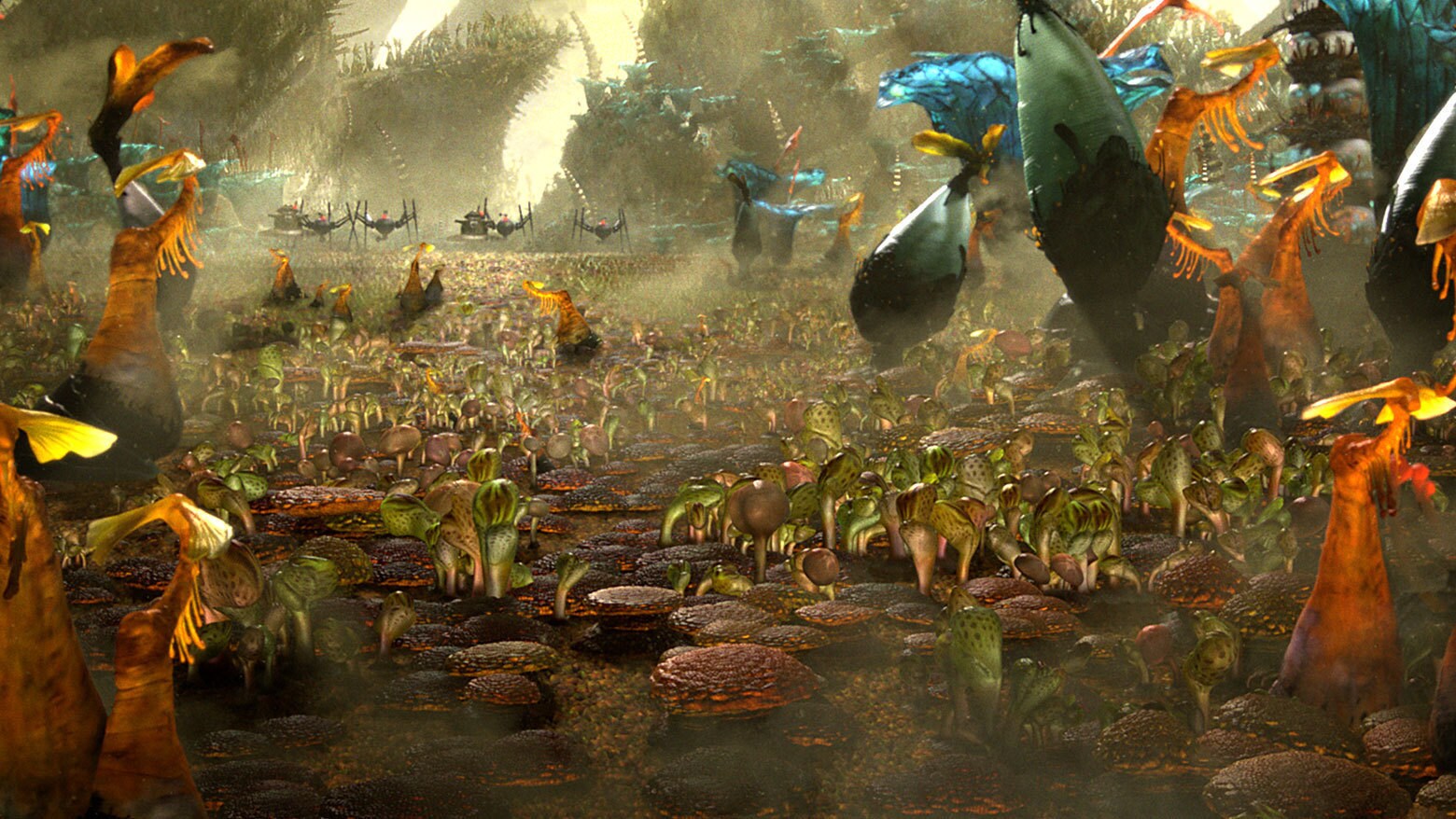
The Gossam Courivers were explorers from Castell who used tumble hyperdrive technology to move beyond their home region. Around 27,000 BBY they reached Felucia, one of the most biologically distinctive worlds in the galaxy.
Later Gossam settlement on Felucia remained limited by the planet's aggressive ecosystems. The world became associated with exploitation, retreat, and selective habitation rather than straightforward replacement of the native environment.
The Courivers matter because they demonstrate that early hyperspace technology immediately changed what kinds of worlds could be reached. A destination no longer had to justify the enormous commitment of a one-way sleeper ship.
The Devaronian experiments
Devaronians were also among the earliest peoples experimenting with tumble hyperdrive technology. Later Legends culture would strongly associate Devaronian males with travel, scouting, trade, and life away from the homeworld, but IDS avoids reading those later cultural patterns backward as a biological inevitability.
What the chronology establishes is that Devaronian technical experimentation contributed to the earliest post-Rakatan attempts to develop faster-than-light travel independently.
The significance is institutional as much as mechanical. Building an experimental drive requires workshops, specialists, material supply chains, mathematics, testing, and communities willing to risk lives on uncertain technology.
Speed is not enough: the navigation problem
Crossing into hyperspace does not automatically create a usable transportation network. Travelers must know where it is safe to go, how long a journey may take, what hazards lie along the route, and how to return.
This is why later early hyperspace societies depended heavily on navigational beacons and carefully surveyed corridors. Faster-than-light travel without dependable navigation can produce spectacular exploration while remaining poor infrastructure.
The real technological revolution therefore required both propulsion and information.
Faster travel changes social time
Sleeper-ship societies live with long delays. Political orders can rise and fall before a message reaches a distant colony. Hyperdrive begins collapsing that delay.
When people can travel between systems within a meaningful portion of one lifetime, entirely new institutions become possible. Merchants can maintain repeated relationships. Diplomats can negotiate in person. Governments can respond to distant crises. Families can migrate without assuming permanent separation. Armies can project force beyond one system.
Faster travel therefore changes social time as much as physical distance.
From colonization routes to trade routes
A sleeper ship creates a line between an origin and a destination. A hyperdrive network creates a web. Once repeated journeys become possible, routes gain economic value. Ports develop. Service industries emerge. Navigational knowledge becomes property. Political authorities begin regulating movement.
This is the beginning of the world that later produces the Perlemian Trade Route, Corellian Run, Corellian Trade Spine, and other famous hyperspace corridors.
Those later routes were not simply discovered all at once. They were built historically through repeated travel, mapping, beacon placement, commerce, and political investment.
A new phase of colonization
Experimental hyperdrive travel also changes the ethics and politics of colonization. A one-way sleeper-ship settlement is difficult and slow. Faster travel allows repeated migration, resource extraction, military reinforcement, commercial exploitation, and stronger control by distant powers.
Colonization therefore becomes easier to scale. That can produce denser exchange, but it can also intensify pressure on already inhabited worlds.
Felucia is an early reminder that reachable does not mean empty.
After Rakata: rebuilding FTL without the Force
The wider technological context still includes Rakatan influence. Former subject peoples had seen or inherited Force-attuned hyperdrive systems, but those systems could not simply be copied for universal use.
The long transition toward ordinary hyperdrive involved experimentation that removed dependence on Force sensitivity, stabilized jumps, and made propulsion usable by a broader population. Gossam and Devaronian tumbledrives belong inside that transitional landscape rather than standing as the final form of the technology.
Later Corellian and Duros developments would make hyperdrive broadly dependable enough to support sustained interstellar civilization.
Mobility, identity, and power
Transportation technology changes who can meet whom, how often, and under what conditions. That means it changes culture. Migration becomes easier. Marriage networks widen. Languages encounter one another more often. Religious ideas travel farther. Markets expand. Political centers gain or lose influence depending on their position within transportation networks.
At the same time, mobility is never evenly distributed. Experimental drives require wealth, expertise, and willingness to accept risk. Some groups become explorers, traders, or colonizers while others remain locally rooted.
The beginning of hyperspace civilization therefore creates new inequalities even as it creates new connections.
Canon versus Legends
Where the transition fits
Sources and further reading
- Daniel Wallace and Jason Fry, Star Wars: The Essential Atlas, Del Rey, 2009.
- Essential Atlas Extra: The History of Xim and the Tion Cluster, StarWars.com
- Felucia, StarWars.com Databank
- 27,000 BBY/Legends, Wookieepedia
- Tumbledrive/Legends, Wookieepedia
- Tion Cluster/Legends, Wookieepedia