
Around 22,800 BBY, an unnamed Jedi scout navigating through poorly charted hyperspace sensed something extraordinary: a persistent pull in the Force coming from far beyond familiar Republic routes. The scout followed that call into deep unexplored space and arrived in the Ilum system. The fifth planet was a frozen world buried beneath ice and battered by extreme cold. Beneath its surface lay immense deposits of crystals that resonated with the Force and could be used in Jedi lightsabers.
The source tradition
The discovery appears in Legends reference material including The New Essential Chronology, The Essential Atlas, and later Jedi histories. The story describes a scout using Force-assisted hyperspace navigation, sensing a powerful resonance and allowing that sensation to guide the ship toward an otherwise unknown system.
Current StarWars.com material confirms the long-term significance of the discovery even though it no longer uses the Legends date. The official Databank calls Ilum the Jedi Order's most sacred world and describes an ancient temple above the legendary Crystal Caves.

The unnamed Jedi scout
The scout's identity was never securely preserved. Different later references even used different pronouns, making the safest description simply “the Jedi scout.”
That anonymity is historically interesting. One of the most consequential discoveries in Jedi material culture is attached not to a famous Master but to an explorer whose name disappeared.
Institutional history often remembers discoveries while losing the people who made them.
Force-assisted hyperspace navigation
The scout was not following a completed Republic chart. The account describes navigation aided by the Force, with the Jedi sensing a resonance that acted almost like a beacon.
This belongs to an era when major hyperspace corridors were still being mapped and worlds beyond them could remain effectively inaccessible even to advanced civilizations.
The Force therefore functioned as a form of navigational knowledge where ordinary charts failed.
A world beyond familiar space
Ilum lay far outside the densely connected Core and the major routes that supported the young Republic. Reaching it required leaving established corridors and entering poorly understood space.
That distance later became part of Ilum's sacred character. The world was difficult to reach, physically dangerous, and separated from ordinary political life.
Isolation made it useful not only as a resource site but as a place of initiation.
The first sight of Ilum
Legends describes the scout arriving to see a planet almost completely covered in ice. The Force resonance became strongest there.
The scout's experience was presented as mystical rather than merely geological. Ilum did not feel like a world containing useful minerals. It felt alive with a presence that the Jedi could perceive.
That interpretation shaped everything that followed.
The crystal deposits
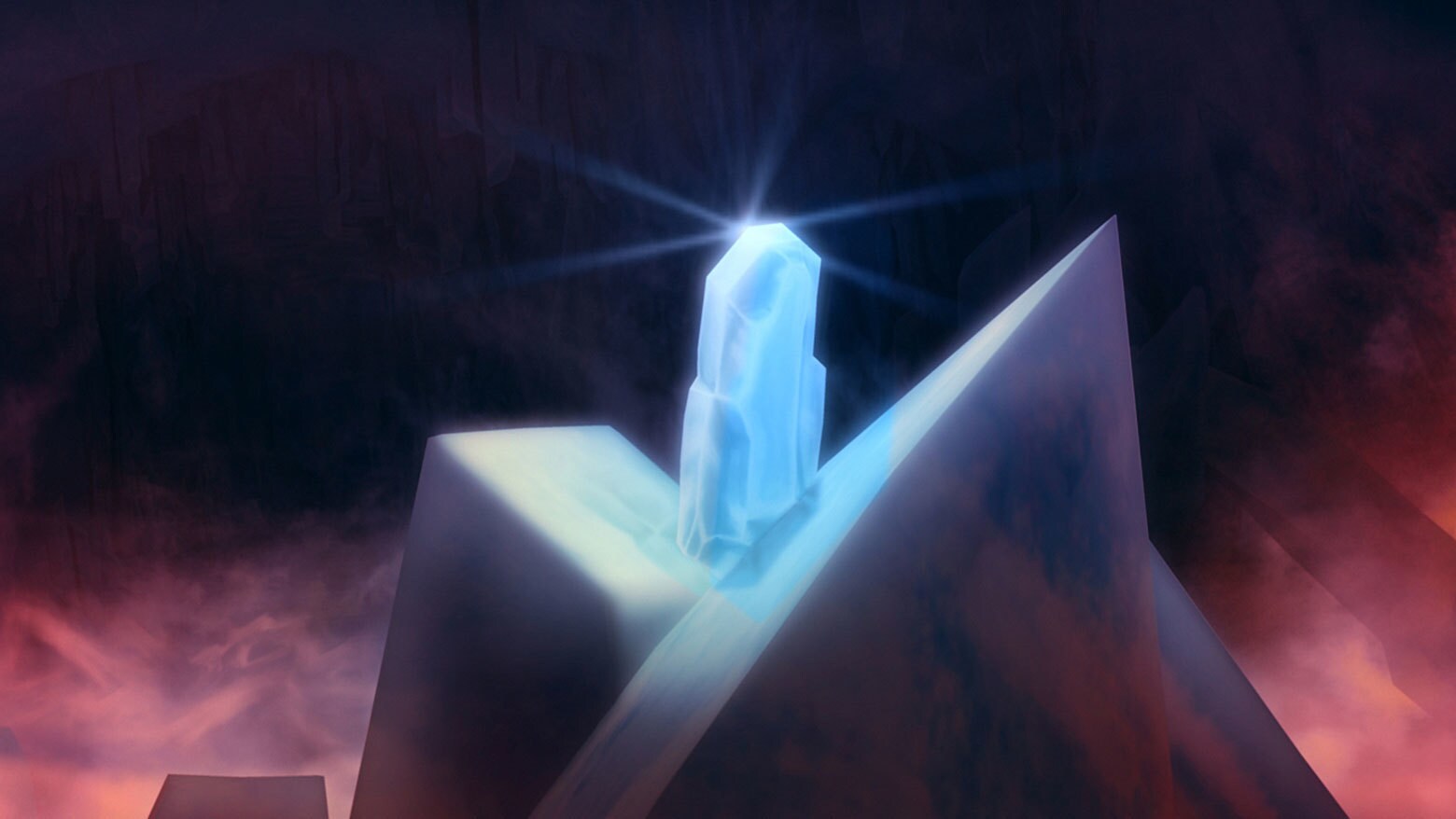
Ilum's caves contained enormous quantities of crystals suitable for lightsaber construction. Legends material identified these deposits through older crystal terminology, including formations associated with kathracite, mephite, and pontite classifications.
Later continuity increasingly used “Ilum crystals,” while current canon places Ilum within the broader category of kyber-bearing worlds.
IDS keeps those vocabularies separate rather than treating every historical source as though it used the modern term “kyber.”
Not merely a mineral deposit
The Jedi did not treat Ilum like an ordinary mining world. The crystals' relationship with the Force made extraction a spiritual act.
A material required for weapon construction became part of a religious process in which the Jedi sought compatibility between practitioner and crystal.
Material culture and spiritual identity became inseparable.
The first Jedi temple on Ilum
After the discovery, the Jedi established a temple and training center above the crystal caves. Legends places that construction in the same broad c. 22,800-BBY period.
The choice of location deliberately embraced Ilum's isolation, cold, and difficulty. Reaching the caves required effort and discipline.
The physical environment became part of Jedi training.
Sacred architecture follows the resource
The temple was built because the crystals were already there. In this sense, Jedi architecture followed sacred geology.
The caves were not created by the Order, but the temple transformed them into an institutional pilgrimage center with controlled access, teaching traditions, and ritual meaning.
Religious landscapes are often produced through this combination of natural feature and social interpretation.
The Gathering develops later
Current canon presents Ilum as the site of the Gathering, a rite in which Jedi younglings enter the caves, confront internal fears or obstacles, find a crystal attuned to them, and begin constructing a lightsaber.
The mature ritual should not be projected in full detail onto the first year of discovery. The safest historical reading is that the temple and crystal-gathering practices developed over time.
A resource site became a pilgrimage tradition through repeated institutional use.
Why the environment matters to the trial
Ilum's extreme cold, darkness, caves, narrow passages, and isolation made the planet naturally suited to rites of passage.
The environment separated initiates from ordinary support systems and required them to rely on perception, patience, and self-control.
What could have been treated as logistical inconvenience became part of the ritual's meaning.
Crystal and self
Current canon makes the relationship especially personal: a kyber crystal is attuned through the Force to the Jedi who finds it, and the lightsaber becomes an extension of that Jedi's awareness.
Legends described the crystal tradition differently in technical detail, but Ilum still became a place where obtaining a lightsaber component was linked to Jedi identity rather than simple procurement.
The object mattered because of the relationship surrounding it.
Ilum changes lightsaber culture
Before Ilum's discovery, Jedi obtained suitable crystals from other sources, especially worlds associated with the Adega system and related deposits.
Ilum gave the Order a large, reliable source under Jedi control and allowed crystal acquisition to become standardized within Jedi training.
A supply change became a cultural change.
Control of a sacred resource
The Jedi's relationship with Ilum also created a form of institutional resource control. The Order possessed the knowledge of the planet, maintained the temple, and regulated access to the caves.
That control protected a sacred site but also concentrated an important military and spiritual resource inside one institution.
Religious stewardship and strategic monopoly overlapped.
Pilgrimage and institutional memory
Generations of Jedi returning to the same caves created continuity across enormous spans of time. Masters who had once traveled there as initiates later accompanied new generations.
The landscape therefore accumulated memory through repetition.
A Jedi could enter Ilum knowing that countless predecessors had faced similar uncertainty in the same frozen world.
A shared tradition across a dispersed Order
The Jedi served across many worlds and came from many species and cultures. Shared pilgrimage helped create an Order-wide identity that transcended birthplace.
A youngling from one end of the Republic and another from somewhere entirely different could participate in the same Ilum tradition.
Ritual produced institutional unity across galactic distance.
Ilum becomes sacred geography
Ossus, Tython, Coruscant, and Ilum all became sacred to the Jedi for different reasons. Ilum's importance centered on material encounter: the place where a Jedi's relationship with the lightsaber became physically embodied.
The planet therefore linked Force belief to landscape and object.
The Jedi did not merely carry religion with them. Particular worlds became integral to it.
Sacred concentration creates vulnerability
Concentrating so much meaning and material value on one planet created a long-term vulnerability. Enemies who discovered Ilum could attack both a strategic crystal source and a symbol of Jedi identity at the same time.
Later Sith and Imperial campaigns repeatedly exploited that vulnerability.
The same concentration that strengthened tradition made the site militarily valuable.
Ilum's later history
Across later millennia, Ilum endured Sith attacks, Jedi restoration efforts, and repeated conflicts over access to its crystals.
In current canon, the Empire eventually strips much of the planet for kyber and reshapes the world on a colossal scale. Ilum ultimately becomes the basis of Starkiller Base.
That later fate makes the original discovery especially tragic: a world first encountered as a sacred place of attunement is ultimately converted into industrial extraction and planetary weaponry.
From sacred material to weaponized material
Kyber demonstrates how the meaning of a material depends on the institution controlling it. To the Jedi, crystals become part of initiation, identity, and disciplined self-knowledge. To later imperial powers, the same material becomes an energy resource for superweapons.
The physical substance does not dictate one social use.
Culture determines whether it becomes relic, tool, commodity, or weapon.
Pilgrimage, objects, and sacred landscapes
Anthropologically, Ilum shows how institutions transform resources into sacred objects through ritual. A crystal is not important only because of its physical properties. It becomes meaningful through journey, danger, selection, teaching, memory, and incorporation into a lightsaber.
The planet itself becomes sacred for the same reason. Generations of repeated practice turn geography into tradition.
The discovery of Ilum therefore changed Jedi culture far beyond the technical problem of finding better lightsaber crystals.
Canon versus Legends
Where the discovery of Ilum fits
Sources and further reading
- Daniel Wallace, The New Essential Chronology, Del Rey, 2005.
- Daniel Wallace and Jason Fry, Star Wars: The Essential Atlas, Del Rey, 2009.
- Ilum, StarWars.com Databank
- Kyber Crystal, StarWars.com Databank
- Ilum/Legends, Wookieepedia
- Unidentified Jedi scout/Legends, Wookieepedia