
Around 22,000 BBY, Human settlers colonized Nubia. The planet was not an obvious agricultural paradise. Much of its surface was dry, and dependable water appeared limited. The crucial discovery lay underground: enormous aquifers. Colonists installed massive pumping systems to bring that water to the surface, irrigated the land, and turned environmental engineering into the foundation of a new planetary society.
The source tradition
Coruscant and the Core Worlds provides the main planetary history: hardy Human settlers arrived around 22,000 BBY after the discovery of large subterranean aquifers. They installed enormous pumps, raised water to the surface, and created an agricultural society on terrain that otherwise appeared too dry for intensive settlement.
The Essential Atlas later standardized Nubia's placement in the Corellian sector and included it in the larger geography of the ancient Core.
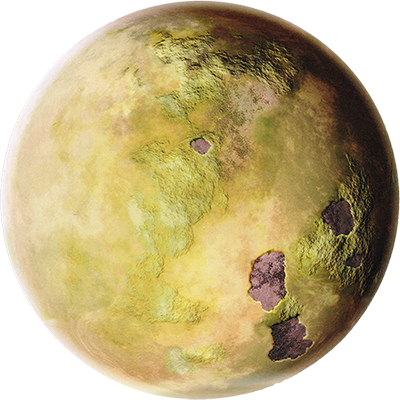
A colony inside the ancient Core
Nubia's settlement belongs to the Republic's long Expansionist Era, but “expansion” did not always mean pushing into the distant Rim. Even within the Core, worlds could remain lightly settled or underdeveloped until transportation, engineering, and political conditions made large-scale colonization practical.
Nubia sat close enough to the Corellian sphere to benefit from one of the Republic's most important growing transportation networks.
Its history shows that galactic regions were settled unevenly rather than in a simple outward wave.
The aquifers
The discovery of vast underground water reserves made permanent large-scale settlement possible. Water that was scarce on the surface existed in abundance below it.
Colonists therefore faced an infrastructural problem rather than a simple absence of resources: the water existed, but society had to build systems capable of reaching and distributing it.
The colony began with pumps.
“Just add water”
Later descriptions summarize Nubia's transformation with the phrase “Just add water.” The phrase makes the process sound easy, but the actual social achievement would have required large pumps, energy systems, pipes, reservoirs, irrigation networks, maintenance labor, and governance over access to water.
Bringing water to the surface changed where people could live and what they could grow.
Infrastructure turned buried geology into social abundance.
Irrigation creates a new landscape
Once aquifer water reached the surface, settlers could support extensive agriculture across otherwise arid plains. Nubia's warm temperatures and long growing season amplified the benefits of irrigation.
The cultivated landscape was therefore neither wholly “natural” nor artificial. It was a hybrid system in which planetary climate, groundwater, engineering, plants, labor, and settlement planning worked together.
The colony succeeded by reorganizing water.
From frontier settlement to self-sufficiency
Over time Nubia became known as a world of abundance and self-sufficiency. Its agricultural base supported large populations while also generating exports.
That shift matters because colonies initially depend heavily on supply from older worlds. A settlement becomes politically and economically more autonomous when it can reliably feed itself.
Food security becomes a form of political capacity.
The mountains and mineral economy
Nubia's massive mountain ranges contained valuable ore deposits, including bronzium. Mining settlements developed alongside agricultural communities.
This gave the planet a more diverse economy than farming alone could provide.
Agriculture sustained population while mineral extraction attracted industry and investment.
Urban growth follows unsuitable land
Later Nubian development concentrated cities and industry in areas less useful for agriculture or mining.
This pattern demonstrates how land classification shapes urban geography. Fertile zones become farms, mineral-rich mountains become mining districts, and less productive terrain becomes available for dense settlement.
The planetary economy mapped itself onto environmental differences.
The Corellian Run
Nubia's position along the Corellian Run eventually linked the planet to one of the galaxy's most important trade corridors.
That access allowed agricultural goods, metals, manufactured components, travelers, and technical knowledge to move between Nubia and older Core worlds.
Local environmental engineering became far more valuable once hyperspace infrastructure connected its products to interstellar markets.
Settlement and migration
The original settlers were Human, but Nubia's later prosperity attracted migrants, businesses, and manufacturers from elsewhere.
This is a common pattern in colonial development: initial settlement creates infrastructure, infrastructure creates opportunity, and opportunity changes the demographic composition of the settlement.
A frontier colony gradually becomes an established Core society.
What the sources do not tell us
The standard Legends account describes Human colonization but does not provide a developed account of an indigenous sentient population displaced by the settlers.
That absence should not be converted into a claim that the world was definitively “empty.” It means the surviving reference tradition does not document such a population.
IDS distinguishes absence of evidence from evidence of absence.
Manufacturing follows extraction and trade
Nubia's agricultural stability, mineral resources, and position on a major route eventually made it attractive to manufacturers.
Factories and industrial districts expanded around urban centers such as Nuba City.
The economic transition from farming and mining to advanced manufacturing was gradual, but it transformed Nubia's galactic reputation.
The rise of Nubian shipbuilding
In later eras, Nubian engineering became especially associated with high-quality starship components and propulsion systems. Firms such as Nubia Star Drives became important names in galactic aerospace manufacturing.
The famous “Nubian” technology associated with elegant Naboo spacecraft refers to Nubian engineering and components, not to the planet Naboo itself.
This distinction is easy to miss because the names sound similar.
Nubia is not Naboo
Nubia and Naboo are separate worlds with separate histories. Nubia is an ancient Core World in the Corellian sector. Naboo is a Mid Rim world with its own Human and Gungan civilizations.
Later Naboo royal starships combined Naboo aesthetics and construction with technology and components associated with Nubian manufacturers.
The relationship is industrial, not geographic identity.
Engineering as cultural identity
Over millennia, Nubia's reputation shifted from a settlement made possible by water engineering to a world celebrated for mechanical and aerospace engineering.
Those histories are connected. A society founded through large-scale technical control of water already depended on infrastructure, maintenance, and applied engineering.
Technical competence became part of the planet's social identity.
Water infrastructure is political infrastructure
Aquifer pumps are not politically neutral. Whoever controls pumps, reservoirs, distribution systems, and maintenance controls access to life itself in a dry landscape.
The surviving sources do not describe Nubia's earliest water governance in detail, but any colony dependent on engineered water would have needed rules for allocation and repair.
Environmental engineering therefore creates institutions as well as fields.
The hidden cost of abundance
Groundwater can support extraordinary agricultural growth, but aquifers are finite systems if extraction exceeds recharge.
Star Wars sources emphasize Nubia's success rather than documenting an ancient groundwater crisis, so IDS does not invent one.
Still, the colony's dependence on pumped groundwater illustrates how abundance can rely on infrastructure that must be continually managed.
Colonization as environmental engineering
Anthropologically, Nubia shows colonization as more than movement of people. Settlers changed the relationship between groundwater, soil, crops, settlement, and trade until the planet supported a social system very different from the one they first encountered.
The colony was built through technological mediation of the environment.
That makes Nubia an important example of how Republic expansion could proceed through infrastructure and settlement rather than military conquest alone.
Canon versus Legends
Where Nubia fits

Sources and further reading
- Coruscant and the Core Worlds, Wizards of the Coast, 2003.
- Daniel Wallace and Jason Fry, Star Wars: The Essential Atlas, Del Rey, 2009.
- Suns of Fortune, Fantasy Flight Games, 2014.
- Nubia/Legends, Wookieepedia
- 22,000 BBY/Legends, Wookieepedia
- Nubia, Jedipedia