
In 4006 BBY, Barrison Draay and Krynda Hulis were promoted to Jedi Knight. Their companion Haazen was denied the rank because his skills and temperament were judged inadequate. Rather than leaving the group, Haazen became Barrison Draay's assistant, creating a status hierarchy that later fed resentment and manipulation.
Two promotions, one rejection
Draay and Hulis crossed a major institutional boundary from trainee to Knight.
Haazen remained close to them while being formally excluded from equal status.
Haazen remains inside the social network
Denial of rank did not remove Haazen from Jedi-associated life.
Serving Draay kept him close enough to elite networks to preserve grievance and ambition.
Anthropological assessment
The event shows how institutional ranking changes relationships even when people continue to share the same social space.
Status denial can become especially destabilizing when the excluded person remains close to peers who receive the recognition he sought.
Early Republic / source-led investigation
Three Jedi companions are separated by rank
Barrison Draay and Krynda Hulis received Jedi Knight status in 4006 BBY while their close associate Haazen was denied advancement. The decision did not end their social relationship. Haazen continued near the promoted pair in a subordinate service role, creating an especially visible gap between personal closeness and formal institutional recognition. The episode belongs to the background history of the later Jedi Covenant and the complicated loyalties that shaped Zayne Carrick's era.
The promotions marked a legitimate institutional decision about training and readiness, but also changed how the three individuals could understand their place within the Order. Rank affects access to responsibility, public honor and future influence. Haazen's later resentment cannot be reduced to the ceremony alone, yet a hierarchy that keeps an excluded person close to recognized peers can make differences in status persistent and difficult to ignore. The historical account should distinguish this early decision from the manipulation and violence that occur decades later.
Status changes while relationships continue
Promotion gives a new formal position without dissolving earlier ties. People who once trained together may remain in the same social circle while the institution now treats them differently.
Explaining resentment without excusing harm
Denied rank can help explain someone's later bitterness, but does not justify later acts or establish that those acts were inevitable. An ethical history preserves responsibility alongside social context.
Did all three companions become Jedi Knights together?
No. Barrison and Krynda were knighted; Haazen was not, and later remained close to their circle in another capacity.
Source and continuity: Knights of the Old Republic comic series, Krynda Draay and Haazen backstory. This page records Legends continuity; source limits are preserved rather than filled with undocumented events.
Ancient Republic · Legends · Historical field note
Interpreting The knighting of Draay and Hulis
Jedi knighting is an institutional transition that marks recognized status, training and responsibility.
Research distinction: The documented event anchors this article. Its political and cultural implications are analytical observations, not invented scenes or claims about undocumented participants.
Open the historian's evidence question
What is directly established by the cited account, and what is an interpretation of its significance? Avoid treating an approximate date or a short reference entry as evidence for exact dialogue, motives or casualty totals.
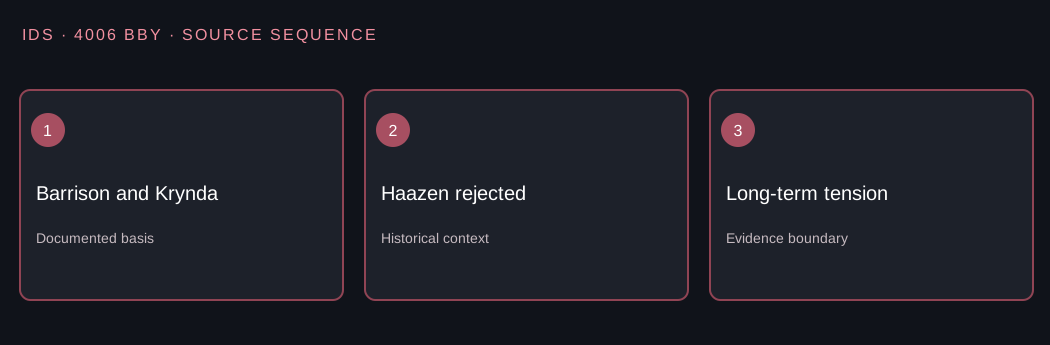
4006 BBY · Legends · assessed sources
Jedi knighthood and Haazen's exclusion
Evidence
Knights of the Old Republic #33 shows the knighting of Barrison Draay and Krynda Hulis while their companion Haazen is denied advancement. The events are told in a flashback.
Anthropological interpretation
Jedi rank and the older servant–employer relationship between Haazen and Barrison overlap but are distinct forms of authority. Haazen's complaint about privilege is his allegation, not evidence of a purchased title.
What remains uncertain
A later Sith affiliation should not be presented as predestined at the moment of the ceremony.
Historical judgment: Did Haazen prove that Barrison bought his rank?
Explanation: No. Arca Jeth considered Barrison qualified and Haazen unready.
Source: Knights of the Old Republic #33, Vindication, Part 2. Consult source record →.
c. 4006 BBY · Legends · Source and historical interpretation
Draay, Hulis and Haazen: how Jedi rankings reshaped social ties
What is directly established
The knighting of Barrison Draay and Krynda Hulis is normally placed around 4006 BBY in Legends. The year is reconstructed from a flashback in Knights of the Old Republic 33 set ten years before the Battle of Toprawa, whose date is separately placed in 3996 BBY. The event should therefore be labeled approximate rather than presented as a surviving Jedi Council entry written in that exact calendar year. The story places the promotions of Barrison and Krynda alongside the denial of knighthood to their fellow trainee Haazen, whose abilities and temperament failed to meet the standard expected by his teachers.
Later events in their proper order
The difference in status produced a lasting imbalance. Barrison and Krynda entered the Order's rank of Knight, while Haazen remained attached to the circle as Barrison's assistant. Their relationships later involved marriage, family ties, resentment and political manipulation, but these later events must not be imported into the ceremony as if their final outcomes were already known. Haazen's subsequent involvement in the Covenant and its conspiracy belongs to a much later phase of the narrative. A chronology article should begin with the institutional decision, then show how it shaped relationships without claiming that the Jedi foresaw every consequence.
Anthropological reading
Promotion is not only recognition of an individual's skill. It changes authority, access to decisions, status in the peer group and relationships of dependence. Barrison and Krynda could continue working with Haazen, yet they did so within a newly unequal set of roles. That distinction can generate a feeling of exclusion while allowing everyday cooperation to continue. It is useful to examine how a rank system creates obligations as well as honors. The source describes one set of evaluations, not evidence that the Jedi Order universally used unfair criteria or that Haazen's later decisions were inevitable products of the failure.
Source disagreements and limitations
The precise words spoken at the knighting and Haazen's private thoughts at that moment should not be invented. The date is inferred from later flashback chronology; Knighthood and subsequent family tragedy are separate historical markers.
Evaluate the evidence: Was Haazen also made a Jedi Knight when Barrison and Krynda were promoted?
Correction and explanation: No. He was denied the rank and became Barrison's assistant, while the two companions were promoted.
References: Star Wars: Knights of the Old Republic 33; The Essential Atlas chronology; 4006 BBY references. Source record and bibliography ↗. Original-edition pagination and image rights remain under review.
Sources and further reading
- Knights of the Old Republic comic series.
- 4006 BBY, Wookieepedia