
Around 13,800 BBY, the Fourth Alsakan Conflict began. It was the latest phase in a struggle that had started more than three thousand years earlier, when Coruscant and Alsakan emerged as competing centers of political and economic power inside the Galactic Republic. The surviving record is sparse. The Essential Guide to Warfare preserves the conflict's approximate dates and two named engagements: the Defence of Drogheda in 13,649 BBY and the Conquest of Manaan in 13,220 BBY. What is missing is equally important. No initiating incident, declaration of war, opening commander, mobilization order, or first battlefield survives in the standard chronology.
Five centuries after the Third Conflict
The Third Alsakan Conflict ended in 14,300 BBY.
Roughly five hundred years passed before another major war began.
That interval was long by individual human standards but short compared with the fourteen-thousand-year history of the larger Alsakan rivalry.
The same institutional rivalry returns
Coruscant remained the political capital of the Galactic Republic.
Alsakan remained the center of a powerful competing network of aristocratic, commercial, and colonial interests.
The conflict therefore outlived every individual who had participated in the earlier wars.
A conflict larger than personalities
No single ruler, admiral, or political faction can explain why the wars kept returning.
The rivalry persisted through institutions, inherited alliances, trade relationships, colonization systems, and political memory.
That makes the Alsakan Conflicts useful for understanding how political structures can reproduce antagonism across generations.
A civil war inside a republic
The Alsakan Conflicts were not simply wars between two unrelated states.
Coruscant and Alsakan existed within the broader Republic system.
That meant the wars were also arguments about who had the right to define Republic policy, sponsor expansion, control colonial networks, and speak for the political center.
Colonization remained central
The broader Alsakan struggle was closely tied to the Expansion Region and to competition over the right of corporations and political blocs to sponsor settlement.
Colonies created wealth, voting relationships, transport corridors, and influence.
Control of expansion therefore affected both economics and constitutional power.
Corporate power and political power
Republic expansion depended heavily on commercial organizations.
Colonization required ships, credit, equipment, surveying, transport, security, and long-distance supply.
Organizations able to provide those services could gain influence far beyond ordinary trade.
The Grand Companies
By the later stages of the Fourth Conflict, powerful trading conglomerates known as the Grand Companies controlled territory associated with the Spin hyperspace route.
They were aligned with Coruscant.
Their position around Manaan shows that commercial blocs had become part of the war's political geography.

The conflict on the galactic map
The Alsakan wars were shaped by hyperspace geography rather than simple physical distance.
Routes such as the Perlemian Trade Route, the Corellian Run, the Spin, and their connecting corridors determined which worlds mattered strategically.
Colonies along those routes could become political assets, supply points, and military targets.
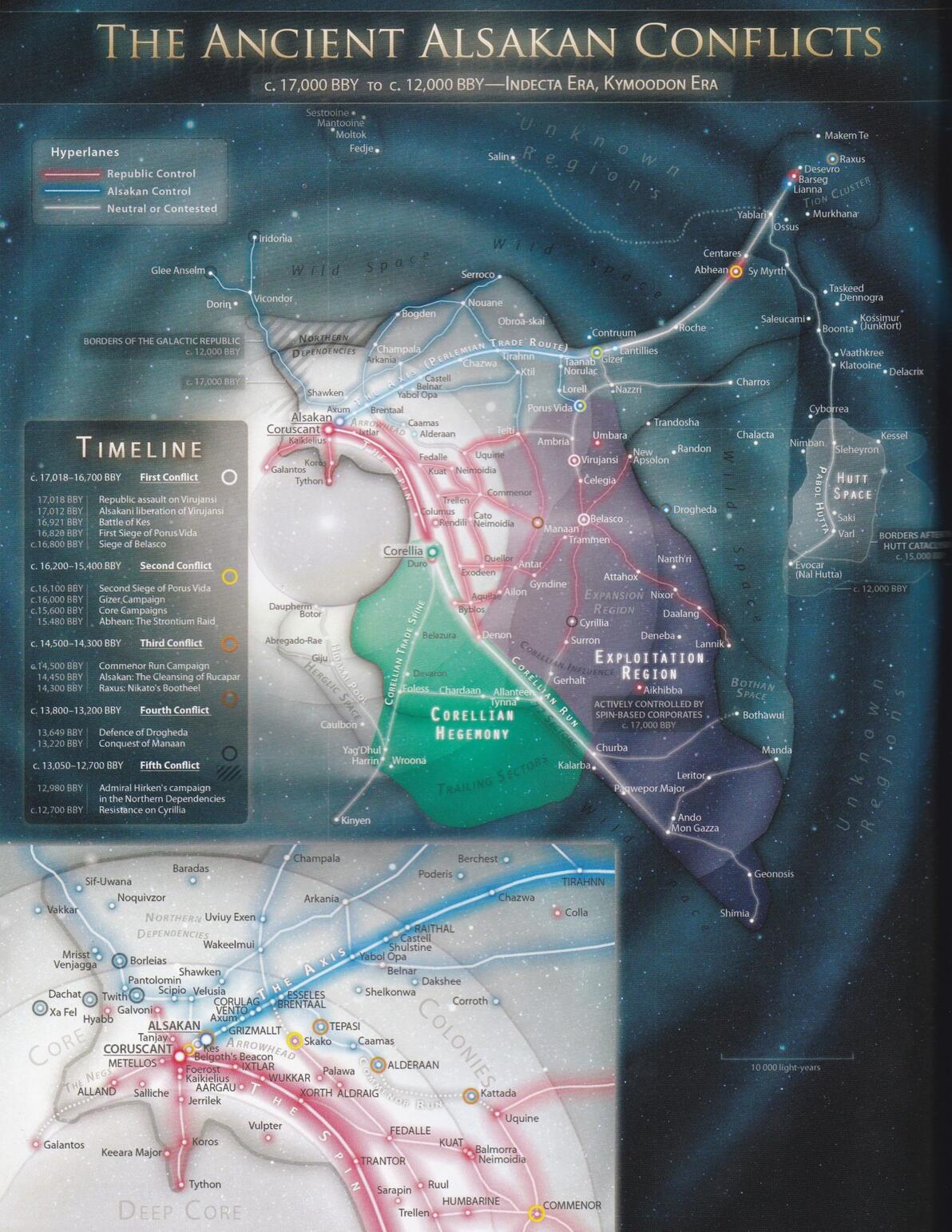
The opening campaign is unknown
Unlike the Third Conflict, whose opening is associated with the Commenor Run Campaign, the Fourth Conflict has no named opening operation in surviving summaries.
We know when the war began only approximately.
We do not know which side crossed a line first or which world became the first battlefield.
The missing trigger should remain missing
Long historical gaps tempt reconstruction.
One could imagine a colonial dispute, a corporate confrontation, or a Senate crisis.
None of those possibilities is established by the surviving source, so they should not be presented as fact.
A six-century war
The Fourth Conflict lasted from about 13,800 to about 13,200 BBY.
That is roughly six hundred years of intermittent or sustained warfare.
Several generations could have been born, lived, and died while the same conflict remained part of the political world around them.
When war becomes normal
A conflict measured in centuries changes how institutions operate.
Military budgets, shipping patterns, elite careers, settlement decisions, and family memories can all adapt around the expectation of recurring violence.
War stops functioning as a temporary emergency and becomes part of ordinary political life.
13,649 BBY: the Defence of Drogheda
The first named engagement preserved from the Fourth Conflict is the Defence of Drogheda.
It occurred in 13,649 BBY, about a century and a half after the war began.
The source preserves the battle's name and date but very little else.
What we do not know about Drogheda
The standard record does not securely preserve the commanders, force sizes, casualty totals, tactical sequence, or exact strategic objective.
Even the word “Defence” should not be expanded into a detailed siege narrative without evidence.
The event matters because it anchors the otherwise poorly documented opening centuries of the war.
Another event occurs during the war
At approximately 13,720 BBY, the older Herglic trading empire is conventionally placed as collapsing.
That event was not part of the Alsakan Conflict, but it occurred while the Fourth Conflict was underway.
The overlap is a reminder that galactic history did not stop elsewhere simply because Coruscant and Alsakan were at war.
The Herglic date is itself reconstructed
The 13,720 BBY date comes from later timeline reconstruction based on Lords of the Expanse.
The underlying source says the old Herglic trading empire collapsed roughly a millennium before Herglic contact with Humans.
IDS therefore treats 13,720 BBY as a chronological estimate, not a precisely recorded year.
Centuries of poorly documented war
After Drogheda, the surviving record becomes quiet again.
That silence lasts for centuries before the Conquest of Manaan in 13,220 BBY.
Silence in the archive should not be mistaken for peace. It means the surviving chronology names few events.
13,220 BBY: the Conquest of Manaan
The Conquest of Manaan was the second named engagement of the Fourth Conflict.
It occurred on the ocean world Manaan in the Inner Rim.
The battle came only about twenty years before the war ended.
Why Manaan mattered
Manaan lay within territory actively controlled by the Grand Companies.
Those trading conglomerates were based along the Spin and backed by Coruscant.
The world also lay on hyperspace routes under Coruscanti influence.
Economic geography becomes military geography
Manaan's importance was not only local.
Its position inside a commercial and transportation network made it strategically meaningful.
The conquest demonstrates how trade zones could become war zones once their political alignment mattered.
Do not project later Manaan backward
Manaan is much better known from stories set thousands of years later, especially the kolto economy and conflicts of the Jedi Civil War.
Those later institutions should not automatically be assumed to have existed in the same form in 13,220 BBY.
The Fourth Conflict evidence establishes the world as strategically relevant but does not provide a full social history of the ancient planet.
What “Conquest” establishes
The surviving name indicates that control of Manaan changed through military action.
It does not preserve the full occupation regime, local resistance, civilian toll, duration, or political settlement.
Again, the archive preserves strategic outcome more clearly than lived experience.
The war ends around 13,200 BBY
The Fourth Alsakan Conflict ended around 13,200 BBY.
The standard source does not preserve a detailed treaty or decisive final battle.
The Conquest of Manaan is the latest named engagement, occurring roughly twenty years before the accepted end date.
No permanent settlement followed
Only about a century and a half later, around 13,050 BBY, the Fifth Alsakan Conflict began.
The short interval shows that the political structure producing the rivalry remained intact.
The Fourth Conflict therefore ended militarily without permanently resolving the larger constitutional struggle.
Political memory survives peace
Each Alsakan war added another layer of remembered grievance and precedent.
Later leaders inherited stories about which colonies had been lost, which routes had been controlled, which worlds had suffered, and which alliances had held.
Those memories could influence future policy even when no veteran of the previous conflict remained alive.
The question of the capital
The larger Alsakan struggle concerned more than territory.
It repeatedly returned to the political status of Coruscant and the place of Alsakan within the Republic.
Competing ideas of legitimate leadership were embedded in disputes over colonies, routes, and representation.
A problem of federalism
The Galactic Republic combined local autonomy with shared institutions.
That arrangement allowed enormous cultural and political diversity.
It also created space for powerful members to accumulate enough influence to challenge the center without leaving the Republic altogether.
Infrastructure carries power
Hyperlanes, ports, supply depots, corporate networks, and colonies were not neutral background features.
They determined how authority could move through the galaxy.
The Fourth Conflict shows political power operating through infrastructure as much as through constitutions or speeches.
The civilian experience is mostly lost
A six-century conflict must have affected traders, settlers, workers, families, and local governments across many systems.
Yet the surviving summary records only two named military events.
This imbalance is important. Military archives preserve what states and strategists considered significant, not necessarily what ordinary people experienced most intensely.
Continuity across generations
The Fourth Conflict began thousands of years after the Republic's founding.
Its combatants inherited institutions far older than themselves.
That longevity allowed political identities to become historical identities, giving later generations reasons to understand themselves through conflicts they had never personally witnessed.
Canon versus Legends
The Fourth Alsakan Conflict, the Defence of Drogheda, and the Conquest of Manaan belong to Legends.
Current canon retains Coruscant and Manaan, but it has not re-established this ancient war.
Shared planets should therefore not be treated as evidence that the Legends conflict itself is canon.
Anthropological assessment
The Fourth Alsakan Conflict demonstrates how institutions can preserve conflict longer than individuals can preserve memory. Coruscant and Alsakan repeatedly produced new generations capable of entering the same political struggle because the organizations, routes, property systems, and historical narratives behind that struggle endured.
The conflict also shows how colonization and commerce become political power. The Grand Companies around Manaan were not simply merchants. Their territorial and route relationships tied economic infrastructure to one side of a constitutional conflict.
Finally, the six-century duration exposes the limits of war-centered archives. We can name Drogheda and Manaan, but the experiences of most people living through those centuries are absent. The surviving military chronology is not the same thing as the total history of the period.
What the sources establish
Where the Fourth Conflict fits
Sources and further reading
- Jason Fry with Paul R. Urquhart, Star Wars: The Essential Guide to Warfare, Del Rey, 2012.
- Daniel Wallace and Jason Fry, The Essential Atlas, Del Rey, 2009, for the broader geography and history of the Alsakan rivalry.
- The Essential Guide to Warfare Author's Cut, StarWars.com
- Fourth Alsakan Conflict, Wookieepedia
- Conquest of Manaan, Wookieepedia
- Alsakan Conflicts/Legends, Wookieepedia