
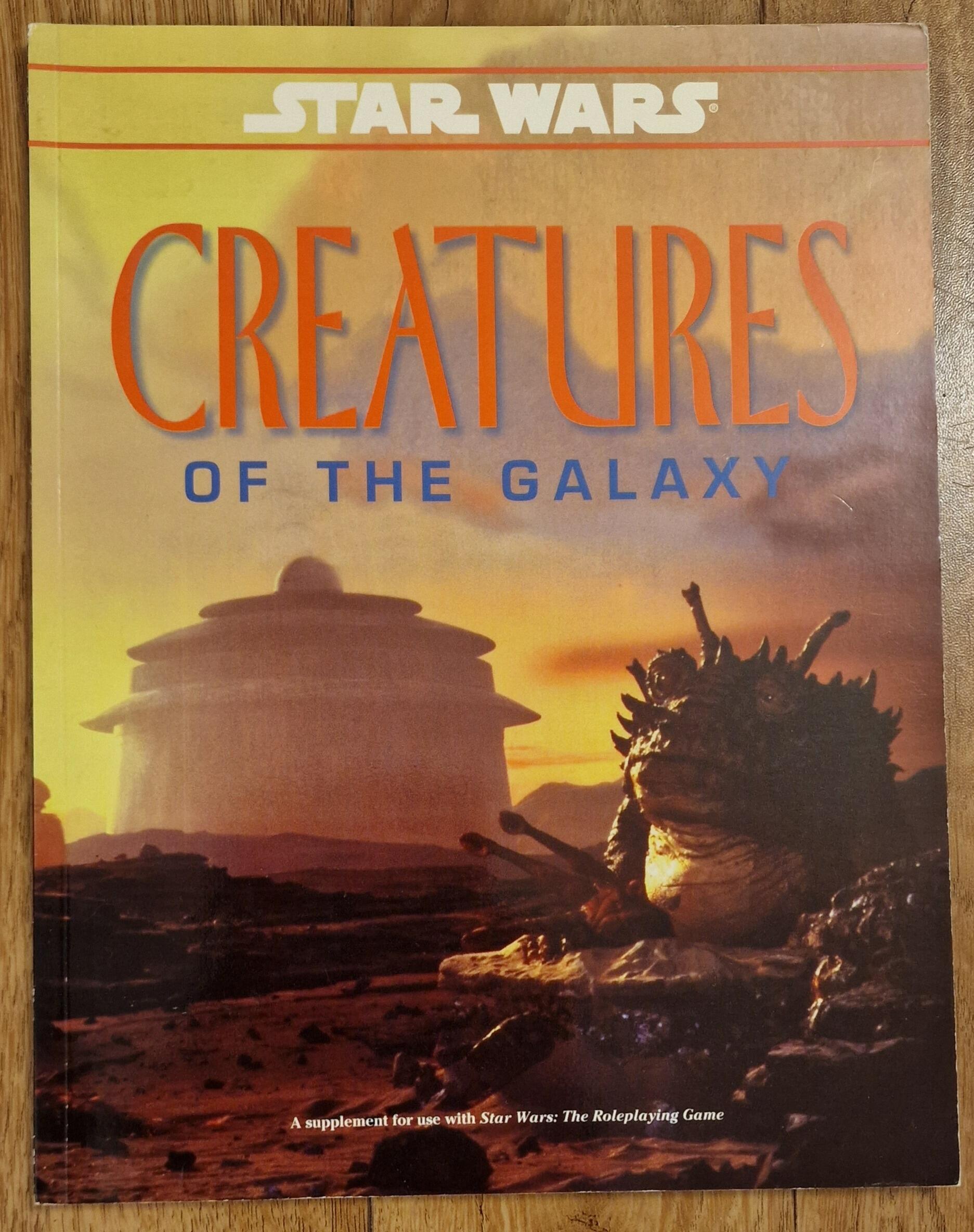
By approximately 600,000 BBY, the ibliton had already evolved on Randorn 2. The creature was introduced in West End Games' 1994 sourcebook Creatures of the Galaxy, where later xenobiologists used fossil evidence to show that iblitons had inhabited the planet for hundreds of thousands of years. That makes Randorn 2 one of the earliest points in the IDS timeline where the past is reconstructed explicitly through fossils rather than ruins, texts, or surviving traditions.
The source: Creatures of the Galaxy
Phil Brucato created Randorn 2 and the ibliton for Creatures of the Galaxy, a 1994 supplement for West End Games' Star Wars: The Roleplaying Game. The sourcebook presented more than sixty creatures through an in-universe reference style, combining zoological notes, habitats, behavior, folklore, and field reports.
Later reference works such as The Complete Star Wars Encyclopedia repeated the claim that the fossil record placed ibliton ancestors on Randorn 2 roughly six hundred thousand years before the Battle of Yavin. The exact date is therefore best read as a Legends chronological anchor drawn from paleontological evidence inside the fiction.
Randorn 2: swamp world of the Outer Rim
Randorn 2 was a terrestrial world dominated by swamps and bayous. Its ecosystem included fish, rodents, avians, reptiles, domesticated creatures such as the hecxt and layall, and the caustic harrowbane plant. At the top of this food web sat the ibliton.
The planet's later placement in the Outer Rim is itself a much younger political classification. Six hundred thousand BBY, Randorn 2 already had an ecosystem, but the hyperspace geography, sector boundaries, governments, and trade systems that later defined the Outer Rim did not give that ecosystem its meaning.
What was an ibliton?
The ibliton was a slow but formidable predatory mollusk, two to five meters long, with traits described as both cephalopod-like and crustacean-like. A hard shell protected its soft body, while tentacles and bladed limbs made it dangerous at close range. On Randorn 2 it functioned as an apex predator.
The creature's long fossil history is important because it separates biological persistence from cultural interpretation. Iblitons existed hundreds of thousands of years before the later Mizx society developed the myths through which it understood them.
Fossils as historical evidence
The ibliton entry is one of the clearest examples in early Star Wars chronology of scientists using a fossil record to infer deep time. Fossils do not preserve an organism's entire life. They preserve partial traces: shells, impressions, mineralized structures, spatial distributions, and geological context. Later researchers use those traces to reconstruct age, morphology, habitat, and evolutionary continuity.
That makes the 600,000-BBY date epistemologically different from a recorded battle or treaty. No eyewitness wrote down the year an ibliton ancestor lived. The date exists because later specialists interpreted material evidence and translated it into a chronology.
The Tyberious Institute of Xenobiology
Researchers from the Tyberious Institute of Xenobiology later visited Randorn 2 and dredged ancient ibliton shells from its swamps. Their work connected living animals with older remains and allowed the species' deep history to be studied through continuity between fossils and contemporary organisms.
The same researchers also encountered a living ibliton during an attack on a Mizx village. That episode is significant because the scientists were not detached observers. They participated in the social world they were studying, defended villagers, killed the predator, and later described what they had seen.
When biology becomes mythology
By the era in which the Mizx lived on Randorn 2, the ibliton was more than an animal. Mizx mythology interpreted the predator as an incarnation of Hershoon the Destroyer, an evil mage whose destructive spirit continued through the creature. Children were taught to fear the swamps, and harrowbane was planted near settlements partly because it was believed to repel iblitons.
From the xenobiologists' perspective, iblitons were an ancient species documented in the fossil record. From the Mizx perspective, the same animals participated in a moral and supernatural order. Neither system is simply a different label for the same thing. One organizes evidence through zoology and paleontology; the other organizes danger through narrative, memory, ritual practice, and cosmology.
Science and local knowledge
Randorn 2 is valuable anthropologically because it shows two knowledge systems operating around the same organism. Scientific institutions ask how old the species is, how it reproduces, where it fits in the food web, and how its anatomy functions. Local traditions ask what the creature means, why it threatens people, how communities should behave around it, and what moral history is encoded in its presence.
These systems can overlap without being identical. Mizx practices around harrowbane may contain useful ecological knowledge even when explained through sacred tradition. Xenobiologists can describe chemical effects and evolutionary history while still failing to understand the social meaning of those practices.
The important analytical point is not to reduce one system to superstition and the other to truth. The fossil age of the ibliton is a scientific claim. The creature's role in Mizx mythology is a cultural fact. They answer different kinds of questions.
The ancient-colonist theory
Harzoon Parr of the Galactic History Foundation proposed that a vanished starfaring civilization might have deliberately introduced iblitons to Randorn 2. The idea interested xenobiologists, but the source explicitly treated it as speculation.
IDS preserves that distinction. A fossil record establishes that iblitons were present hundreds of thousands of years ago. It does not establish how the species first reached the planet. The lost-colonist theory belongs in the history of interpretation, not in the list of confirmed events.
Where Randorn 2 fits in Deep Prehistory
Sources and further reading
- Phil Brucato, Bill Smith, Rick D. Stuart, and Chuck Truett, Creatures of the Galaxy, West End Games, 1994.
- Stephen J. Sansweet et al., The Complete Star Wars Encyclopedia, Del Rey, 2008, entry “ibliton.”
- Daniel Wallace and Jason Fry, Star Wars: The Essential Atlas, Del Rey, 2009.
- Randorn 2, Wookieepedia
- Tyberious Institute of Xenobiology, Wookieepedia
- Timeline of galactic history/Legends, Wookieepedia