
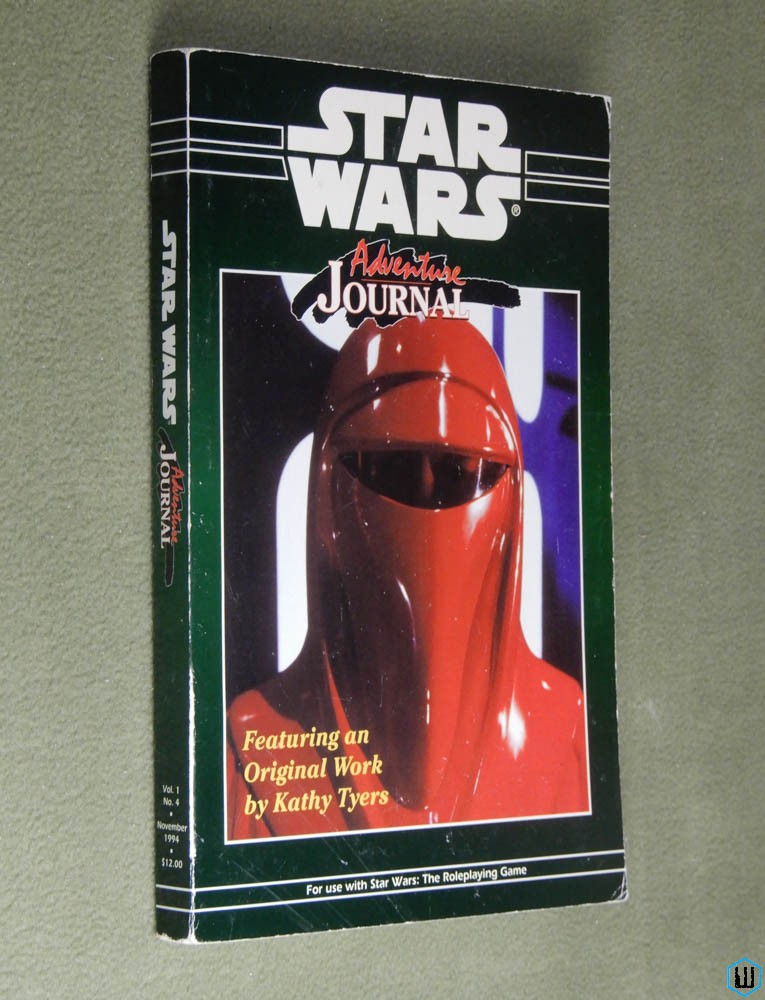
Around 1,000,000 BBY, an intelligent aquatic species inhabited the planet Jerrilek. Its civilization eventually vanished, leaving ruined cities beneath the planet's oceans. The species was introduced by James L. Cambias in the West End Games role-playing article “Loyalties,” published in Star Wars Adventure Journal 4 in 1994. Unlike the earlier Deep Prehistory files, this is no longer only a story of astronomy, geology, or evolution. Jerrilek gives the timeline one of its first clearly described civilizations.
The original source: “Loyalties”
James L. Cambias created Jerrilek's lost species as background for “Loyalties,” a seventeen-page role-playing scenario in Star Wars Adventure Journal 4. The adventure itself takes place around the Galactic Civil War, but its planetary profile reaches far deeper into the past. Archaeologists had found evidence that an intelligent aquatic species once inhabited Jerrilek, and the planet's seas covered ruined cities associated with that vanished population.
The species did not appear directly in the adventure. It existed through traces: ruins, archaeological interpretation, and rumors about what might still be hidden beneath the water. That makes Jerrilek unusually well suited to an archaeological reading because the culture is known almost entirely from material remains rather than named rulers, surviving texts, or living descendants.
Jerrilek: a world dominated by water
Legends describes Jerrilek as a warm, tropical planet in the Deep Core. Most later land is concentrated in equatorial archipelagos with only two small mountainous continents. Its oceans dominate the surface, and much later populations rely heavily on fishing, watercraft, beaches, and island settlements.
For an aquatic civilization, that geography changes the meaning of archaeological space. A terrestrial society leaves roads, walls, foundations, and settlements on dry land. An aquatic species can build into reefs, continental shelves, trenches, submerged mountains, or shallow coastal waters. When later inhabitants are primarily land-oriented, entire ancient landscapes can remain physically present yet socially remote.
Cities under the sea
By the Galactic Civil War, the strongest surviving evidence of Jerrilek's ancient inhabitants was architectural. Ruined cities lay beneath the oceans. The sources do not provide a complete catalogue of those sites, their plans, construction materials, population sizes, or political relationships. They establish that urban-scale remains existed and that later archaeologists recognized them as the work of an intelligent aquatic species.
That distinction is important. A ruin is evidence that something was built, but it does not automatically explain what a structure meant. A large complex might be residential, ritual, administrative, industrial, defensive, funerary, or something outside categories familiar to later scholars. Without texts or living informants, interpretation depends on context, spatial pattern, material remains, and comparison.
What archaeologists did not know
The unidentified Jerrilek species is a rare Star Wars civilization defined by uncertainty. Its name is unknown. Its languages are unknown. No confirmed political system, religion, kinship structure, writing system, technology level, or cause of extinction is provided by the original evidence. Later rumors suggested possibilities, but possibilities are not the same as established history.
Cambias deliberately left openings for role-playing stories. The species might not have been completely extinct. Its ruins might conceal advanced technology. The inhabitants might have possessed knowledge of the Force. Those suggestions are adventure hooks, not confirmed facts. IDS keeps them separate from the minimum evidence: an intelligent aquatic population existed, built cities, disappeared, and left submerged ruins.
Archaeology after a million years
A million-year archaeological gap is enormous. Even durable materials are subject to erosion, sedimentation, tectonics, biological growth, corrosion, currents, and chemical change. Underwater sites face additional problems because access, mapping, excavation, and conservation differ radically from archaeology on dry land.
Star Wars technology would make some forms of underwater investigation easier than they are in the real world. Submersibles, droids, advanced scanners, pressure-resistant equipment, and orbital mapping could reveal large structures quickly. Yet better instruments do not eliminate interpretation. A scanner can identify a wall or void. It cannot automatically reconstruct the social rules, memories, identities, and intentions of the people who built it.
This is the point where Deep Prehistory becomes unmistakably anthropological. The problem is no longer only when something happened. It is how later societies create knowledge from fragmentary evidence left by a population that can no longer explain itself.
Who owns a civilization with no living descendants?
Jerrilek also raises a heritage question. If the ancient species is extinct and has no identified descendant community, who has the authority to excavate its cities, remove artifacts, display objects, or profit from discoveries? Later planetary governments might claim jurisdiction because the sites lie within Jerrilek's territory. Universities might claim scientific value. Private collectors might seek rare objects. Tourism businesses might treat the ruins as attractions.
None of those later claims are neutral. Archaeological heritage becomes a field of power precisely because the people whose material culture is being interpreted may not be present to object. Jerrilek's vanished civilization is an extreme version of a familiar problem: later institutions can control the remains of earlier peoples and decide which stories become official.
A million years later: a completely different planet socially
By the Galactic Civil War, Jerrilek was inhabited by millions of Humans and Ithorians and was known as a tropical vacation world. Graleca, one of its major cities, occupied an island in the equatorial archipelago. Fishing, agriculture, tourism, seafood products, watercraft, and modern infrastructure characterized the later society.
The planet therefore contained two radically different cultural landscapes at the same time. On the surface and islands stood modern settlements tied into Imperial politics and interstellar trade. Beneath the waves lay cities built by an unrelated civilization approximately a million years earlier. Physical proximity did not mean cultural continuity.
This layered landscape is one of the most useful ideas in archaeology. A place can be occupied repeatedly by populations with no direct cultural relationship to one another. Later inhabitants may live beside, above, or inside older material worlds whose original meanings have been lost.
The parallel 1-million-BBY milestone on Goroth Prime
Legends chronology places another evolutionary development at approximately the same date: semi-intelligent ancestors of the Gorothites emerged on Goroth Prime. That event belongs to a different kind of evidence. Jerrilek provides an already intelligent aquatic civilization with cities, while Goroth Prime provides a biological stage on the long path toward later Gorothite sentience and civilization.
The two entries show why a single date can contain radically different historical scales. On one world, social organization and urban construction already existed. On another, the ancestors of a later sentient species were only beginning to cross an evolutionary threshold. Galactic history did not develop everywhere at the same pace.
The anthropology of disappearance
Most Star Wars histories are organized around survivors: dynasties, Jedi lineages, governments, military units, families, and traditions that transmit information forward. Jerrilek reverses that pattern. The civilization matters precisely because it did not survive in a recognizable form.
Extinction or disappearance creates an asymmetry between material evidence and cultural voice. The cities remain, but their builders cannot explain them. Later archaeologists become intermediaries between the dead and the living. Their classifications, excavation methods, research questions, and institutional interests shape what the vanished society becomes in historical memory.
That makes Jerrilek a useful warning against treating archaeological interpretation as simple recovery of facts. Evidence constrains interpretation, but interpretation is still produced by people in the present. A ruin does not arrive with its own final explanation.
Where Jerrilek fits in Deep Prehistory
Sources and further reading
- James L. Cambias, “Loyalties,” Star Wars Adventure Journal 4, West End Games, 1994.
- Stephen J. Sansweet et al., The Complete Star Wars Encyclopedia, Del Rey, 2008, entry “Jerrilek.”
- Daniel Wallace and Jason Fry, Star Wars: The Essential Atlas, Del Rey, 2009.
- Unidentified Jerrilek species, Wookieepedia
- Jerrilek/Legends, Wookieepedia
- 1,000,000 BBY, Wookieepedia
- Goroth Prime/Legends, Wookieepedia