
- Region
- Taris theater
- Key worlds
- Jebble, Vanquo, Tarnith
- Commanders
- Jimas Veltraa, Noma Sommos
- Purpose
- Protect Taris and resource network
In 3966 BBY, as Mandalorian forces threatened Jebble, Vanquo, Tarnith, and Suurja, the Republic organized a defensive cordon around Taris. The line connected key systems whose resources and routes supported the city-world. It was not a literal wall in space. It was a strategic network of fleets, patrol zones, defended approaches, and mutually supporting positions.
3966 BBY · Legends · Historical source lab
THE TARIS CORDON
Documented sequence and limitations
As Mandalorian expansion threatened the worlds supporting Taris, the Republic organized a defensive cordon near Jebble, Vanquo and Tarnith. The establishment is usually placed around 3966 BBY, although not every reference specifies an exact founding day. Republic naval figures including Saul Karath and Jimas Veltraa served on the threatened frontier. The line linked systems and patrol positions, rather than forming a solid physical wall in space.
People, institutions and context
The military priorities were also economic geography: Taris depended on resource-producing neighboring systems and their industrial networks. Political lobbying and commercial interests could affect where a defense was considered urgent. A line can protect some trade routes while leaving peripheral settlements exposed. The archive distinguishes this interpretation from unsupported claims about the motivations of every officer.
Source trail: Knights of the Old Republic Holofeed; The Essential Atlas; defensive line history. Chronology/source record →. Exact primary edition page citations remain under review. Banner art is original IDS symbolism, not the source comic.
A defensive line built from economic geography
Taris could not be defended by protecting its skyline alone. The ecumenopolis depended on surrounding systems for food, raw materials, trade, and strategic depth.
The Republic therefore militarized the network that made urban life possible. Supply geography became battle geography.
Admirals try to hold a stretched frontier
Jimas Veltraa and Noma Sommos were among the officers responsible for the line. Saul Karath also commanded Republic forces in the theater.
The scale of the cordon strained the Navy. A political promise to defend Taris created a military commitment larger than one world.
The line becomes the stage for the False War
Suurja and Vanquo would become repeated battle sites. For a time the Republic checked Mandalorian momentum, contributing to the period later called the False War.
The apparent success was temporary. The line delayed expansion but did not solve the strategic problem.
Event sequence
Taris enters the Republic.
Threats to Jebble, Vanquo, Tarnith, and Suurja prompt a Republic cordon.
Direct clashes with Mandalorians intensify in the False War.
Suurja and Vanquo become major combat zones as the theater collapses toward Taris.
Explore this entry
Was this a physical wall?
No. It was a military boundary and defensive network built from defended systems and fleet positions.
Why are resource worlds so important?
An ecumenopolis consumes enormous amounts of food, material, and energy. Cutting supporting worlds can threaten a city even without attacking the city directly.
Anthropological assessment
The Jebble–Vanquo–Tarnith line makes infrastructure visible as political dependency. Urban centers that appear self-contained are sustained by networks of labor, extraction, transport, and food production located elsewhere.
War exposes those relationships because military planners target or defend the systems ordinary life usually treats as background.
Historical judgment · 3966 BBY
Test your historical interpretation
Answer both questions for a scored assessment with educational explanations and corrections.
The Taris defensive line was a network, not a wall
Republic frontier · c. 3966–3964 BBY. Original published story records, later chronology and anthropological interpretation are distinct evidence types.
The politics behind the cordon
Taris needed stable supply connections to its neighboring resource systems. Jebble, Vanquo and Tarnith were vulnerable not only because of their location near expanding Mandalorian forces, but because disrupted shipments could weaken the economic foundations of the city-world. The military boundary described by the Jebble–Vanquo–Tarnith line was an operational zone of defended routes and naval commands, not a physical barrier extending between planets. Moving a fleet from one part of the network could protect one convoy while leaving another approach exposed.
What an in-universe news page can establish
The earliest published Taris Holofeed item, printed with the Knights of the Old Republic/Rebellion flip-book, presented contemporary claims about conflict at Suurja and the defense of the Taris frontier. Its journalistic voice is part of the fictional world. Later comic issues show how citizens and military personnel experience the line. The author’s commentary on issue #7 confirms that the Mandalorian frontier and the line’s associated worlds were intended as an active backdrop to Zayne Carrick’s flight, not a separate, fully surveyed campaign map.
Dating and the danger of precision
The 3966 BBY formation date is an inference from campaign chronology and Taris’s effort to secure its resource worlds. Stories set around 3964 BBY show the already contested boundary. These observations do not fix the day when an admiral first designated its limits or prove that each planet was simultaneously occupied. Admiral Jimas Veltraa and Republic Captain Saul Karath appear in the broader frontier record, but individual assignments should be traced to the particular Holofeed or comic issue before being described as a single joint command.
Research judgment: Does a map line mean fleets held an unbroken physical frontier?
Explanation: No. It represents a connected strategic defense across worlds and routes, not a continuous wall in space.
Follow the evidence: Creator commentary: KOTOR #7 and the Mandalorian frontier → · Creator commentary: KOTOR #13 and The Admiral’s List →. The linked source descriptions and commentaries are publication evidence; detailed scene claims require the original game or comic.
3966 BBY · Legends · evidence file
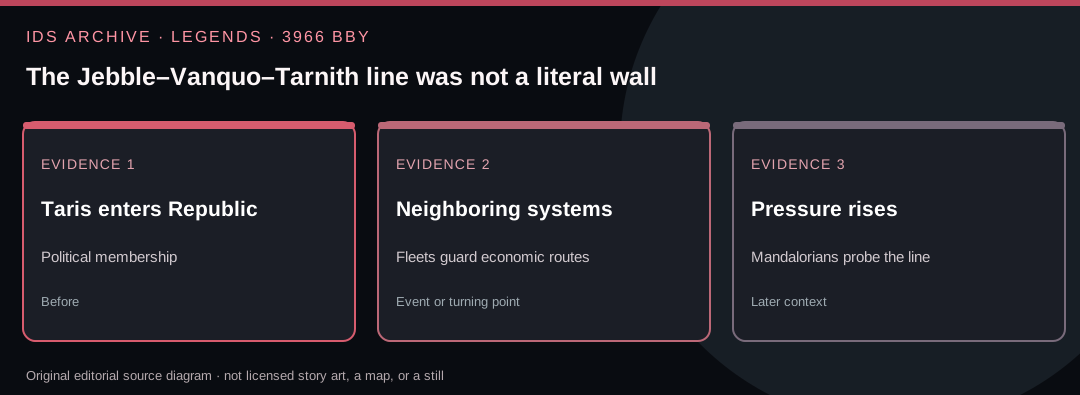
The Jebble–Vanquo–Tarnith line was not a literal wall
Published evidence
The Republic attempted to defend Taris and surrounding systems including Jebble, Vanquo and Tarnith as Mandalorian forces threatened their trade and material supply routes. The defensive line refers to a military disposition across worlds, not a continuous physical barrier in space.
Institutions and culture
A city-world depends on a distributed landscape of production. Protecting Taris required protecting resource extraction and transport across multiple systems. A military map can make those supporting populations disappear behind the label of a supply corridor.
What remains unverified
The phrase line does not authorize the invention of precise fleet positions, permanent walls, or the claim that all named planets were equally well defended in 3966 BBY.
Check the historical record: Should the Jebble–Vanquo–Tarnith line be illustrated as a physical wall?
Explanation: No. It describes an interplanetary defensive arrangement, not a literal structure.
Sources and further reading
- Knights of the Old Republic comics.
- “The Taris Holofeed: Prime Edition.”
- The Essential Atlas.